
Libertarians hold that absolute freedom of association allows individuals to form unions, guilds, or cooperatives to bargain collectively, provided membership remains entirely voluntary and the organization never uses government force to coerce others. But that theory does not reflect how Big Labor developed in the United States, where the collusion between government and labor unions is more damaging with the unions representing public school teachers than anywhere else.
Unlike private enterprise, public school systems operate as tax-funded monopolies where citizens cannot easily choose to take their business elsewhere, and school boards hold no personal financial stake in the revenue being negotiated. State-enforceable collective bargaining in this context effectively creates a cartel system: it forces taxpayers to finance union-negotiated benefits, compels teachers to submit to standardized union contracts regardless of individual merit, and limits parental choice. Furthermore, because public sector unions can use state-collected dues to lobby the very politicians sitting across the negotiating table, state protection of public teachers unions represents an unconscionable conflict of interest by using government coercion to insulate a public service from accountability, merit-based compensation, and free-market competition at the direct expense of taxpayers and students.
Recently, America’s teacher unions have exhibited a structural difference in how labor power is conceptualized and deployed in the country. Traditional American labor history exhibited an adherence to a philosophy of “pure and simple unionism.” This philosophy fundamentally shaped how American labor operated within the capitalist framework. For over a century, America’s organized labor rejected using union power as an instrument for broad political reform, fearing it would dilute trade-specific goals and invite dangerous state overreach. Historically, the foundational philosophy of American unionism—championed by early labor leaders and built through the American Federation of Labor—was rooted in “voluntarism” and “business unionism.” Under this traditional model, labor organizations strictly limited their domain to workplace “rates and rules,” negotiating directly with employers over wages, health benefits, job security, and safety within a discrete firm or trade. The state was viewed primarily as a neutral regulatory arena rather than an economic co-planner, and union leverage was derived entirely from shop-floor bargaining power rather than sweeping societal mandates.
Modern teachers’ unions, however, reject those voluntary limits and have embraced a practice known as “Bargaining for the Common Good” (BCG). By leveraging public-sector monopolies to extract structural socio-economic commitments from local and state governments, they have abandoned the standard American model of workplace-focused bargaining in favor of the European model of institutionalized social planning. In contrast, the BCG approach aligns directly with the European “neo-corporatist” tradition. By using contract negotiations to demand broader societal policies—such as municipal housing subsidies, environmental decarbonization goals, and tax restructurings—teachers’ unions seek to operate as political co-governors pushing macro-level policy agendas through collective bargaining.
By stretching traditional collective bargaining far beyond wages, benefits, and working conditions to embrace BGC, public sector teachers’ unions have effectively engineered a back-door mechanism to bypass the democratic process. Under the guise of community advocacy they demand sweeping mandates on social and political issues. We see these unions wield an illegitimate veto over broader public policy, exploiting their state-granted monopoly to hold local governments and taxpayers hostage. Unlike private sector entities that face market discipline, public school unions use forced dues and political leverage to negotiate against the very public that funds them, effectively weaponizing contract negotiations to dictate political outcomes. This unholy alliance of administrative overreach and political activism transforms public education into a vessel for ideological coercion, ensuring that an unelected labor bureaucracy exerts an outsized, distorting influence over American civic and political life at the expense of students, parents, and constitutional governance.
Public sector unions negotiating over broad socio-economic policies like municipal tax structures, environmental mandates, immigration policies, or affordable housing present several critical constitutional challenges.
Under Article IV, Section 4 (the Guarantee Clause) of the United States Constitution and general principles of federal and state constitutional law, political power is vested in the electorate and their elected representatives. When public unions, in order to dictate broad public policy, use the leverage of statutory collective bargaining or the threat of shutting down public services, they effectively bypass the open legislative process. This creates situations where private interest groups negotiate sovereign policy decisions behind closed doors, usurping the lawmaking authority of elected officials.
In Janus v. AFSCME (2018), the Supreme Court ruled that public-sector collective bargaining inherently constitutes political speech because it directly impacts public budgets, taxation, and government priorities. When unions expand their demands to explicitly political platforms, forcing dissenting public employees to accept or subsidize representation on contentious social issues, it infringes on First Amendment rights against compelled speech and political association. This decision has been widely ignored by the teachers’ unions.
State constitutions typically grant executive branch officials the non-delegable duty to manage public agencies in the interest of the general public. Binding the government to social policy outcomes via union contracts surrenders discretionary executive authority to non-elected labor leaders, violating state-level non-delegation doctrines.
The political power of public-sector teachers’ unions stems from a direct monetary-to-legislative loop, where massive financial war chests—derived from taxpayer-funded payroll deductions—are deployed to secure favorable policies and block competitive reforms. According to campaign finance tracking from OpenSecrets and federal expenditure reports compiled by groups like Defending Education, the National Education Association (NEA) and American Federation of Teachers (AFT) direct the overwhelming majority (often upwards of 98%) of their political action committee funds and advocacy spending toward Democratic candidates and allied political entities. In exchange for this electoral mobilization, unions secure “gatekeeper” influence over education policy, enabling them to effectively veto school choice initiatives, shield traditional tenure structures from performance evaluations, and ensure that state and federal education spending remains strictly routed through district public schools.
The practice of BCG weaponizes collective bargaining to impose radical, non-workplace social agendas through public-sector coercion. BCG completely abandons any capitalist restraint, transforming unions into unelected political cartels that hijack contract negotiations to demand off-mandate socio-economic engineering. These include subjects that they could never pass through the democratic legislative process such as rent control, green energy mandates, and tax restructurings,
This shift directly aligns unions with socialist economic theory by replacing free-market price signals and voluntary exchange with centralized, coercive social planning. By utilizing public-sector monopoly power these organizations bypass market realities to extract broader socio-economic concessions from government officials. Teachers’ unions effectively strike against taxpayers and hold children’s education hostage to achieve those concessions. Public-choice analysis reveals the ultimate danger: BCG creates a self-reinforcing public sector that continually expands government spending, erodes private property, and redistributes wealth under the guise of “community solidarity.” As documented in analysis of bargaining for the common good frameworks and critical debates surrounding social movement unionism vs. traditional bargaining, expanding contract demands beyond the employer-employee relationship serves as a stepping stone toward democratic socialism, transforming labor unions from market participants into instruments of state-directed ideological planning.
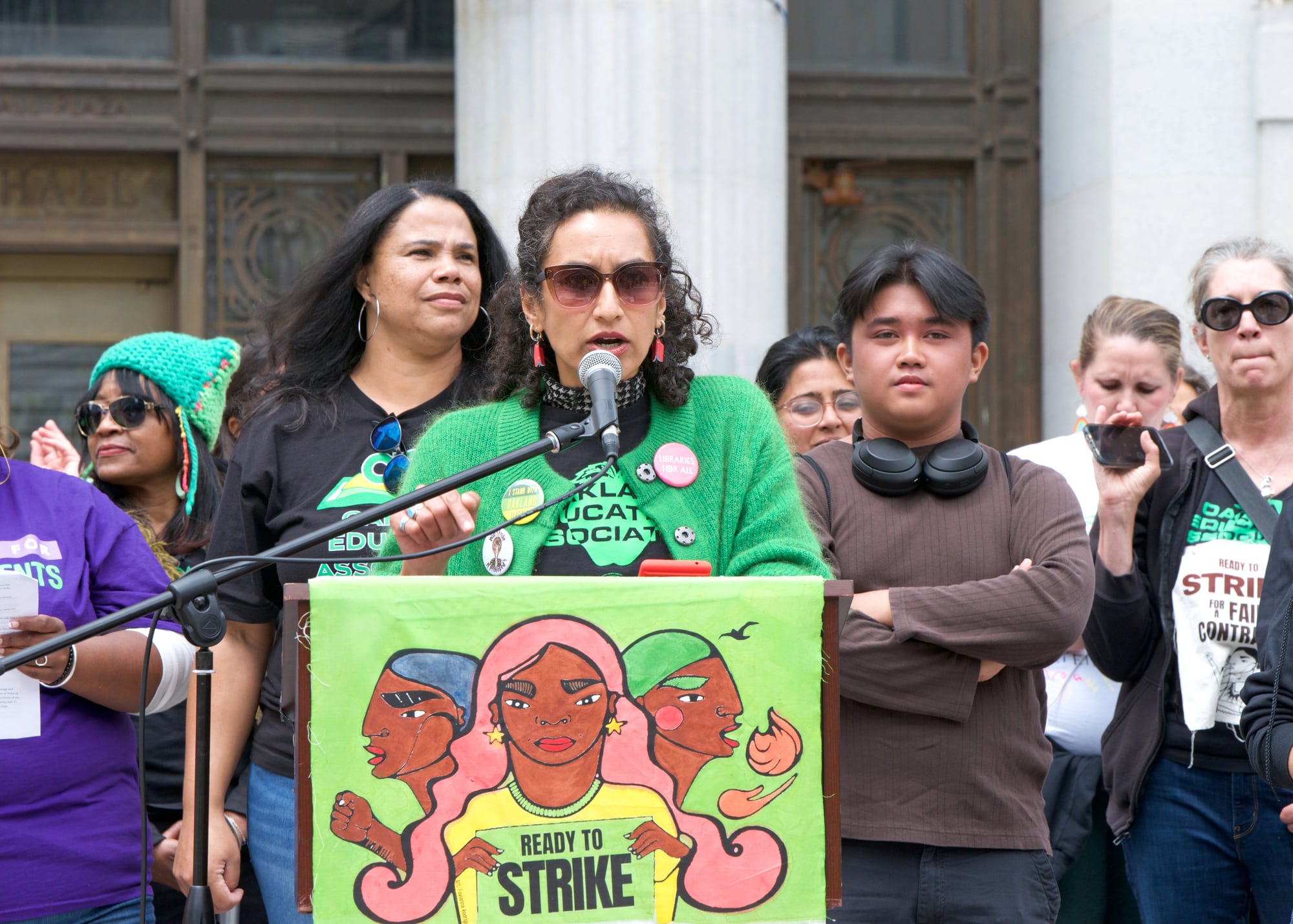
The American Federation of Teachers (AFT) and the National Education Association (NEA) demonstrated this dynamic directly when they funded campaigns against voucher measures, such as opposing Educational Savings Account expansions in several states. Additionally they have exerted immense political influence. A prime example was the Chicago Teachers Union which organized, funded, and elected its former organizer, Brandon Johnson, as mayor of Chicago. Teachers unions also spearheaded a series of high-profile statewide walkouts and strikes in states like West Virginia, Oklahoma, Arizona, Kentucky, and California. These strikes carried explicit political goals such as pressuring state legislatures to raise taxes on corporations or oil and gas extractions to fund public infrastructure. AFT President Randi Weingarten this year spearheaded a nationwide back-to-school boycott of Target stores under the “Shop Smart, Not Target” Campaign. AFT union leadership instructed its 1.8 million members, and further urged the broader fifteen million member AFL-CIO network, to abandon the retailer for back-to-school purchases, citing corporate silence on immigration policies and non-workplace social issues.
Critics and legal scholars pointing to the Liberty Justice Center’s Analysis on AFT Pension Funds highlighted this boycott as the height of public-sector distortion: state pension plans, which are continually underwritten by taxpayers to cover liabilities, hold millions of dollars in corporate shares like Target. By utilizing union machinery funded through government payroll deductions to launch boycotts against companies held within their own public pension portfolios, union bosses actively endanger the financial returns of their own members’ retirement funds to execute pure political warfare against private enterprise.
The structural dynamic of public-sector unionism ultimately creates a profound disconnect: millions of rank-and-file teachers are effectively held political hostage, forced to watch their money and institutional representation weaponized in favor of a far-left agenda they do not necessarily support. While national union executive boards operate as aggressive arms of the progressive movement, a Pew Research Center study on teacher political demographics reveals that 35% of public school teachers identify as Republicans and nearly a third describe their political views as conservative or moderate. Despite this ideological diversity within the workforce, the union leadership directs virtually none of its considerable PAC contributions directly to candidates on the right, while simultaneously funneling compulsory member dues toward controversial socio-political positions—ranging from aggressive pro-choice resolutions to “Common Good” socialist economic policies. Prior to landmark judicial rulings like Janus v. AFSCME, millions of teachers were legally compelled to pay dues or agency fees as a condition of employment, leaving them with zero choice but to subsidize political platforms that violated their core moral, religious, or economic beliefs. Even today, through automatic payroll deduction mechanisms and opaque legislative spending, public-school educators remain trapped inside an institutional monopoly that uses their professional existence to bankroll a radical political machine.
When public-school unions shift their primary focus from fundamental classroom instruction to acting as a macro-level political lobby, administrative resources and instructional focus are inevitably diluted—leaving students with stagnating test scores inside a system that prioritizes institutional ideology over basic educational outcomes. Thus, we see taxpaying parents stripped of their right to democratically decide how they are to be governed while at the same time watching their children being held hostage to a failing educational system.