

Across the animal kingdom, natural selection has sculpted a remarkable array of reproductive strategies, but humans are unique in that we consciously design institutions that shape incentives and constrain behavior. The modern welfare state highlights this dynamic. As resources are redistributed for paternalistic purposes, the state increasingly supplants functions once anchored in family and kinship. By altering costs and benefits, these interventions create conditions for alternative reproductive strategies to emerge.
The patterns of reproductive behavior are illuminated by Robert Trivers’s Parental Investment Theory, which demonstrates how sexes differ in their approaches to the trade-off between parental care and mating efforts. Applicable across species, the theory predicts that the sex that invests more in parenting (e.g., gestation, lactation, food provisions, or training) will be more selective when choosing a mate, while the opposite sex competes for intrasexual mating opportunities. Selection pressures arising from this competition favor conditional responses, which over time, and across variations, can stabilize as Alternative Reproductive Tactics (ARTs) within a population.
Against this evolutionary backdrop, Homo sapiens harness their cognitive capacities to an unmatched degree in reproductive strategies and beyond, employing high-level abstractions and acting purposefully through reason to achieve multi-layered ends. To impose order, mankind has devised systems in which authority spans from centralized to decentralized, with forms of governance ranging from ruthless tyrants to libertarian societies rooted in natural rights. Along this continuum, modern welfare states justify redistributive policies under the guise of benevolence—and by doing so, subvert incentives that hold families together.
As economist and libertarian theorist Hans-Hermann Hoppe observed in Democracy: The God That Failed:
“Every form of government welfare—the compulsory wealth or income transfer from ‘haves’ to ‘havenots’ lowers the value of a person’s membership in an extended family-household system as a social system of mutual cooperation and help and assistance. Marriage loses value.”
In other words, by systematically altering the payoff matrix of reproduction, welfare states not only redistribute resources; they predictably distort incentives, weaken pair-bonding, and favor reproductive tactics that externalize parental costs, mirroring parasitism in the biological sense. These effects are not pathologies of character, but consequences of institutional design. To analyze how relative incentives are reshaped, we turn to game theory.
A classical game involves two or more rational actors, typically represented in a payoff matrix, where payoffs depend on strategies employed. Evolutionary game theory extends this approach to the frequency-dependent evolution of phenotypes in biological systems by analyzing competition among genetically inherited, conditional, or learned strategies. Payoff matrices capture survival and reproductive strategies, molded by natural selection and measured as fitness. In 1973, John Maynard Smith and George Price introduced the Hawk-Dove game to illustrate the logic of conflict over resources in animals.
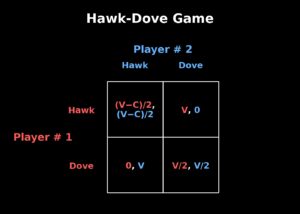
Figure 1. Payoffs are listed as Player #1, Player #2. Colors correspond to each player.
Organisms of the same species play the game, escalating aggression (Hawk) or retreating (Dove), depending on the opponent’s strategy. If one plays Dove and the other Hawk, the Dove yields while the Hawk claims the resource (V,0) or (0,V). If both play Hawk, conflict reduces payoffs to (V-C)/2 each due to the risk of injury. If both play Dove, the resource is shared, (V/2, V/2).
The Hawk-Dove payoff matrix is determined by the resource’s value and fighting cost. When V < C, no pure dominant strategy exists, and the population stabilizes as a mixture of Hawks and Doves. As the resource’s value rises, so does the frequency of Hawks; when the cost of fighting rises, Doves become more common.
Successful strategies replicate and spread according to their relative fitness, emerging without conscious design. Like competing firms in a free market, advantageous strategies proliferate, while disadvantageous ones fade away. Over generations, these pressures harden into enduring behavioral patterns, paving the way for Alternative Reproductive Tactics.
In nature, a dizzying variety of strategies has evolved to secure mates. When selection pressures produce a discontinuous distribution of behavioral, physiological, or morphological traits, an ART may emerge. Given natural limitations of energy, time, and resources, each tactic carries its own biological costs and benefits. Echoing Thomas Sowell’s insight, evolutionary systems offer no costless solutions—only trade-offs.
Male side-blotched lizards come in three flavors: orange are territorial and polygamous, yellow are non-territorial and employ a “sneaky” strategy, copulating whenever dominant males are occupied, and blue are mostly monogamous, dedicating resources to mate-guarding on smaller territories. Like rock, paper, scissors, color dominance shifts over time as success is based on the frequencies of competing colors within the population. When orange lizards are common, blue ones struggle to secure mates, and sneaky yellows thrive. As blue lizards become numerous, sneaky yellows falter, and the cycle repeats.
Such equilibria include tactics that differ not only in behavior, but in how parental investment is borne. In bluegill sunfish, smaller “sneaky” males dart over guarded nests during spawning to release sperm. These parasitic tactics externalize investment, trading lower fertilization success per attempt for reduced energetic and risk-related costs.
Within a species, high-investment and parasitic strategies fluctuate dynamically over time, often stabilizing due to frequency-dependent selection. Parasitic tactics cannot dominate indefinitely; their success depends on the continued presence of high-investment competitors. When parasitic strategies spread too widely, selection can lock populations into individually adaptive yet collectively maladaptive states, leaving the system destabilized, heightening the risk of population collapse. In non-human species, these dynamics unfold through biological selection alone; in humans, they are further shaped by cognition, culture, and the institutions they construct.
Unlike their animal brethren, humans act purposefully through high-level reasoning. The value of potential mates is inherently subjective, shaped by personal and social context, and can be inferred from observable human action. Yet humanity’s biological underpinnings remain, as sexual desires can cloud reason. Consequently, human payoff matrices reflect a hybrid of evolutionary biological pressures and reasoned decision-making, where strategies respond dynamically to environmental and social conditions.
Parental investment theory highlights a profound asymmetry between the sexes. Women invest nine months in pregnancy, and often bear most post-birth care, while a man’s minimal contribution is measured in minutes and milliliters of semen. As a result, women tend to be more selective when choosing mates, whereas men compete for reproductive opportunities. These differences in investment influence when ARTs emerge, though cultural and social factors can modulate their expression.
In contemporary societies, men employ a variety of reproductive strategies. Through a game-theoretic lens, mates are a proximate resource, instrumental to the goal of offspring production. Monogamous pairings and marriages act as forms of mate-guarding. Aggression, following Hawk-Dove logic, can serve as a reproductive tactic. However, forced copulation—which is descriptive, not justificatory—yields low long-term success due to the significant costs it entails, including injuries, retaliation, ostracism, or incarceration. Alternatively, enabled by technology, a man seeking to maximize offspring could adopt the sperm bank approach. Other ARTs may emerge as a result of institutional interference.
The rise of institutional strategies is an adaptive response to incentive structures imposed by their environment. Welfare programs vary in eligibility and benefits, with their effects moderated by cultural stigmas. Here, the safety net refers to assistance—cash or in-kind—provided to impoverished parents. These institutions systematically replace or supplement support traditionally provided by kinship and pair-bonding, functioning as social insurance. By externalizing parental costs and lowering the penalties for non-investment, the safety net creates conditions for parasitism to take hold as a viable reproductive strategy.
Evolutionarily, men typically boost reproductive success by philandering. In a welfare state, however, men who once needed to invest heavily in resource acquisition to attract mates can now redirect efforts toward spreading genes, as the redistribution of resources reduces the relative cost of abandonment within the payoff matrix. This, in turn, further favors a more polygamous reproductive strategy. Males adopting this parasitic strategy not only gain access to sexual variety but also have the option to adopt a mixed strategy, in which time and resources are selectively provided to improve the well-being of progeny.
From the female perspective, the quality of a mate is prioritized over quantity. In the absence of a safety net, extreme caution must be exercised when selecting a mate, with the man’s ability to assist with child-rearing emphasized. Welfare can warp the female payoff matrix, altering mate-choice incentives. As predicted by Gary Becker’s economic analysis of the family, this phenomenon was termed the “independence effect.” If a woman has her own resources, she may adjust her mate preferences or opt to raise children alone.
The Seattle-Denver Income Maintenance Experiments (SIME-DIME) provide a vivid illustration of the independence effect. Families with at least one dependent below a specified income threshold received guaranteed cash transfers for up to five years. Analyses of the program found higher divorce rates in the experimental group than the control group—approximately 36% higher for black couples and 40% for white couples. Relieved of financial dependency on their spouses, participants adjusted their reproductive strategies.
Since the implementation of the Great Society programs, welfare has dramatically altered family structures. The proportion of births to unmarried women has risen sharply, from 5.3% in 1960 to 40.0% in 2023. Simultaneously, the share of children living in two-parent households in the United States has declined—from 87.7% in 1960 to 71.1% in 2023. These patterns are disproportionately concentrated among poorer and working-class families, who are also the primary recipients of welfare. While the expansion of the welfare state is only one of many influences and not a monocausal explanation for these trends, the correlation between state interventions and a reduced reliance on stable pair-bonds is striking.
When resources are subsidized by the state, provisioning becomes less salient in mate selection, and relative rankings of potential partners may shift. As a result, welfare programs distort how subjective values are expressed through demonstrated preference in reproduction. The introduction of institutional ARTs disrupts equilibrium patterns that have historically favored high-investment pair-bonding, facilitating the proliferation of parasitic strategies that undermine traditional families.
From an evolutionary perspective, the welfare state reshapes human incentives. By reducing the personal costs of child-rearing and parental investment, it enables alternative reproductive strategies that would otherwise remain marginal. Over time, interventions that redistribute resources warp the payoff matrix, fostering dependency on the state while weakening traditional pair-bonding.
These are not the consequences of moral failings, but follow the logic of incentives. When the costs of reproduction are systematically externalized, parasitic strategies gain a relative advantage on the fitness landscape. As long as this payoff advantage persists, low-investment strategies will increase in frequency relative to high-investment strategies, creating conditions that can destabilize the population over generations.
Historically, families and local communities bore primary responsibility for dependents. In such environments, the costs and benefits of child-rearing were largely internalized within households and kin networks, keeping reproductive incentives aligned with parental investment.
The welfare state cannot eliminate reproductive trade-offs; it can only select which strategies prevail.