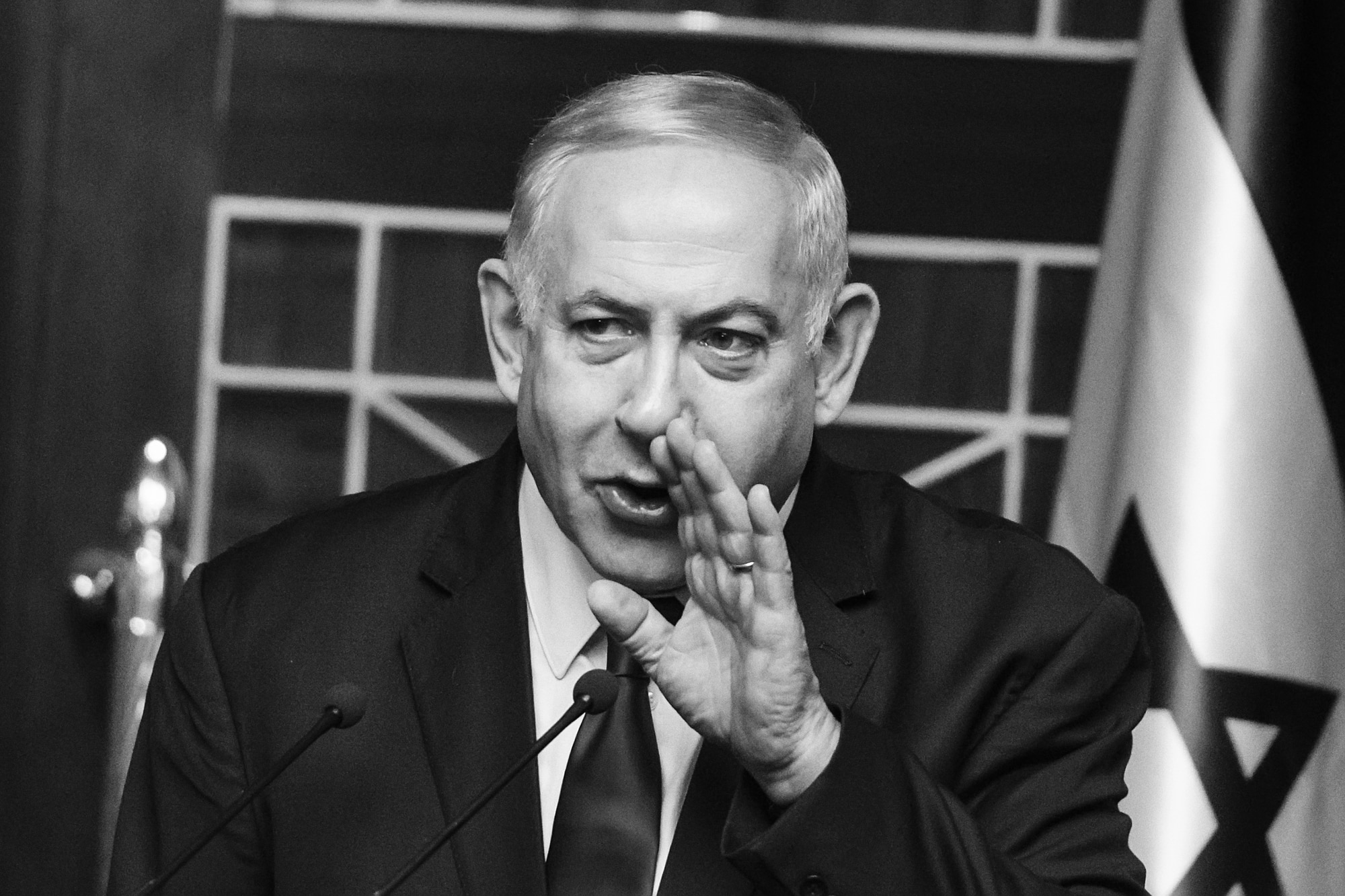
It has been accepted for months that Israeli Prime Minister Benjamin Netanyahu was instrumental in convincing U.S. President Donald Trump that war with Iran was a good idea. In February, The New York Times reported on the shocking extent to which Netanyahu had access to Trump before the war, in a propaganda blitz which included a detailed presentation selling the idea that the Iranian regime was primed for collapse. Confident in this assessment, Trump would go on to launch the military campaign with the expectation that a people-powered uprising would commence.
“To the great, proud people of Iran, I say tonight that the hour of your freedom is at hand,” Trump urged. “When we are finished, take over your government. It will be yours to take.”
This plan wouldn’t end up coming to fruition. Despite the Israeli claims that a bombing campaign alone would “foster the conditions for the Iranian opposition to overthrow the regime,” the Islamic Revolutionary Guard Corps (IRGC) survived the onslaught, and no organized dissident group took advantage of the chaotic situation to make their move.
So, the Israelis were wrong. In a normal organization—which the U.S. federal government most certainly is not—a decision this catastrophic would raise serious questions. Where were the voices warning against this?
Well, they were certainly in Trump’s ear, urging restraint, but they were relatively few in numbers and were ultimately ignored.
On August 24, The Wall Street Journal reported that in the days leading up to the war, then-Director of National Intelligence Tulsi Gabbard presented Trump with the non-interventionist pitch. She said, according to the Journal:
“…killing Iran’s supreme leader would likely usher in a more hard-line regime open to acquiring nuclear weapons. Tehran would rush to close the Strait of Hormuz, destabilizing the global energy market. And it would strike U.S. forces and partners in the Middle East, prompting questions about American resolve and reliability with allies.”
Similarly urging restraint, Vice President J.D. Vance is said to have pushed the president to pursue a “more cautious approach,” one where diplomacy is the tool of choice rather than military action.
Trump saw the situation differently from these officials. In his view, Iran was weak enough that they could be dealt with in short order. According to The Wall Street Journal, Trump didn’t believe the Iranians would be able to maintain a closure of the Strait of Hormuz. He predicted that the regime would capitulate to American demands rather quickly, making them incapable of closing the waterway.
This theory from Trump received pushback from top officials, such as General Dan Caine. The chairman of the Joint Chiefs of Staff reportedly explained to Trump that Iran would likely close the Strait of Hormuz, and that this could be done through the use of their arsenal of missiles and drones, as well as mines. This would turn out to be a correct assessment, proven by the fact that Iran has maintained their effective closure of the Strait of Hormuz for roughly six months by using the exact methods that General Caine warned of. Trump’s inability to degrade these Iranian capabilities, coupled with the fact that the Strait’s closure is having severe effects on the global economy, means that reopening the Strait has now become one of the main focuses of U.S. officials. This was not an issue before the war was launched, mind you.
Simply put, this war has been a disaster, and it was all totally predictable. Trump had access to voices of a fairly non-interventionist persuasion, warning him that military action would be a mistake. However, when it was time to choose a path, Trump sided with a foreign country over his own staff. We cannot simply brush this off as just another example of Israeli influence over U.S. foreign policy. This is such an open and explicit betrayal of this nation that it should offend all of us.
We can speculate as to why he may have done this. I happen to believe that the Venezuela operation in January, which was short and went relatively smoothly, played a part in boosting Trump’s ego. The military’s ability to swiftly nab their president, Nicolás Maduro, and to do so without an American casualty, may have convinced Trump that this was a more effective form of global statecraft than long, drawn-out diplomatic processes. It’s possible he believed that this type of military campaign—short and forceful—could be used to degrade Iran in a quick manner.
This vision fails to grapple with the immense complexity of the Iranian situation, however. While Maduro was instantly succeeded by his Vice President Delcy Rodríguez, who quickly accepted American demands, Iran didn’t have a clear alternative set of leaders that would comply with Washington. Similarly, Iran is a vastly larger country than Venezuela, both geographically and in population size. Militarily, Iran has showcased an ability to deal serious damage to America’s regional infrastructure and partners, a level of retaliation which Venezuela simply wasn’t equipped to carry out. The fact that this was an explicit regime change war changed the dynamic as well. When war becomes a matter of regime survival, leaders become more willing to take risks. This is why we saw Iran directly hit multiple U.S. bases in this conflict, when they didn’t respond with such force in the Twelve-Day War in June 2025.
Due to these disparities alone, an attempt to carry Venezuela logic over to Iran was doomed to fail.
The legacy media also had a role in pushing Trump to launch this war. Despite his unceasing verbal attacks on network television, Donald Trump does care about how they cover him. As was evident in his attacks on Tucker Carlson—who he told to “go get a television network and say it so that people listen”—he still sees television, particularly Fox News, as the center of the political discourse.
In the buildup to the conflict, Fox News was beating the war-drums. A host that has unique sway over Trump is Mark Levin, a foreign policy hawk and fierce supporter of Israel and Bibi Netanyahu. Donald Trump has posted clips from Levin’s monologues on Truth Social, signaling his support for Levin’s pro-war advocacy. On a similar note, Trump posted a bizarre mini-essay heaping praise on Levin, whom he calls “a man of Great Wisdom and Common Sense.”
Trump told his followers that “Mark is Tough, Strong, and Brilliant, hence the nickname, ‘THE GREAT ONE.’”
Though it may be hard to imagine that Mark Levin has genuine fans, he does, and his style appeals to older, pro-war Republican types. It is possible that his relentless push for war with Iran eventually convinced Trump that “MAGA” supported this policy. After all, Trump hilariously still views cable television hosts like Levin as more influential on the discourse than Tucker Carlson.
The Iranian expat community has also pushed the narrative that the vast majority of the Iranian people wanted the U.S. to bomb their country. Many have made frequent media appearances, selling the idea that an organized opposition was ready to overthrow the government the moment the U.S. intervened. Masih Alinejad, a frequent guest on Fox News and other outlets, has been one of the most vocal figures urging Trump to strike. Immediately following the killing of Ayatollah Ali Khamenei, she called on Trump and the Europeans to build on this “first step,” and “help the people of Iran to end this regime.” Masked behind the praise for Trump, whom she called a “true leader,” is an air of entitlement. She believes that the U.S. government is a tool which should be wielded to serve her special interests overseas, and if anybody disagrees with her goals, they are essentially endorsing brutal theocrats.
What is important to point out here is the creation of an echo chamber. As Alinejad is speaking on Fox, videos are being played next to her showing crowds of Iranian expats cheering for Trump’s war. This is the intentional crafting of a narrative, one that works to make Trump and his supporters believe that this is an incredibly popular operation to Iranians. They seek to make the viewer believe that the opinions of these Iranian-American expatriates are the views of the entire nation of Iran, which is made up of over ninety million people. According to these activists, we should expect all ninety million Iranians to jump for joy in response to the bombing of their cities and the murder of their fellow citizens, and collectively embrace this massive American project of establishing a liberal democracy in their society. This is lunacy.
Whatever the reason for Trump’s persuasion to Israel’s sales-pitch, he was so on board that he was willing to disregard the concerns of his own administration officials. The conflict seems to be going exactly how the “naysayers,” as Marc Thiessen mindlessly dubbed them, had predicted in the beginning. The best answer is the same as it has been this whole time: just come home. This war is as pointless as it was in the beginning, and these war-skeptical voices—particularly J.D. Vance—should use whatever political leverage they have within the administration to push for an end to the conflict. Otherwise, things risk spiraling even further out of control.