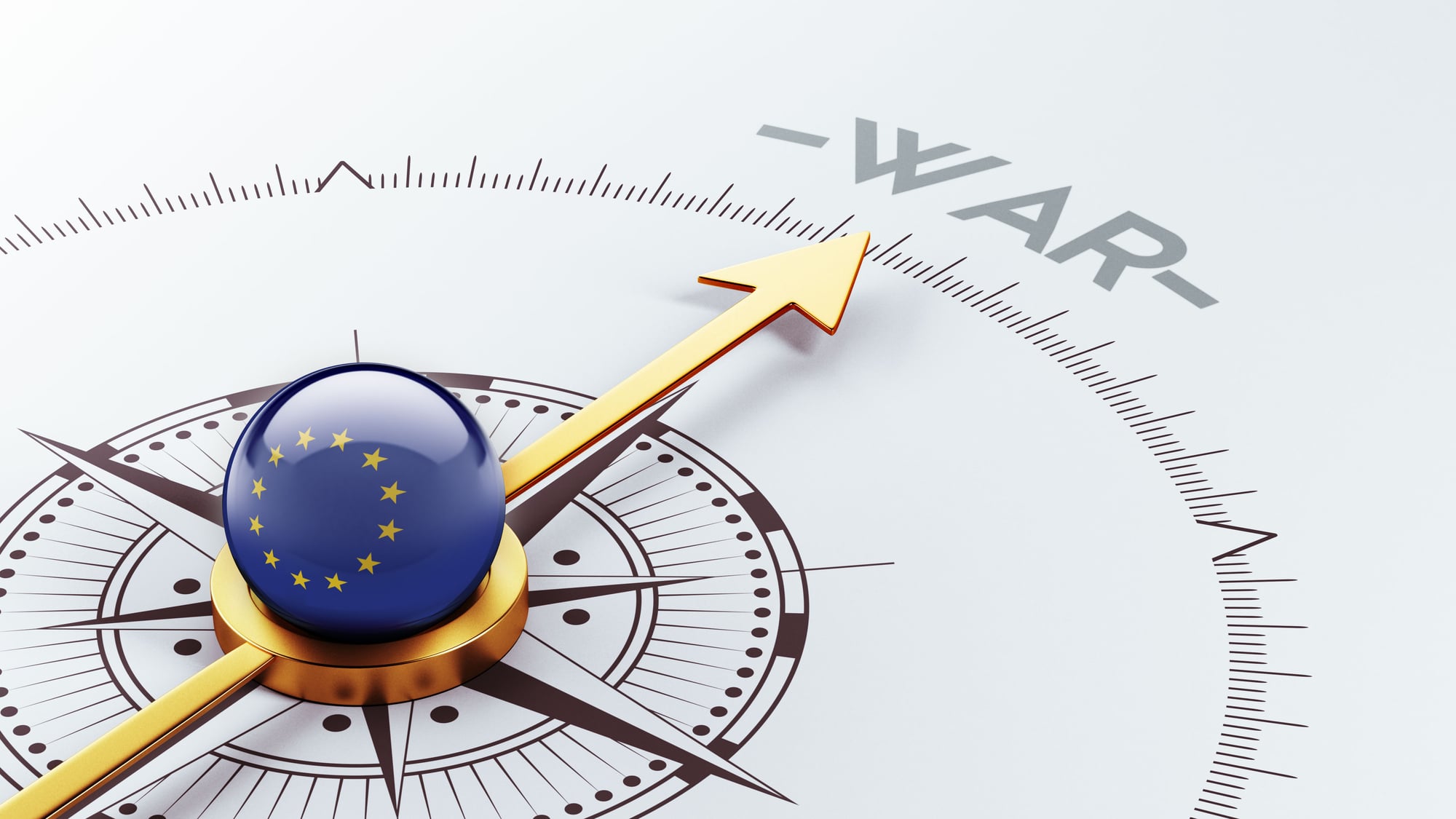
Unfortunately, the probability rises with every passing day that NATO will wage war with Russia. The proxy war, openly fought since February 24, 2022 between Russia and Ukraine and which has lasted longer than World War I, may soon become an open war between Russia and the West.
The ideology of globalism dominates the corridors of European governments, and war is among the means that adherents in Berlin, London, Paris and Brussels are quite willing to use in order to reach their goals.
Globalism is an ideology according to which people on the globe may no longer shape their own destinies in a system of free markets, but are instead to be directed, pushed around from above, from a central command point—by an internationally tightly connected council of heads of government, a “council of the enlightened,” or by supranational institutions.
To gain the necessary control over the economic system and societal developments, the globalist zealots mainly used the dissemination of the themes of “green policy” (“saving the climate”), “wokeism,” and the coronavirus. Now war follows as a means, both as a threat potential and/or as an actual armed conflict. War is an especially effective means of expanding state power to the maximum: directing the economy, restricting or even abolishing people’s freedoms—and that is precisely what the globalists are aiming for.
Their goal is a command economy in which the state (or the special-interest groups that harness it for their purposes) de facto determines who produces what, when, and how, and who may consume what, when, and in what quantity. Establishing a “war economy” is not the only expedient option for the globalists to bring a command economy serving their purposes into being. Actual warfare, with its humanitarian and societal emergencies, is also a suitable means to that end.
One must understand that, economically speaking, the state (as we know it today) is a territorial coercive monopolist with the power of final decision over all conflicts in its territory. Such a coercive monopolist is aggressive inward and, when the opportunity arises, also aggressive outward. Inward in the form of taxes, prohibitions, and regulations; outward in the form of conflicts, including war. In particular, war offers the state (or those groups that profit most from it) an opportunity to expand their power position and enrichment at the expense of third parties.
Those circumstances currently exist. It is undisputed that the large European states are over-indebted. The tax and contribution burden is crushingly high, yet the states do often no longer satisfactorily perform its basic functions, the economies barely grow anymore, demographics are marked by aging and, in the near future, population decline.
The possibility and the will to bring about a reversal of the trend by political means are very slight. Especially so as the political class (and the special-interest groups it favors) pursue quite different goals: war now offers them an extremely suitable “opportunity” to set in motion things they could not carry out in peacetime—such as tightening the tax screw still further, financing the state by issuing ever more new money and thereby devaluing the purchasing power of money, imposing capital controls, carrying out expropriations, ending freedom of speech and of the press (social media), and driving further the general control and surveillance of the population (keywords: digital ID and digital central-bank money). The “scapegoat” that state propaganda can then blame for all economic and financial miseries and political hardships is “the enemy” from outside. War plays into the hands of the globalism agenda and paves the way to the omnipotence of the state, to the totalitarian state.
As is well known, those who first profit from war are those who produce and supply weapons, ammunition, military services or strategically important raw materials. But war can also become an attractive source of income for soldiers and their families; contract soldiers receive high recruitment bonuses, ongoing pay and high compensation in case of injury or death. And the banks profit, because firms that produce war material and states usually finance at least part of their spending by credit. Against this background it should already have become clear that it is anything but far-fetched to suspect that rulers, bureaucrats and influential, powerful special-interest groups use the state for acts of war when it literally pays off for them.
A “war boom” can, at least initially, improve the income situation of the broader population in the short term as more jobs are created directly and indirectly by the expansion of war production. It lets company profits grow and wages rise. And so resistance to continuing the war, to ending it quickly, fades; resistance to an expansion of the fighting is also weakened. Sooner or later, however, in addition to the human horrors and suffering, the thousands of deaths that war causes, the economic and financial damage also becomes apparent: impoverishment of the population, debasement of the currency, devaluation of savings, unsustainable government debt, political unrest, and so on. In other words, a war boom only prolongs and intensifies the damage of war; at its core it is economically and socially ruinous.
War—planned, large-scale, organized violence that drags everything and everyone into it—is a business that yields large profits for a few, and the conclusion is obvious that it would not exist if there were nothing to be earned from it.
Equally clear is that war arises from the existence of states. It is not an accident, but an accompaniment of the state, not least because here war can be profitably exploited by a few at the expense of the many in the most literal sense of the word.
The consistent demand that follows from this was aptly formulated by the economist Ludwig von Mises in 1919:
“Whoever wants peace among nations must seek to restrict the state and its influence as strongly as possible.”
The further, particularly urgent question now is: what form would a war between the European countries and Russia take? Different people might offer very different answers. Here we will confine ourselves to two brief scenarios.
If the conduct of the war is determined by the West, a limited war is most probable. The war will deliberately not be waged with all available means until the complete destruction of the opponent. Objectives, weapons used, geographic scope and intensity remain limited, and escalation to nuclear war is avoided. A drawn-out war of attrition would not only be a strategy to exhaust the Russian military and the country’s population in the literal sense. It would above all also be a “permanent threat backdrop” that would enable the globalists to roll out an increasingly authoritarian regime in the European Union; and the powerful special-interest groups would profit splendidly from a protracted conflict.
If one assumes that Russia does not intend a war of conquest or annihilation in Europe, but aims to secure the conquered territories in Ukraine and to drive NATO influence out of the country, then an expansion of fighting along the eastern border of NATO territory is not improbable. The use of nuclear weapons would presumably not be expected here either—such an escalation would be expected if the Russian government saw no other way left to avert defeat.
In sum, those who currently fear a war between NATO and Russia are probably right. For the danger of war, given the prevailing circumstances, must be rated as relatively high. And there is much to suggest that it will be a limited but long-term war, one that will sharply reduce the prosperity and freedom of people especially in Europe, and that will open enormous opportunities for enrichment and plunder to the powerful special-interest groups.
In conclusion we should remember an important insight: the modern, specialized, and productive society that has brought people prosperity and culture is the work of peace. Peace and not war is the father of all things. Ludwig von Mises emphasized this again and again, and so let us close this podcast with a quotation from him:
“Only one thing can overcome war—that attitude of mind which can see in war nothing but destruction and annihilation.”