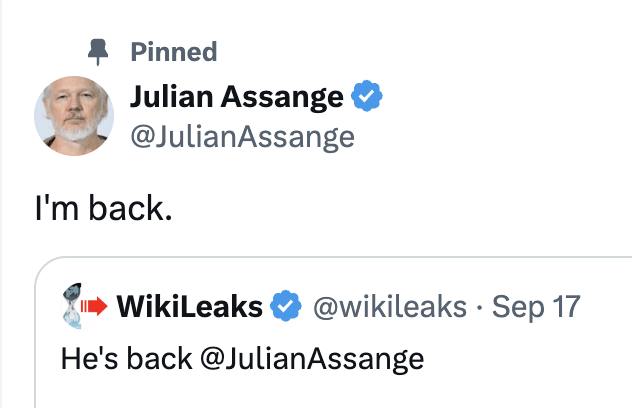
On September 17, Julian Assange’s return to Twitter/X did not go unnoticed. With more than fifty-one million impressions, it becomes clear his and WikiLeaks’ impact is undeniable.
Still, his journalism and WikiLeaks have not come without scrutiny. Former Republican vice presidential nominee Sarah Palin stated Assange should be “hunted down.” Current U.S. Ambassador to Israel Mike Huckabee said regarding his work, “whoever in our government leaked that information is guilty of treason, and I think anything less than execution is too kind a penalty.”
Meanwhile, former secretary of state and CIA Chief Mike Pompeo considered kidnapping and killing Julian Assange, according to reports from Yahoo News.
While Assange’s disclosures revealed many new and significant details, perhaps the most notorious was the Collateral Murder video, which showed U.S. Apache helicopter attacks in Baghdad that killed civilians, including two Reuters journalists.
The organization’s revelations about revolutionary movements in the 2000s for various countries have also proved equally essential.
For Belarus, WikiLeaks cables revealed that opposition candidate Alaksandar Milinkievič met with U.S. Ambassador George Krol for a discussion focused on the “need for quicker disbursement of foreign assistance to the coalition.” Discussions were even held about a three-part strategy for the opposition in Belarus: increase Milinkievič’s support, organize mass demonstrations, and launch a negative PR campaign against President Aleksandr Lukashenko.
The PR campaign against Lukashenko was also planned to have no direct ties to Milinkievič’s campaign. Organizers hoped to bring 30,000 to 50,000 people into the streets if disputes arose over the election.
This was also not Milinkievič’s first contact with Washington. Another cable described him as the embassy’s longtime “main contact in Grodno and western Belarus.” The cable further revealed that the embassy had helped fund a kidney operation for Milinkievič earlier that year through the International Republican Institute.
The cable also noted that Milinkievič had built a network of NGO supporters and represented the Belarusian Soros Foundation in Grodno from 1996 to 1997.
In Azerbaijan, the cable “AZERBAIJAN’S YOUTH MOVEMENTS: A BREAKDOWN OF KEY PLAYERS” discussed youth activists in the region while noting that “youth can play a quite critical role in democratic development.”
The cable also revealed numerous conversations between youth groups and political officers at the U.S. embassy in Baku. This included members of the Yeni Fikir movement, Dalga, Yox, Magam, and even Ireli—the pro-government youth group. The embassy also contrasted Azerbaijan’s U.S.-educated youth with those in Georgia and Ukraine.
In addition, the American Alumni Association—an embassy-supported organization of more than 2,000 Azerbaijanis who had studied in the United States through government programs—was led by Fariz Ismailzade, who had previously spent nearly five years working for the International Republican Institute (IRI).
In Egypt, the April 6 movement’s Ahmed Saleh attended the Alliance of Youth Movements Summit in New York, which PBS described as a State Department-organized summit. Saleh also thanked the embassy for concealing his identity at the event.
While in Washington, Saleh met with then-Congressman Edward Royce (R-CA), staff from the offices of then-Congressman Frank Wolf (R-VA) and then-Congresswoman Ileana Ros-Lehtinen (R-FL), Senate staffers, and members of several think tanks. Notably, he also asked Washington to pressure the Mubarak government in Egypt.
With the Arab Spring beginning in Tunisia, in a 2008 secret cable, U.S. Ambassador Robert Godec warned that “corruption is the elephant in the room; it is the problem everyone knows about, but no one can publicly acknowledge.”
Under Ben Ali, the “nexus of Tunisian corruption” also became a factor on the ground during the Jasmine Revolution.
A later 2009 cable showed just how extravagant the Ben Ali family lifestyle was. Ben Ali’s daughter and her husband, El Materi, lived in a guarded beachfront home with an infinity pool, Roman artifacts, and even a pet tiger. The couple even brought in ice cream and frozen yogurt from Saint-Tropez after an extravagant dinner of fish, steak, turkey, and octopus.
All of this led Godec to conclude that their lifestyle helped explain why they were “disliked and even hated by some Tunisians.”
When activists in Tunisia started to post the cables online through TuniLeaks, they noted it had a “psychological effect” on the political class of Tunisia. The story of the extravagant lifestyle choices in particular spread through social media, serving as an “accelerant” to the later revolution.
With Foreign Policy considering Tunisia as the “First WikiLeaks Revolution,” from revelations about U.S. involvement in foreign countries in the moments before and after revolutionary movements to detailing corruption in these countries, the impact WikiLeaks has had on journalism and exposing corruption has been undeniable.
As members of the political elite view Assange as a hostile threat, his organization’s cables have proved essential in understanding how countries truly operate. Without his work, the world would be a much different place.