
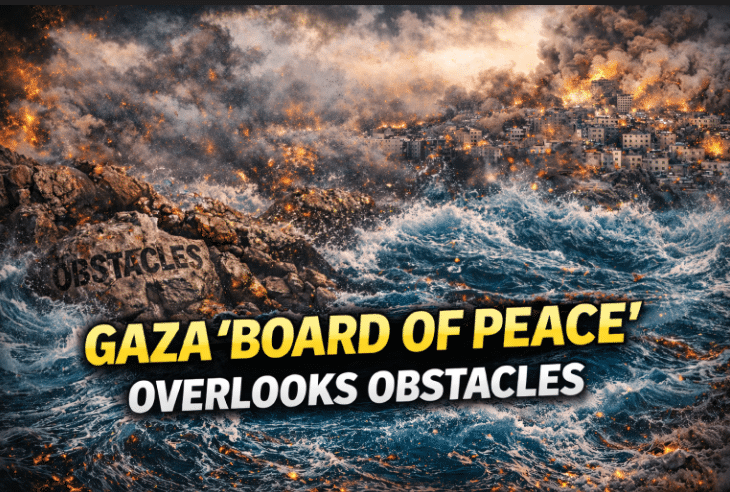
Jared Kushner arrived at the World Economic Forum in Davos with a redevelopment pitch for Gaza: sleek high-rises, new roads, a rebuilt airport, and a modern port on the Mediterranean, under the umbrella of President Donald Trump’s newly chartered “Board of Peace.” In a 10-minute address on January 22, Kushner said that, with “security,” cities in the region can be rebuilt “in three years,” and that Gaza could follow that model.
The plan’s premise is simple: stabilize Gaza, then let capital and construction do the rest. The obstacle list is longer, and it is written into the ground itself.
Rubble first, then demining, then everything else
U.N. officials say Gaza holds more than 60 million tonnes of rubble – roughly the capacity of 3,000 container ships. UNOPS chief Jorge Moreira da Silva said this month that clearing it is likely to take “over seven years,” a timeline that does not count the follow-on work needed to remove or neutralize unexploded ordnance embedded in debris.
UNMAS has warned that explosive remnants remain widespread, with unexploded shells and missiles reported in residential areas “visible among the rubble and along roadsides.” Rights groups say large-scale rubble clearance and demining have not begun in earnest where most civilians are concentrated because Israel has restricted the entry of heavy machinery.
Security as the gatekeeper, and the gate is still contested
Kushner’s slides make reconstruction conditional: rebuilding would not begin in areas that are not “fully disarmed.” Demilitarization, in his outline, would be handled by a U.S.-backed Palestinian technocratic committee meant to administer day-to-day life in Gaza during a transition, with an eventual handoff to a reformed Palestinian Authority.
That requirement lands in the middle of an unfinished war. Hamas officials have said they would consider “freezing” weapons as part of a process toward Palestinian statehood, but they have also described armed “resistance” as legitimate. Meanwhile, Israeli fire continues inside Gaza even after the Oct. 10 ceasefire: AP reported at least 470 Palestinians killed since the truce began, based on Gaza’s Health Ministry figures, as Israel says it is responding to violations.
Displaced lives, property, and the politics of who benefits
Kushner’s Davos presentation largely skipped the interim question: where Gaza’s residents live while neighborhoods are cleared, demined, and rebuilt, and what happens to people whose homes sit in zones designated for “tourism” or other flagship projects. Many Palestinians are sheltering along parts of Gaza City and much of the coastline – precisely the space that Kushner’s slides flag for beachfront development.
For displaced Gazans, that omission reads like policy, not a footnote. “I was planning to pitch a tent where my old house was, and gradually rebuild my life again,” said Ahmed Awadallah, living in a Khan Younis displacement camp. Another displaced resident, Bassil Najjar, said, “I have lost hope to return to my house,” after his home fell in an area under Israeli control.
A joint estimate by the United Nations, the European Union, and the World Bank has put Gaza recovery and reconstruction at about $70 billion, with roughly $20 billion needed in the first three years. And skeptics question whether Israel would accept Kushner’s skyline: conflict-resolution expert Nomi Bar-Yaacov called the early concept “totally unrealistic,” warning that high-rises near the border would overlook Israeli military sites. This skepticism has been echoed recently by Israeli Settlement Affairs Minister Orit Strock, who has been critical of Trump’s Board of Peace from the outset, and has called for Israel to reoccupy the Gaza strip.