
The White House has authorized employing strategic assets in South Korea more frequently. The announcement comes as Pyongyang, Seoul and Washington conduct unprecedented aerial war games.
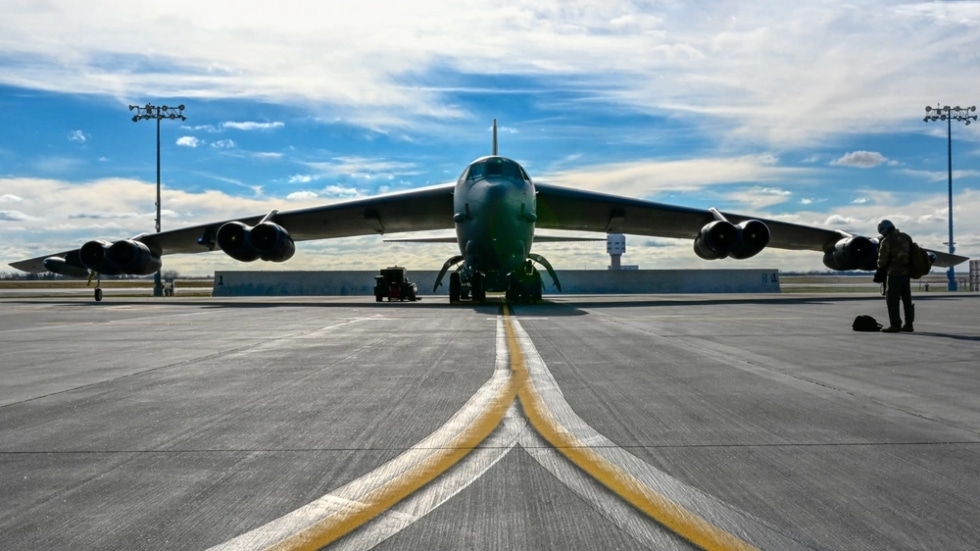
At a news conference with Secretary of Defense Lloyd Austin and South Korean Defense Minister Lee Jong-sup, Lee stated Austin pledged to set up deployments of nuclear-capable weapons. He said the US promised, “to effectively respond to any DPRK provocation by employing US strategic assets to the level equivalent to constant deployment through increasing the frequency and intensity of strategic asset deployment in and around the Korean Peninsula.”
Austin expressed the deployments would not be permanent but rotate in and out. “No new deployment of strategic assets on a permanent basis, but you’ll see assets move in and out on a routine basis,” the defense chief said.
Austin stated the strategic deployments will extend beyond the Korean Peninsula. “What we’re doing together not only to – on a bilateral basis, but also with our allies in Japan,” Austin said. Washington, Seoul and Tokyo signed a trilateral defense agreement on the sidelines of the NATO summit in June. Pyongyang denounced the agreement as a NATO-like alliance in the Pacific.
The news conference came after the US and South Korea announced it was extending their largest-ever aerial war games. The military drills, dubbed Vigilant Storm 23, include 240 US and South Korean aircraft. Initially, the exercises were scheduled to run for five days but have now been extended by a day.
Before Vigilant Storm 23 kicked off, North Korean Supreme Leader Kim Jong-un slammed the drills as a rehearsal for invasion and promised a “powerful” response if Seoul and Washington went through with the exercises.
On Wednesday, Pyongyang fired 23 short-range ballistic missiles, a single-day record. One missile was fired near the maritime border for the first time since the partition. South Korea responded by firing three air-to-surface missiles into waters north of the inter-Korean maritime border.
North Korea followed the flurry of missiles by launching an intercontinental ballistic missile on Thursday. Seoul believes the ICBM failed in-flight.
On Friday, North Korea carried out large-scale aerial maneuvers. South Korea’s Joint Chiefs of Staff said that 180 North Korean warplanes were detected in various areas inland and along the country’s eastern and western coasts. Seoul noted the warplanes did not approach the inter-Korean border.
In response, South Korea scrambled 80 warplanes, including F-35s. The South Korean Joint Chiefs of Staff said it was “maintaining a firm readiness posture for further provocations.”
Military activity on the Korean Peninsula is at a multi-year high. Pyongyang has carried out a record number of missile tests this year. Washington and Seoul have returned to live-fire war games.
A diplomatic solution currently seems impossible. Austin and Lee reiterated Washington and Seoul’s position that Pyongyang must agree to give up its nuclear arsenal. Kim signed a new law in September that says North Korea will not denuclearize until the US does.
Kim views his nuclear weapons as the only effective deterrent against Washington-based regime change. The White House says it seeks a nuclear-free Korean Peninsula. However, Austin threatened to use nuclear weapons against North Korea at the press conference. Last week, Deputy Secretary of State Wendy Sherman said Washington was prepared to deploy its nukes to defend Seoul.
This article was originally featured at Antiwar.com and is republished with permission.