
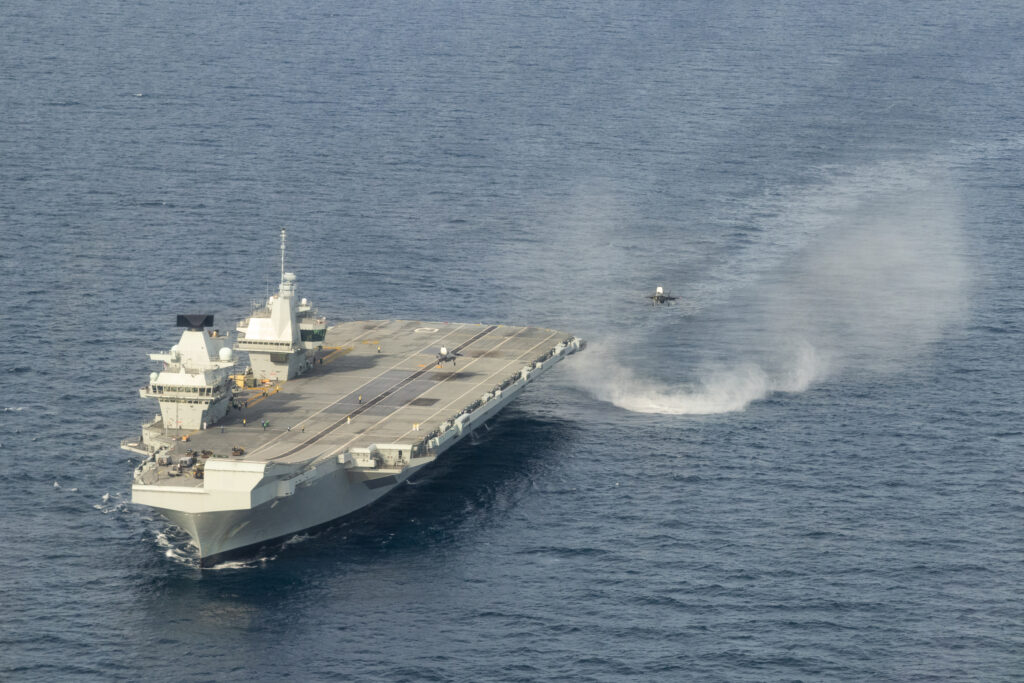
Two F-35B Lightning II aircraft from the F-35 Integrated Test Force (ITF) successfully landed onboard HMS Queen Elizabeth on 1 November 2018 marking the beginning of the second phase of Development Testing (DT-2) of first-of-class flying trials (FOCFT). Maj Michael ‘Latch’ Lippert, USMC landed first in BF-04 and was followed by Mr. Peter ‘Wizzer’ Wilson in BF-05. Both ITF test pilots are based at Naval Air Station Patuxent River, Maryland. (RELEASED / U.S. Navy Photograph by Liz Wolter)
So pardon me for a rather technical discussion that points out yet another flaw in the haunted and ridiculously poorly performing F35 program.
Why was Shipborne Rolling Vertical Landing (SRVL) EXTREMELY important for the UK carriers?
The SRVL capability needs as little as 10% of the F-35B entire fuel capacity during the landing process. During SRVL, the F-35B nose is pitched up and the fighter glides to a landing by friction on wheels only, with no outside assistance. As good as this capability is at conserving fuel, it is very difficult and dangerous, there is no guarantee SRVL will work with high crosswinds, micro-bursts or in bad weather, the F-35B landing on a wet flight deck may just slip off the other end. The Royal Navy (RN) has been testing SRVL for over seven years and couldn’t get it to combat ready status, so they decided to cut it.
Vertical landing (hover mode landing straight down) on the other hand is extremely fuel inefficient, it takes 60 to 90 seconds for F-35B to stay in hover mode and land slowly. This burns as much as 2700kg of fuel, that’s 32% of the entire fuel capacity of the F-35B.
Which means that without SRVL capabilities the already short combat radius of the F-35B will be cut from approx 900km to 600km (depending on payload and takeoff load it could be less). This means the RN will be forced to use the F-35B not as carrier air-wings fighting for air dominance, rather like how the USMC use them, as expensive short range ground support aircraft. Keep in mind that all carrier flotilla must devote some of their fighter strength to a Combat Air Patrol (CAP) and a Barrier Combat Air Patrol (BCAP) which are the two air loiter perimeters to defend the carrier flotilla.Not to mention the British naval aviators will have to drop all unused bombs and missiles into the sea before landing, which can cost millions every time they land. This will disincentivize UK carrier aviators from flying with real bombs and missiles during training.And during situations where combat is not guaranteed, that’s the quickest way to deplete your munitions.
Why don’t they just do a normal arrest hook landing? But there’s no room for it with the 90 degree rotating nozzle on the F35B. The F-35B really is the runt of the family huh. Eight years is about how much production time is left on the B line. With the recent USMC force change from 5:1 to 2:1 F35B’s to F35C’s, that cut the number of years USMC will keep ordering B’s at the current rate to about 6-8 years remaining. The F-35B has the worst commonality with the A and C regarding weapons bays/internal carriage. It also has the most restrictive weight limitations. Aircraft historically get heavier over their lifespans as new systems/boxes are thrown into the jets. The F35B simply cannot add more.
The F-35B is the only variant that can be used on US Navy LHA/LHDs (9), Japanese Carriers (2), the Future South Korean carriers (2 planned), British Carriers (2 current), Italian Carriers (2).
This means that the two British carriers are even more useless than anyone thought.
For the Navy, perhaps the next most significant line in the accounts is the Rolling Vertical Landing upgrade cancellation. This implies that HMS Queen Elizabeth will not receive the Bedford Array in her current refit as previously announced. This is a lighting system that F-35 pilots would use to guide them safely onto the deck while performing the demanding Shipborne Rolling Vertical Landing (SRVL) manoeuvre.
Instead of landing vertically as normal, during SRVL, the aircraft approaches the ship directly from behind at relatively low speed. A combination of thrust from its nozzle and lift-fan and lift created by air over the wings allows it to land with up to 7000lbs greater all-up weight (UAW). Without SRVL capability, the F-35B would be forced to ditch some or all of the unused fuel and weapons when returning to the ship. Fuel is a precious resource and munitions are expensive. For example, a single AIM-120D AMRAAM missile costs around £2.4M. With limited stocks and such a price tag, not something you want to casually jettison into the sea if unused.
Only around £309,000 has apparently been written off by this cancellation. The RN has already made efforts in early development trials of SRVL, but there appears to have been little progress since a second modest round of developmental test flights in 2023. It is possible that funding for further SRVL development has been redirected, for now at least, into the hybrid carrier wing, which may now assume greater priority than operational SRVL capability. Reconfiguring the flight deck to varying degrees may be required for UAVs and it may be prudent to postpone the installation of SRVL-related landing aids until the way forward is more settled.
In the end, this is yet another example of not extrapolating the possible effects of technology development getting well ahead of the possible and making promises that when not fulfilled threaten the efficacy of the entire enterprise.
Here is a very good report on the failure of Joint Programs.
Sunk costs – MoD accounts reveal cancelled Royal Navy projects