Governments that want to send young people to die in distant countries have always faced the same problem: the arithmetic of the transaction is unfavorable. You are asking a twenty-three-year-old to trade his life for a geopolitical objective he cannot see, in a country he cannot find on a map, on behalf of politicians who will not be going themselves. Across history, the most reliable solution to this problem has been God. Tell the soldier he is not serving the state—that cold, bureaucratic, manifestly self-interested entity—but rather serving the Almighty. Make the war a crusade. Make dying for Washington indistinguishable from dying for heaven.
The Trump administration has revived this arrangement with unusual openness. The evidence is now public record: over two hundred complaints filed with the Military Religious Freedom Foundation from more than fifty installations, documenting U.S. military commanders telling their troops that the Iran campaign is part of God’s divine plan, that President Donald Trump has been “anointed by Jesus to light the signal fire in Iran to cause Armageddon,” that they are instruments of biblical prophecy. This is not a secret ideology operating in the shadows. The Secretary of Defense has a medieval Crusader battle cry—Deus Vult, “God wills it”—tattooed on his bicep. The White House holds regular prayer ceremonies with self-described apostles and prophets. The machinery is visible to anyone who cares to look.
Libertarians should look carefully, because what is being assembled here is not primarily a religious story. It is a story about state power—specifically, about how states expand and sustain military power by outsourcing its justification to institutions that can reach places government cannot. The church provides the volunteer army its moral vocabulary. The state provides the church political access and social prestige. The transaction has worked for a thousand years. It is working now.
The First Amendment prohibits Congress from establishing a religion. The Uniform Code of Military Justice prohibits commanders from using their authority to impose religious views on subordinates. These are not ambiguous provisions.
The complaints documented by the MRFF describe something that straightforwardly violates both. A non-commissioned officer filed a report that his commanding officer told the unit—a unit on alert for deployment—that Trump was “anointed by Jesus to light the signal fire in Iran to cause Armageddon and mark His return to Earth.” This is not a chaplain offering a voluntary prayer service. It is a commander, exercising coercive authority over soldiers who cannot leave the room, subordinating their constitutional oath to a prophetic narrative they did not choose and may not share. More than two dozen members of Congress have asked the Pentagon’s inspector general to investigate whether Secretary Pete Hegseth’s rhetoric has “metastasized into segments of the military chain of command in ways that contravene constitutional protections.”
The Pentagon’s response to the original Rolling Stone inquiry—which asked directly about the MRFF complaints—was to redirect journalists to videos of Hegseth speaking about the war. This is an answer, of a kind. It tells you that the department does not consider the complaints a problem requiring a substantive response. The silence lands with the weight it deserves.
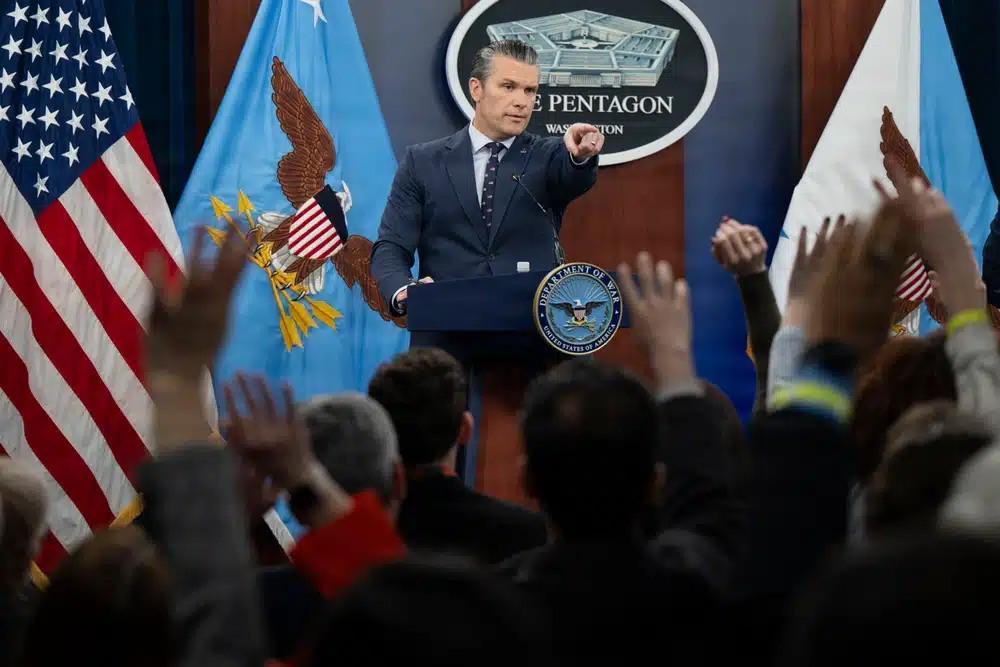
Pete Hegseth is the man who set this tone. The Jerusalem cross constellation on his chest, the Deus Vult on his bicep, the Arabic word for “infidel” added below—taken together, these are not private spiritual expressions. They are a public declaration, worn on the body of the country’s chief military officer, that the defense establishment he now controls is aligned with a particular vision of civilizational warfare between Christianity and Islam. An internal report from his time running the nonprofit Concerned Veterans for America documented a 2015 episode in which he repeatedly chanted “Kill all Muslims!” in a drunk and violent manner at a bar in Ohio. His lawyer called the claim outlandish. The tattoos, which tell a consistent story, were acquired voluntarily and worn publicly to his confirmation hearings.
There is a simple thought experiment that clarifies the constitutional issue. Imagine a Muslim-American Defense Secretary with a Quranic battle verse tattooed on his chest, who invited Islamic scholars to lead prayer services in the Pentagon auditorium, and whose commanders were telling troops that the war they were about to fight was foretold in the Hadith. No serious person believes that nominee would have been confirmed, or that the commander situation would have been met with anything other than immediate court-martial proceedings. The asymmetry reveals what the constitutional principle actually is in practice, as opposed to what it claims to be in theory.
The theological infrastructure behind these prayer services has a name and a history. The New Apostolic Reformation is a loosely organized network of independent charismatic Christian leaders who claim the offices of apostle and prophet—positions of direct divine authority—and who have spent the last two decades building significant influence inside the Republican Party. Paula White-Cain, who heads the White House Faith Office that Donald Trump re-created for her at the 2025 National Prayer Breakfast, is a prominent figure in this network. Dutch Sheets, another NAR leader with documented White House access, declared after the 2020 election that “it is God’s will for Trump to win”—and then, when Trump lost, took a team of twenty apostles and prophets to contested states to conduct what the movement called spiritual warfare campaigns on his behalf.
The movement’s political theology is the Seven Mountain Mandate—the doctrine, developed through the 1970s and radicalized since, that Christians are called to seize dominion over seven spheres of society: government, military, education, media, arts, business, and family. The language is precise and intentional. Not “influence.” Not “participate in.” Dominion. A 2024 survey found that 55% of American evangelicals now endorse this framework, a near-doubling from the year prior. The “mountain” of government is, in this schema, a territory to be captured and ruled according to biblical law.
The libertarian critique of this arrangement does not require any hostility to Christianity, or to religion, or to prayer. It requires only consistency. If you believe that state power is dangerous—that governments left unchecked tend toward expansion, toward violence, toward the suppression of those who dissent—then you should be specifically alarmed when that power acquires divine sanction. A state that acts in God’s name is a state that has insulated its decisions from ordinary accountability. You cannot audit a prophecy. You cannot cross-examine a biblical mandate. You cannot file an injunction against Armageddon. The moment a government successfully frames its wars as divine will, it has placed those wars beyond the reach of the arguments that might otherwise constrain them.
This is not a theoretical concern. Senator Lindsey Graham (R-SC) told reporters that the current conflict will determine the shape of the Middle East “for a thousand years.” Hegseth has promised that the firepower coming is a “multiple” of what has already been deployed. There are no stated objectives, no defined conditions for victory, no exit. The administration, when asked about the soldiers already dead, treats the casualties as a communications problem. Hegseth complained that the press “only wants to make the president look bad” by reporting deaths. These are the characteristic features of a war that has been given a religious rationale: it cannot end on human terms because its justification is not on human terms.
Whether Donald Trump is a sincere believer is, for these purposes, less important than the function his performed faith serves in the political economy of American militarism. The pre-2015 record is worth a brief accounting. His church of decades in Manhattan stated in 2015 that he was “not an active member.” His biographers across the political spectrum have generally described him as someone for whom religion was ambient rather than substantive. When asked directly at a 2015 Iowa forum whether he had ever sought God’s forgiveness, he replied, “I don’t bring God into that picture.” He could not name a favorite Bible verse. Addressing evangelical students at Liberty University, he referred to 2 Corinthians as “Two Corinthians” — a fumble suggesting unfamiliarity not with a single passage but with how Christians actually speak about their scripture.
The NAR’s prophets have a theological resolution for this inconvenience. Their framework of the “Cyrus king”—drawn from the Old Testament account of the Persian emperor who freed the Jewish people from Babylonian captivity without himself being Jewish—permits them to support a leader whose personal conduct would disqualify him from most evangelical congregations, because his piety is irrelevant. He is a vessel, not a saint. God works through flawed instruments. Lance Wallnau, who was present at early Trump Tower meetings with evangelical leaders and who later claimed a prophecy came to him in Trump’s presence, declared the forty-fifth president “Isaiah 45’s Cyrus”—the anointed secular king through whom God would deliver his people from cultural exile.
This framework serves everyone’s interests efficiently. Evangelical leaders receive White House access, judicial appointments, executive orders, and the political legitimization of their dominionist project. Trump receives a motivated base that frames his elections as cosmically significant and his defeats as demonically engineered. The military receives a righteous narrative to offer its soldiers. And the warfare state receives the most durable justification in human history for the exercise of lethal force abroad.
There is a version of the objection to this reporting that deserves acknowledgment: Iran really does have a theocratic government. Its Supreme Leader really does claim divine authority. Its Revolutionary Guard really does conduct foreign policy partly on the basis of Islamic eschatology. The contrast that the Trump administration’s critics are drawing—between Iranian theocracy and American constitutional governance—has genuine substance.
But the contrast only holds if the American side of it is real. If U.S. military commanders are telling their troops they are instruments of biblical prophecy, the contrast collapses—not because the two systems are morally equivalent, but because the argument that justified the intervention has been consumed by the behavior of the intervenors. You cannot prosecute a war against theocracy while running one.
The libertarian position on this has always been simpler than the liberal or conservative ones, and more consistent: the state has no legitimate religious function. Not for wars it wants to fight. Not for political coalitions it wants to hold together. Not for soldiers it wants to motivate. A government that claims divine sanction for its military campaigns has not found a better justification for those campaigns but just a more dangerous one, because it has placed itself beyond the questioning that free people are supposed to apply to power.
The soldiers filing complaints with the MRFF understand something their commanders may not: that being told you are fighting for God is not a promotion. It is a transfer of accountability from the politicians who sent you to a deity who cannot be held responsible for the outcome. The Constitution promises those soldiers something more honest than prophecy. It promises them a state that answers to law. Whether it is keeping that promise is the question that ought to be driving the investigation—and that, regardless of the investigation’s outcome, ought to be driving the rest of us.