

Since the beginning of the war, President Donald Trump has touted dismantlement of the Iranian government as the American endgame. Even as U.S. officials negotiate with their Iranian counterparts to end the fighting and restore stability to world energy markets, Trump says he still wants to see a “very serious form of a regime change” in the ultimate peace deal.
This imperial hubris is unworthy of the president of a federal republic and would cause the Founding Fathers to cringe.
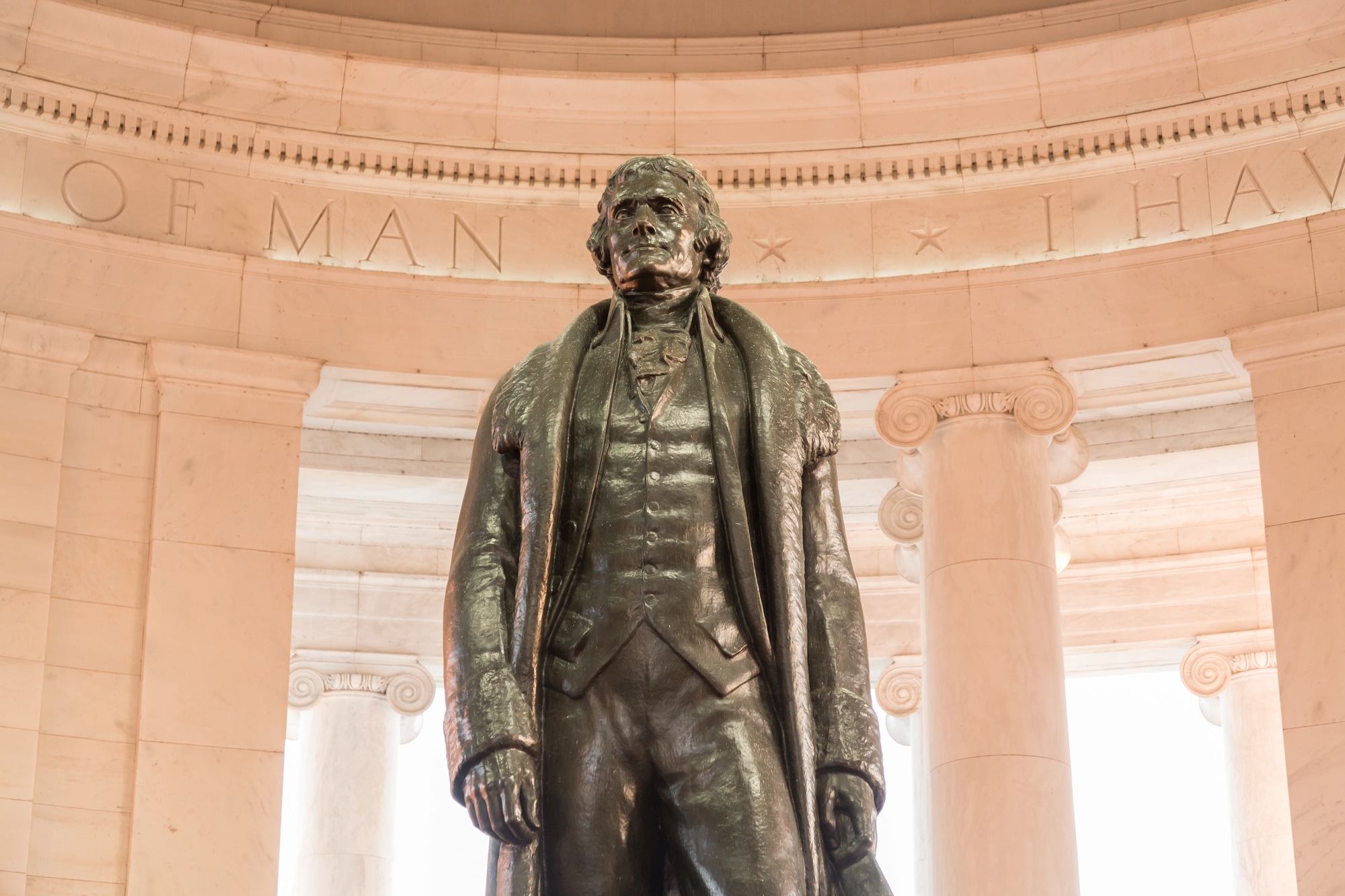
While Thomas Jefferson and his contemporaries were often excited about continental prospects for the thirteen former British colonies, the “empire of liberty” as Jefferson called the American experiment was based on free and equal states and not a unitary nation-state with ambitions of directing the governments of the world.
The Founders, of course, were aware of the novelty of their experiment and that its success could provide hope for millions. In the Philadelphia Convention, James Madison asserted that “it was more than probable we are now digesting a plan which in its operation would decide for ever the fate of Republican Government.” Benjamin Franklin observed that if republican government failed in the United States, “mankind may hereafter from this unfortunate instance, despair of establishing Governments by Human wisdom and leave it to chance, war and conquest.” In his first inaugural address, George Washington declared his belief that “preservation of the sacred fire of liberty, and the destiny of the Republican model of Government, are justly considered as deeply, perhaps as finally staked, on the experiment entrusted to the hands of the American people.”
The influence the Founders sought over other nations was influence by example. They believed that political societies across the globe would seek to emulate American principles of limited government, federalism, and the rule of law. They did not expect that the chief executive, without input from the legislative branch, would bomb foreign countries and demand that new regimes be erected.
Each day the United States looks less like an “empire of liberty” and more like a plain old empire in the mode of the Romans, Ottomans, and Mongols.
Depending on how one counts, the United States maintains upwards of 750 military bases overseas. Scholars estimate that these bases “constitute 95 percent of all the military bases any country in the world maintains on any other country’s territory.” Granted, some of these instillations are tiny with few personnel. Nonetheless, the 95% figure is shocking.
Over one hundred years ago, the stalwart anti-imperialist and Yale sociologist William Graham Sumner warned that American interventionism abroad would put our system of government at risk. Just as the United States was about to go to war against Spain, Sumner cautioned that by taking away Spanish possessions on the ground that Spain was failing in her colonial mission in Cuba, the United States would “shrivel up into the same vanity and self-conceit of which Spain now presents an example.” If the United States truly believed in liberty, then Sumner suggested that it should tend to its own affairs and leave other peoples “to live out their own lives in their own way.” What would be in store for the United States if it succumbed to the temptations of interventionism? According to Sumner, “war, debt, taxation, diplomacy, a grand governmental system, pomp, glory, a big army and navy, lavish expenditures, political jobbery—in a word, imperialism.”
Listening to President Trump’s bluster as he asks Congress for $200 billion to continue his war of regime change in Iran, it is hard to disagree with Sumner that we have traded our peaceful federal republic for an avaricious empire. Congress must deny this request. The United States should serve as an empire of liberty, in Jefferson’s words, and leave the vanity of imperialism for despotic powers.