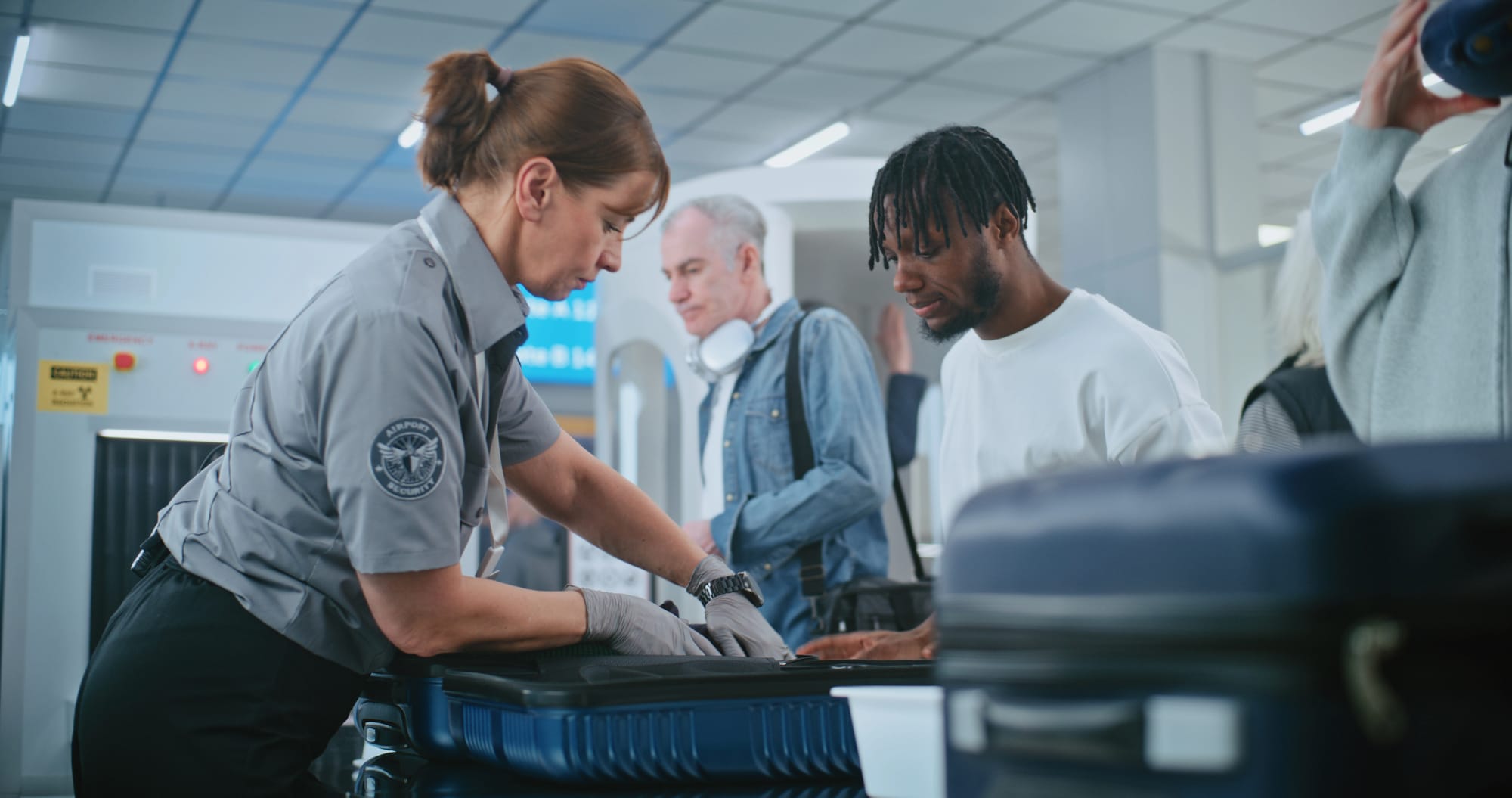
For more than a decade, Transportation Security Administration (TSA) agents have plundered passengers at airport security checkpoints on the flimsiest or most shameless pretexts. If you get stopped at an airport security checkpoint with $100 or more in cash, TSA agents can fleece you.
More than 10,000 travelers have been stripped of their money by TSA agents since 2014. But the feds almost never bother filing criminal charges against the victims of asset forfeiture. TSA considers itself generous when it “permits the passenger to continue on to their destination”—after taking away their money.
Since 2019, the Institute for Justice, a non-profit constitutional law firm, has been fighting this TSA abuse. Their class action lawsuit was finally argued in federal court in Pittsburgh in February but no decision has been announced. The case is spearheaded by Dan Alban, America’s forfeiture knockout champion. “TSA has secret policies that tell its screeners that they must seize travelers’ cash,” says Alban.
TSA sometimes partners with the Drug Enforcement Administration, whose forfeiture program unofficial motto is, “You make it, we’ll take it.” TSA and DEA agents automatically confiscate the cash of any domestic traveler they detect with more than $5,000—their magic threshold for money being “suspicious.”
In August 2019, 57-year-old Rebecca Brown was flying out of Pittsburgh International Airport while carrying a Tupperware container with her father’s life savings totalling $82,373. Her 79-year-old father was showing signs of mental decline and was worried about keeping so much cash in his house. Brown was transporting the stash to her home in Boston where she planned to set up a joint bank account. A TSA agent noticed the money while scanning Brown’s carry-on luggage and alerted a DEA agent who asked Brown some questions and then announced he was seizing the cash. The DEA agent put Brown’s money “into a plastic bag and told her someone would be in touch with her,” The Washington Post reported. The cash grab prevented her father from fixing up his old pickup truck and getting badly needed dental surgery. After an Institute for Justice lawsuit challenging the seizure was publicized, DEA sent Brown a letter rotely declaring. “After further review, a decision has been made to return the property.”
DEA is paying numerous TSA agents across the nation to alert them when they detect ample cash during screening. Josh Gingerich was traveling from Chicago home to the Sacramento area in 2018 when a TSA agent notified DEA agents about $29,000 in cash in his backpack. According to Gingerich, who purchases and resells trucks, DEA agents “claimed to smell marijuana on a plastic bag filled with dirty laundry in his backpack…Officers dumped the clothes, filled the bag with cash, then brought it to the drug dog.” The agents found no drugs, but an alleged scent sufficed to seize the money. TSA agents were sometimes permitted to keep a percentage of travelers’ cash they helped seize but that brazen abuse reportedly no longer occurs.
Federal law prohibits travelers from taking more than $10,000 in cash out of or into the United States without filling out an official form. But traveling inside the U.S. with hefty amounts of cash is perfectly legal.
That doesn’t stop TSA from plundering passengers on any and every BS pretext. The government doesn’t have to prove the person is guilty. Instead, the feds simply take the money and private citizens must engage in a long, expensive fight to attempt to get their money back. TSA routinely uses unreliable alerts by police canines to justify confiscating cash—even though dogs respond positively to almost any bulk currency since drug contamination is widespread on U.S. bills.
TSA cash seizures are arbitrary power at its worst. Though TSA considers travelers carrying “bulk cash” to be a great evil, the agency refuses to limit its power by defining the menace. TSA “cleverly leaves the definition of a large amount of cash up to the individual TSA screener,” Alban notes.
TSA agents in Indiana are encouraged to “trust your instinct” when it comes to commandeering passengers’ money. TSA agents in North Dakota are told that “any large amount of currency will be reported, even if you believe it to be in the low thousands.” TSA agents at the Dallas, Texas airport have been ordered to “immediately” notify Law Enforcement Officers about “ALL discovered bulk cash…regardless of amount.”
Airport cash seizures are turbocharged because TSA considers almost everything to be “evidence of criminal activity.” TSA agents can seize money if it is “Rubber Banded,” bundled in “Store Bought Bands,” or bundled with “Hand Made Bands.” If there is a “Hand Made Label” on the cash, then it is guilty as hell or at least “close enough for government work” guilty. TSA agents can seize money if it is suspiciously all of the same denomination of currency—or if it is suspiciously of different denominations. TSA agents can seize money if it is “Concealed in Bags” the size of a purse, and also if it is in a purse. Carrying any money in your socks is treated like a full confession.
TSA condemns travelers for concealing money even though more than five hundred TSA agents have been fired for robbing passengers. I hammered that nationwide looting spree in a 2004 New York Times op-ed. Remember the Newark, New Jersey TSA agent who confessed to selling on Ebay scores of laptops, cameras, and cell phones he stole from travelers? Three TSA agents were busted for stealing in Miami in 2023, the New York Post reported, and one admitted seizing a thousand dollars a day from wallets sent through TSA x-ray systems.
At some airports, TSA agents rely on “behavior detection” checklists to target travelers for extra scrutiny that could boost the chance of their cash being seized. The current checklist is secret but TSA agents previously zeroed in on anyone who seems “very arrogant and expresses contempt against airport passenger procedures.” If someone gets riled up after TSA takes his money, does that prove he was up to no good?
These airport robberies would not be occurring if TSA had not previously nullified Americans’ constitutional right to be free of unreasonable warrantless searches. Alban points out that “TSA screeners are not law enforcement officers, and the TSA is not authorized to conduct general criminal investigation.” But TSA claims that Americans effectively waived any right to privacy by “voluntarily” submitting to searches. A federal appeals court noted in 2019 that the Justice Department “contends that consent by passengers cancels the Fourth Amendment’s effect.” But there is no consent when the alternative is being prohibited forever from taking any commercial flight in the United States.
Compelling TSA to cease plundering travelers is a step toward putting Uncle Sam back on a constitutional leash. It is time for equal rights for non-billionaires who cannot afford to fly on private jets exempt from TSA depredations.