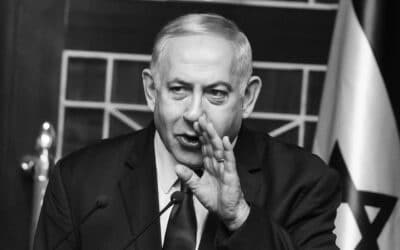
A photograph moved across the Western wires with a caption in capital letters. “COUNTER US POWER,” it read, above an image of the Kyrgyzstan president walking China’s Xi Jinping past an honor guard in Bishkek, when they met at the Shanghai Cooperation Organization (SOC) summit that took place from August 31 to September 1, 2026. The two men were not photographed doing anything to the United States. They were walking to lunch. The caption supplied the enemy, the verb, and the stakes, because the summit itself supplied none of them, and a Western audience cannot be shown a room of Asian and Eurasian heads of state without being told which direction to fear.
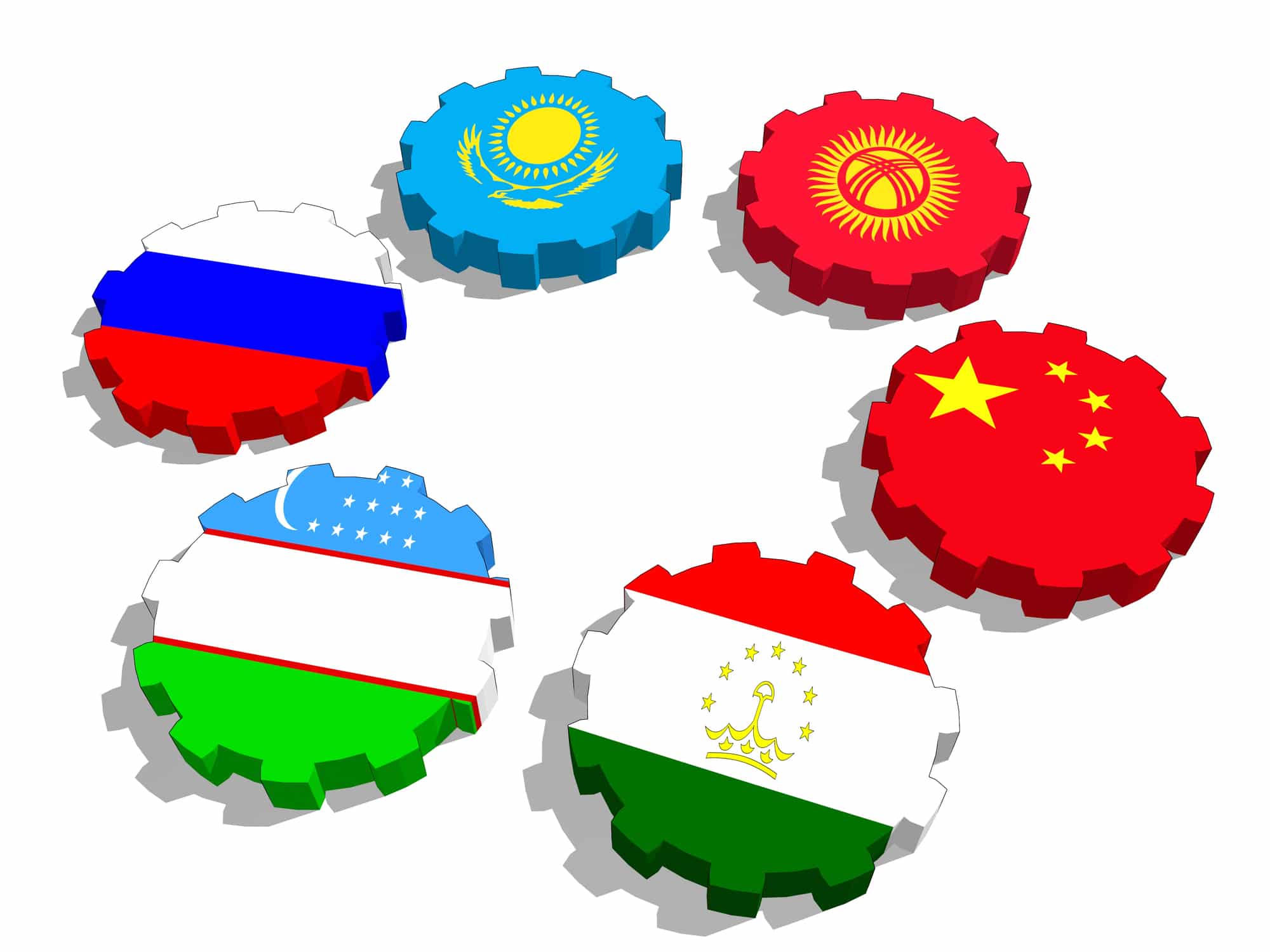
That reflex is the story. On the first of September, the Shanghai Cooperation Organization marked its twenty-fifth anniversary in the Kyrgyzstan capital, ten member states and more than a dozen heads of government in one hall, the United Nations Secretary-General among the guests. The Associated France-Presse dispatch that most American and European outlets ran described the bloc as one that seeks to be a counterinfluence to the West. France 24 sent its leaders to Central Asia to counter Western influence. The London press reached for older equipment and called an earlier session of the same body a gathering of an axis of upheaval. Every one of these descriptions places Washington at the center of a meeting Washington did not attend, was not invited to, and could not prevent.
If we read the coverage closely a small machine reveals itself. The AFP wire notes, correctly, that the organization’s founding declaration calls it not an alliance directed against other states. The very next sentence takes it back, observing that the Russian and Chinese leaders have made anti-Western speeches at past summits. The denial is granted a line and overruled in the following one. The structure instructs the reader which half to keep.
The framing collapses on contact with the guest list, and the reporting mostly declines to notice its own evidence. The same dispatch that calls the bloc a counterinfluence to the West records, a few paragraphs down, writes that the organization now counts fifteen dialogue partners including Turkey, Saudi Arabia, and Qatar. Turkey is a member of NATO. Saudi Arabia and Qatar host the forward headquarters and the largest American air base in the Middle East. The president of Turkey, Recep Tayyip Erdogan, attended in person. An axis assembled against the West does not seat a NATO government at the table and a UN Secretary-General beside it. What assembled in Bishkek was not a front. It was a market, and the West keeps sending its own customers.
India is an interesting case. Prime Minister Narendra Modi flew to Bishkek and met Russian President Vladimir Putin on the sidelines, a scheduled bilateral, days after his government had been hit with a punitive American tariff. Washington had imposed a 50% tariff on Indian goods over New Delhi’s refusal to stop buying Russian oil. India is the state the United States has spent two decades cultivating as a counterweight to China, a partner in the Quad, a buyer of American weapons. Pressed by tariff to abandon Russian crude, it went to Central Asia and shook Putin’s hand. The instrument meant to discipline India delivered it to the very table the instrument was meant to keep it from.
This is the pattern the caption cannot hold. The bloc that Western editors present as a hostile formation is, in large part, a product of Western conduct, and the clearest illustration sat in the plenary session as Iran’s president. Iranian President Masoud Pezeshkian took his seat six months into a war between Washington and Tehran that no American Congress ever declared. The war opened in February with American and Israeli strikes. It has produced no surrender. What it has produced, on the record, is the isolation of the state that started it from the states it needs.
One week before the summit, the U.S. Treasury Department announced what it named Operation Economic Outcast, a sanctions campaign Treasury Secretary Scott Bessant called the most crushing economic operation ever taken against any country. The Office of Foreign Assets Control extended secondary sanctions to five further sectors of the Iranian economy, aviation, digital assets, gold, shipping, and technology, under an executive order signed in 2020. It designated nearly sixty entities, individuals and vessels across multiple jurisdictions, and it suspended five general licenses that had authorized certain remittances and Iranian access to the American cultural and academic system. It went further, warning in a separate alert that any party, of any nationality, who pays a toll to Iran for passage through the Strait of Hormuz risks American sanctions, an assertion of jurisdiction over a waterway two thousand miles from American shores. The word secondary is the whole design. These measures do not fall on Iran alone. They fall on anyone, anywhere, who trades with it, which is to say they are an instruction issued to the sovereign decisions of other governments, backed by the threat of exclusion from the dollar. A sanction on Tehran is a demand made of Beijing, of New Delhi, of Ankara, and each of them heard it.
A state told it will be punished for trade with Iran, and a state told it will be tariffed for trade with Russia, will look for arrangements the United States does not control. The summit was that search made visible. Putin used his pre-summit interview with China’s state agency to condemn discriminatory sanctions and to note that trade between Russia and China is now conducted almost entirely in rubles and yuan. China, the largest buyer of Iranian oil, answered the new American measures by saying it would firmly defend its interests. None of this required an alliance. It required only the accumulating incentive to route around a power that treats access to its financial system as a weapon and then expresses surprise when the targets build a door of their own.
Economist Murray Rothbard held that the state’s foreign wars and its domestic despotism were the same disease presenting in two places. Adopting essayist Randolph Bourne’s dictum that war is the health of the state, Rothbard added the greatest danger clause the slogan usually omits, that a state can die only by defeat in war or by revolution, and so wages war to mobilize its own population behind it. Every foreign campaign returns home as debt, surveillance, inflation, and a public trained to accept them. The war on Iran is undeclared. The sanctions regime is imposed by executive determination, sector by sector, with no vote taken in the body the Constitution assigns the power. The tariff on India is levied by proclamation. Each of these is the executive acting alone against a foreign population, and each is paid for at home.
The bill arrives in forms the summit made legible. The dollar’s power rests on the willingness of others to hold it and to settle in it. Every secondary sanction teaches a foreign ministry that dollar settlement is a leash, and every leash discovered is a reason to test the fence. When the Russian president reports that his trade with China clears in national currencies, he is describing the slow, self-inflicted erosion of the exact instrument that let Washington sanction him in the first place. The empire is spending down the asset that funds it, and calling the depletion someone else’s aggression.
None of this happened at once, and the manner of its growth is the sign. The organization began in 1996 as a border-demarcation arrangement among China, Russia, and three Central Asian republics, a technical body concerned with where lines fell on maps. It gained momentum in exact proportion to Western pressure on its members. India and Pakistan joined in 2017. Iran was admitted after years of sanctions had made the admission attractive to both sides. The roster of dialogue partners swelled to fifteen as American secondary sanctions and tariffs taught a widening circle of governments the value of a forum outside Washington’s reach. At Bishkek, the rotating chair passed to Pakistan, another American security partner of long standing, taking the gavel of the body the American press calls an anti-Western axis. The organization did not recruit these states. American policy delivered them.
It would be a mistake, and a gift to the framing this piece is trying to answer, to reply to the Western caption with a triumphant one. The organization is not a coherent bloc, and honesty about its seams is the difference between analysis and mirror-image propaganda. As one regional analyst told Al Jazeera, the SCO is not a coherent anti-Western alliance. Russia and China compete for the same ground in Central Asia. India and China hold a contested and sometimes lethal border, which is why Modi and Xi shared a stage but scheduled no formal bilateral. India and Pakistan sit in the same organization while hostile to each other. A proposed development bank has been discussed for years and is not yet a bank. The bloc claims to represent some 40% of the world’s population, and that figure describes a fact of scale, not a unity of purpose.
But the seams are the point, not the refutation of it. The remarkable thing is not that these governments agree. It is that governments which distrust one another would still rather manage their quarrels inside a structure the United States does not run than accept the arbitration of one that does. The forum does not need a mutual-defense clause to embarrass the Western map. Its mere existence, absorbing a NATO member and a Quad partner and the two most sanctioned states on earth into the same anniversary photograph, is enough to show that the community Western officials invoke when they say international community is a specific and shrinking set of capitals mistaking itself for the planet.
This is the provincialism of empire, and it is the American public that pays its price. The citizen is told that primacy purchases security, that the sanctions are prudent, that the wars are short and necessary, that the world outside the alliance is a rogues’ gallery held at bay by American resolve. The summit in Bishkek is the standing refutation of that story, which is why it must be captioned before it can be shown. A people kept fluent only in the vocabulary of counter and against and axis is a people prevented from asking the simpler question the pictures raise. If the rest of the world is organizing itself around the avoidance of American power, perhaps the trouble is not the rest of the world.
The men in the photograph were walking to lunch. The empire that could not stop the lunch, could not keep India from the table, could not isolate the state it is bombing, and could not prevent the Secretary-General of the United Nations from attending, is nonetheless assured by its own press that it remains the center around which all of this revolves. The caption is not journalism. It is consolation, and the country that most needs to disbelieve it is the one being consoled.