
In 1924, the Lord Chief Justice of England quashed a criminal conviction over nothing more than an appearance. The clerk who had sat with the magistrates while they deliberated also worked for the firm that was suing the defendant in a related civil matter. No one suggested the clerk had said a word about the case in that room. The conviction was quashed all the same. Lord Hewart held that the appearance of interference was itself enough to taint the result, and that justice must manifestly and undoubtedly be seen to be done. The sentence has been read out in courtrooms ever since, because it names a thing a democracy cannot do without. A verdict reached in the dark asks the public to trust a process it was never allowed to watch.
Open justice has always rested on two conditions, and both have to hold for it to mean anything. The evidence of what was done has to survive, and the proceeding that weighs it has to be open to the public. A state that can destroy the first, or close the second, has freed itself from the one audit it can neither buy nor staff, the scrutiny of people who owe it nothing. For more than half a century the British state has worked against both conditions, and the two efforts, the one that burns the record and the one that shuts the courtroom, are halves of a single design aimed at the sentence Hewart wrote.
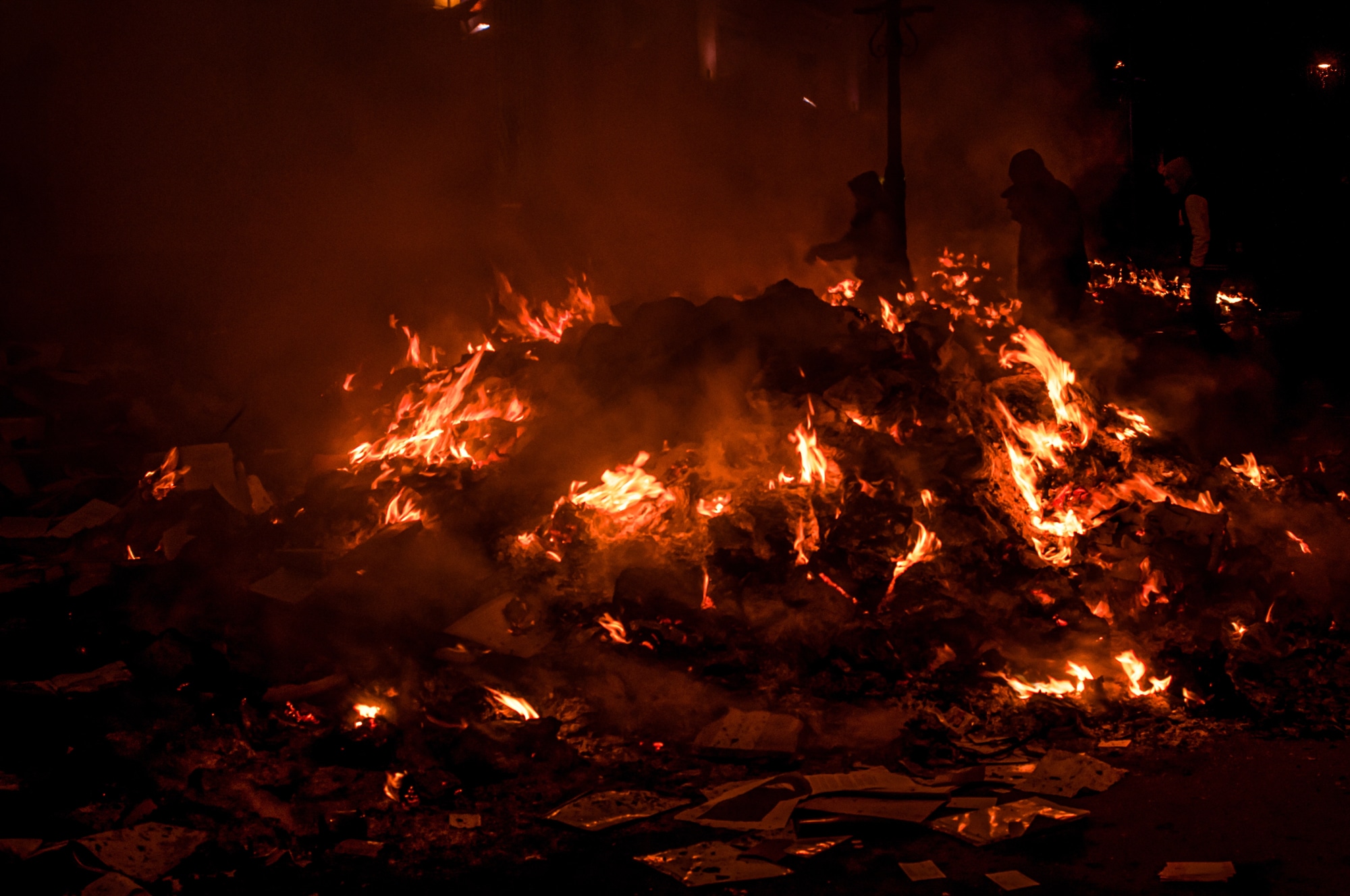
The older of the two methods is destruction, and the record of how it worked survives only because a fraction of the paperwork describing it escaped the fire. When Britain withdrew from a colony it emptied the archive on the way out. From 1961 the colonial secretary, Iain Macleod, instructed officers across the territories to sort their files and remove anything that might embarrass the British government or its servants, from senior officials down to local police informers, along with anything that could be read as evidence of racial prejudice or religious bias.
The sorting had its own vocabulary. Files meant to pass to the incoming government were marked legacy. Files meant for the fire or for secret shipment to London were marked watch, and the instructions went further than ordering their removal. Officials were told that the successor government must never learn the watch files had existed, and that where a watch file was pulled from a run of legacy files a dummy was to be slipped into the gap so the sequence would show nothing missing.
Where documents were burned, the waste was to be reduced to ash and the ash itself broken up. Where burning was impractical, the paper was to be packed into weighted crates and sunk in deep water far from the coast, in a current that would not return it. Crates sent home by sea could be entrusted only to a British ship’s master on a British ship. The work itself was reserved, by rule, for an officer who was a British subject of European descent, and no African clerk was permitted to touch it.
The practice took local forms. In Belize, an intelligence officer burned the sensitive files with the help of the Royal Navy and several gallons of petrol. In British Guiana, short of men who met the race rule, two secretaries fed a fire in an oil drum on the grounds of Government House, until the army agreed to lend a hand. In Aden the burning began in 1966, a full year before the British left, and a committee of three decided what went to the flames; the thinness of the surviving Aden paper suggests the committee leaned toward the fire. In Malaya the destruction in 1957 had been so wholesale, five lorry loads driven to the Singapore naval base in a single purge, that officers in Kenya were later warned against repeating it, on the ground that it had been too visible. When a batch was done, the officer responsible sent a signed destruction certificate back to London. The erasure generated its own paperwork, and that paperwork was then filed and kept. The whole programme carried a name fit for a staff handbook. It was called Operation Legacy.
What the fires were built to erase was concrete and criminal. The three elderly Kenyans whose lawsuit would one day drag the surviving records into the light had been beaten and sexually mutilated in British detention camps during the Kenya Emergency, under a system the files show was sanctioned well up the chain of command. One claimant’s statement described men castrated and women raped in the years before independence. None of it would be public now had the government been left to its own conscience, because it became public only when a court forced the issue. When the Kenyans sued, the Foreign Office fought them for three years, first on the argument that any liability for colonial conduct had passed to the independent Kenyan government in 1963, a claim the High Court rejected. It was during that litigation, more than a decade after the case began, that the department was finally forced to admit what it had denied for two generations, that it had been holding a secret colonial archive all along. Historians including David Anderson and Caroline Elkins had argued for years that the records had been spirited away and hidden, and the government had preferred to let serious scholars look like conspiracy theorists rather than concede the archive existed. When the files surfaced they formed a catalogue series at the National Archives, FCO 141, some twenty thousand files drawn from around forty former colonies, and one of the officials tasked with reviewing them concluded that the migrated archive had been deliberately created.
The admission, when it came, was engineered to contain the damage rather than to reckon with it. On June 6, 2013 the foreign secretary told the Commons that the government would pay £19.9 million to 5,228 claimants, and that it “sincerely regrets” the abuses. In the same statement the government continued to deny legal liability and took care to insist that the settlement set no precedent for any other former colony. The regret cost nothing the government had not already lost in court, and the careful wording left the next claimant, in any other former colony, with nothing to build on.
The crude method was the fire. The durable method is the statute, and it is still running. The Public Records Act of 1958 promises that records chosen for permanent preservation will pass into public view, within twenty years since a 2010 change cut the old thirty-year rule. The same section of the same act carries the exit. A department may keep its records back if, in the opinion of the person holding them, they are needed for administrative purposes or ought to be retained for any other special reason. In its widest form the power applies to a whole category of records at once, through a blanket retention, a standing authorization to withhold an entire class and reviewed only once a decade. The law that guarantees the public its history contains, in its own text, the device for keeping whole classes of that history sealed by administrative decision.
The provision is no museum piece. In 2013, the Foreign Office was found to be holding a further body of files it called its special collections, estimated at the time at some 1.2 million records and held, for years, in breach of the Public Records Act. The government’s response to the discovery that it was unlawfully withholding this much of the documented past was to make the withholding lawful, and the justice secretary signed a blanket authorization covering the lot. A group of historians led by David Anderson weighed a legal challenge under both the Public Records Act and the Freedom of Information Act. Among the holdings are the colonial files of Hong Kong, kept closed under a retention order timed to run until 2047, the fiftieth anniversary of the handover.
The direction of the law has run one way. In 2015, the authority to approve retention under the act was moved from the Lord Chancellor to a Secretary of State, and the instrument was renamed from a Lord Chancellor’s Instrument to a plain Retention Instrument. The Lord Chancellor’s role had carried a measure of independent oversight of the system, and the change brought the sign-off closer to the departments that hold the records and want them kept. The oldest method has not retired either. Between 2017 and 2019 the British army’s own headquarters in Kenya destroyed the bulk of its physical files created before 2015, years after the government had stood in Parliament and expressed its regret for exactly this kind of act, and possibly in breach of the very Act it cites when it lectures other states on transparency.
Destroying the evidence is the blunt way to defeat the principle that justice be seen. A cleaner way leaves every page intact and removes the public from the room instead, and the British state built it in the same years it was still hiding its colonial files.
The opening was handed to the government by the courts themselves. In 2011, in Al Rawi, the Supreme Court held that a court could not impose a closed procedure in an ordinary civil claim for damages, and that if such a power was to exist at all it was for Parliament to create, and Parliament went on to do exactly that. The Justice and Security Act received royal assent on April 25, 2013, after a tumultuous passage that saw the House of Lords strip the most lopsided clauses out of the Bill before the Commons restored a version the government could live with. The act’s second part brought closed material procedures into ordinary civil litigation for the first time.
A closed material procedure works in a particular way. The government applies to give its evidence in secret, on the ground that disclosure would damage national security. If the application succeeds, the person bringing the claim and that person’s own lawyer are shut out of that part of the case and never see the material used against them. In their place the court appoints a security-cleared special advocate, who is allowed to read the secret evidence and to argue about it in the closed hearing. Once he has seen it, he may no longer speak to the client whose interests he represents. The barrister Martin Chamberlain, who has done the work, likened it to the predicament of Joseph K in Kafka’s novel.
The power matters most because of who stands on the other side of it. The government is itself the defendant in these cases, sued by people who say they were mistreated or handed to torture with British help, and the material it most wants kept from the room is the material that would damage the reputation of its intelligence agencies. A barrister who traced the Act’s drafting observed that it let the government apply for secrecy whenever it suited the government to do so. The institution under judgment had acquired a say in what the public would be allowed to hear about the judgment.
The legal profession did not take it quietly. The special advocates themselves, the security-cleared barristers who staff the secret system from the inside, told Parliament that its procedures are “inherently unfair and contrary to the common law tradition,” and fifty of them signed the objection. The Law Society, speaking for the country’s solicitors, warned that the act damaged open justice and the equality of arms on which a fair trial depends. The legal charity Reprieve said the bill took a wrecking ball to the British tradition of “fairness and equality before the law.” Lord Brown, a recently retired Law Lord who had served as the commissioner overseeing the intelligence services, called the legislation so radical a departure from the cardinal principle of open justice that every available safeguard should be built in to limit its use. The disquiet reached beyond Westminster to the government’s own equality and human-rights watchdog, which judged the bill incompatible with European human-rights requirements. None of it stopped the bill. The act became law, and a civil claim about the conduct of the security agencies could now be met by a government defending itself with evidence the person suing it would never be shown.
Having secured its secrecy in the civil courts, the security establishment pressed into the criminal ones, where the rule of open hearings is oldest and least qualified. In 2014, the prosecution applied to hold an entire terrorism trial, the case of two men charged under the Terrorism and Official Secrets Acts, behind closed doors, with the defendants themselves kept anonymous. Had it gone ahead it would have been the first wholly secret criminal trial in modern British history. The Court of Appeal refused the full blackout. Open justice, the judges held, is a hallmark of the rule of law, and it requires that criminal trials be held in public and that the names of defendants be published, with no more than the minimum departure tolerated. They recorded their “grave concern” at the combined effect of trying a man in secret while concealing who he was. The compromise they imposed was a measure of how far the ground had shifted. A core of the trial went ahead in private. A small group of accredited journalists was admitted to parts of it, on the condition that they could report almost nothing of what they heard, and the notebooks they filled were held by the court and reviewed. The secrecy was only partly beaten, and only because judges held a line the government had tried to erase.
The timing of the two campaigns gives away what they share. In April 2013, the Justice and Security Act became law, assembling the machinery to keep future evidence of official wrongdoing out of public view. Eight weeks later, in June 2013, the same government rose in the same Parliament to express its regret for the colonial torture whose evidence it had concealed for fifty years and had surrendered only when a court compelled it. One arm of the state apologized for a concealment while another arm built the legal apparatus for the next one. The torture files reached daylight because open justice, on that occasion, did its work, and a courtroom prised loose what the government had fought for years to withhold. The Justice and Security Act exists so that the next such courtroom can be closed before it prises loose anything at all.
The motive is the same at both ends of the operation, and it is not obscure. A state lives on the belief of the governed that its conduct is broadly lawful and decent, and open justice is the instrument by which that belief is tested against the facts in a room the state does not control. Rothbard located the deepest priority of any state in its fear of any fundamental threat to its own power and its own existence, and little threatens it as precisely as a documented account of its crimes examined in open court. When it can get to the evidence, the state destroys it. Where the evidence has survived into a courtroom, it sets about closing the courtroom instead. The public ends up, by one route or the other, without a view of what was done in its name.
The expense is itself the confession, here as with the bonfires behind the embassies. A government that spends decades burning and burying its files, and then rewrites the rules of its own courts to keep the proceedings dark, is not guarding material it believes to be harmless. The size of the effort is a fair measure of the weight of what the effort is meant to hide.
The instinct is not confined to Britain. It now shapes the way Israel handles the record of what its forces have done in Gaza and the West Bank, where the evidence of war crimes is being pulled off the social media feeds that first carried it, often faster than anyone can save a copy. What has changed is the medium, and the speed at which it now moves.