
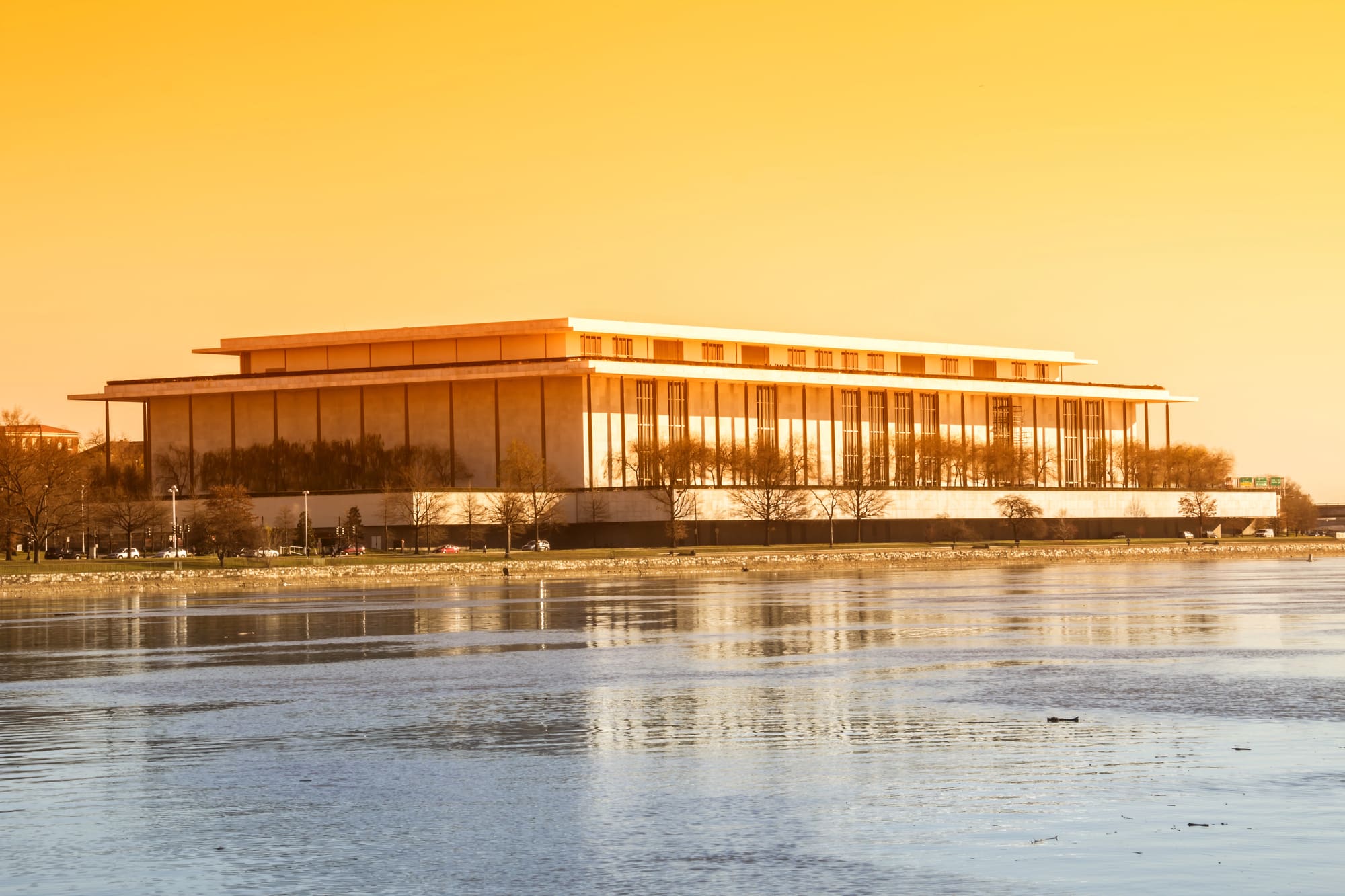
President Donald Trump signaled that he is entitled to raze the Kennedy Center for the Performing Arts if he is not permitted to add his name to the building’s front wall. Trump’s appointees to the center’s board of trustees rubber-stamped adding the president’s name to the Kennedy Center. After a federal judge blocked that name change, Trump’s henchmen padlocked the building last Tuesday. Trump’s appointees at the Justice Department notified the federal court that “without the prominent recognition of the Trump Administration, and President Trump’s efforts, the donors will not contribute, and the Center will continue to be in a financial and structural death spiral.” The president deserves “the respect and dignity of acknowledgment” as the savior of the Kennedy Center—or maybe the administration will have to put the building out of its misery, just like it did to the East Wing of the White House.
The Trump administration’s contortions on this issue almost make Trump’s ravings on the Reflecting Pool seem sane. The Kennedy Center was doing fine financially until Trump took it over at the start of his second term. His behavior is Exhibit A on why culture should be separated from the State.
Ironically, aside from his childlike obsession with renaming the Kennedy Center after himself, Trump has made some excellent proposals on federal cultural subsidies. In his first year of his first term and again last year and this year, Trump called for abolishing funding for the National Endowment for the Arts. Uncle Sam has been screwing American culture big-time ever since the Endowment was created in 1965.
The vast majority of spending for the arts comes from private pockets. Brooklyn theater director David Marcus noted that federal cultural subsidies cause “perverse market incentives…The real way to succeed as an arts organization is not to create a product that attracts new audiences, but to create a product that pleases those who dole out the free cash. The industry received more free money than it did a decade ago, and has fewer attendees.” There is no justice in taxing dishwashers in Arkansas to subsidize programs such as Synetic Theater’s “Silent Shakespeare”—in which actors gyrate and grope in lieu of delivering the richest bounty of the English language.
The Arts Endowment has been corrupting poetry for more than fifty years. In the 1970s, the Arts Endowment began subsidizing scores of obscure journals. In 1980, one small press editor complained in The New York Times, “The result is a steady lava flow, often in unreadably large, unpriced and ‘FREE’ editions of poetry books…I have even noticed such National Endowment for the Arts financed broadsides (dreadnoughts) stacked on the counter, and ‘free,’ of course, at our local delicatessen next to the candy jar.” In 1983, poet-editor Peter Davidson commented in The Washington Post:
“We have developed an entire educational system of poet-think, of schools and graduate schools, and workshops, and conferences, and residencies, where bards link up like chains of algae, funded by state councils and federal grants and half-suspecting taxpayers.”
Humanity has never suffered from a shortage of bad poetry, but the Arts Endowment laid up a stockpile for future generations.
The Arts Endowment abused its subsidies to browbeat literary reviews to kowtow to politically correct opinions. The Hudson Review, one of the nation’s leading literary quarterlies, was denied a grant in 1993 (after receiving several previous grants) because, according to a May 27, 1993 letter from the NEA, “writers of color were significantly under-represented in the Hudson Review.” The Hudson Review grant application was also rejected because it had published an article in its Summer 1992 issue about the black novelist Richard Wright that NEA panelists judged to be “isolating and condescending…This concern was exacerbated…when this essay was compared with the fulsome essay on [Emile] Zola in the same issue.” Roger Kimball, managing editor of The New Criterion, observed, “The message from the NEA’s panel is clear: Only institutions waving the banner of political correctness need apply…Even if you have published articles about, say, black authors, were the articles sufficiently—that is, unequivocally and unreservedly—enthusiastic?”
NEA subsidies squeeze out unsubsidized artists. Playwright John Chodes observed in 1992 in The New York Times that the impact of Arts Endowment subsidies have been:
“…greatly inflated by city, state and corporate matching grants. The funds have, paradoxically, undermined serious theater…Because of subsidies, the price of renting theaters has increased dramatically: one typical New York City theater that rented for $400 a week a decade ago now costs more than $2,000. Government-financed groups have made permanent homes in what were formerly stages rented by the show. These favored companies monopolize theater access. The endowment has a penchant for financing “social issues” plays, and the lure of subsidies coerces these theater companies—often composed of blacks, gays, women and Hispanics—into creating them. The product may be relevant, but hewing to N.E.A. priorities is the antithesis of a personal artistic perspective. And the essence of theater is the individual viewpoint.”
The Endowment also shafts classical music. Composer Stephen Limbaugh, writing in The American Conservative in 2017, slammed the Arts Endowment as “a recidivistic cultural butcher.” He explained:
“The NEA’s process for cultivating art is informed by standards set by universities and critical theorists. Those standards of what qualify as ‘acceptable’ contemporary art seem to be any phenomena that offends an individual’s inherent aesthetic disposition. Preferential treatment is given to those works that 1) are able to evoke the most unpleasant reaction and 2) are created with the least amount of discernible purpose. This destructive artistic praxis is thoroughly documented, and there are few examples of NEA-backed art that does not adhere to it.”
Limbaugh slammed NEA outreach to “normalize atonal noise music,” resulting in “a classical musical dark age.” He noted that one prestigious Endowment program sent small ensembles of musicians and composers to perform the latest music at national parks. Limbaugh declared, “The pieces are so grating that the only conceivable use that warrants taxpayer funding would be as an interrogation technique on Gitmo detainees.”
Trump appointees could marshal daunting evidence to buttress the proposal to end federal funding for the Arts Endowment. But this issue has not held the attention of the White House. The Trump budget proposal for fiscal year 2026 tossed the Arts Endowment into a bucket with other small agencies and declared that elimination of all the agencies “consistent with the president’s efforts to decrease the size of the federal government to enhance accountability, reduce waste, and reduce unnecessary governmental entities. Past Trump administration budgets have also supported these eliminations.”
Trump has apparently devoted vastly more attention to the planned drapes for his new ballroom than to adverse effects of federal cultural subsidies. Maybe it is quixotic to expect Trump to use any elbow grease to advance his few good policies when he prefers to boast another ten times about his glorious defeat of the Iranian regime. Regardless of the outcome of the Washington brawl on renaming the Kennedy Center, taxpayers will be forced to continue financing poems that make readers gag and music that makes dogs howl.