
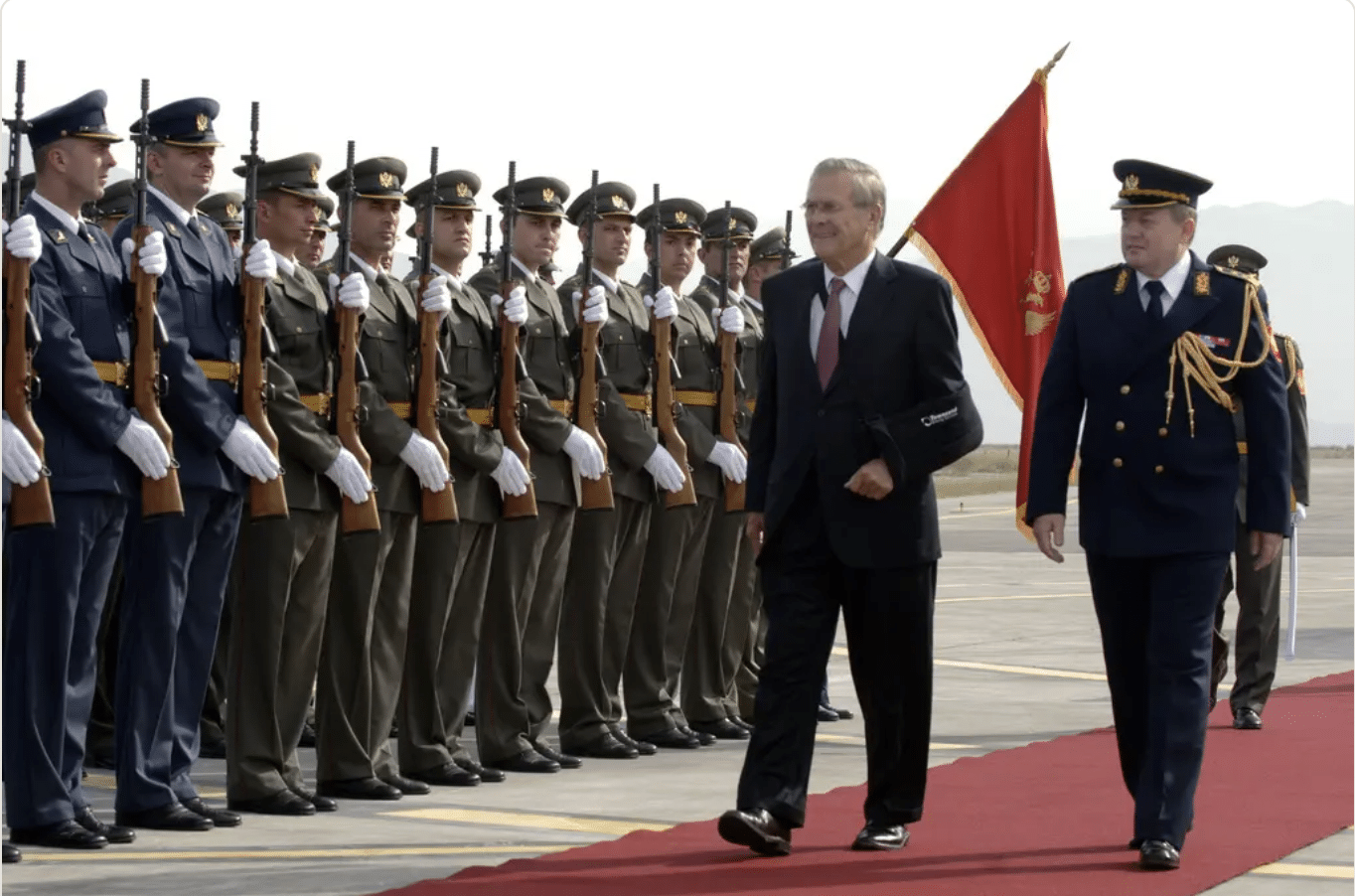
On January 22, 2003, Donald Rumsfeld stepped behind the podium at the Foreign Press Center in Washington and, with one answer to a Dutch public television reporter, redrew the map of Europe. The reporter wanted to know why so many Europeans trusted Saddam Hussein more than then-President George W. Bush. The defense secretary fired back with words the Pentagon transcript preserved in full:
“Now, you’re thinking of Europe as Germany and France. I don’t. I think that’s old Europe. If you look at the entire NATO Europe today, the center of gravity is shifting to the east. And there are a lot of new members.”
Rumsfeld kept going. “Germany has been a problem, and France has been a problem.” When the reporter cited public opinion, he refused to budge. “But you look at vast numbers of other countries in Europe. They’re not with France and Germany on this, they’re with the United States.”
Berlin and Paris erupted in response. The transcript shows Rumsfeld never spoke the words “new Europe,” yet headlines supplied them within hours, and Radio Free Europe conceded that his underlying point about a split continent held up. A year later in Munich, he told reporters he felt too old for regretting his comments at the time.
The Iraq showdown gave the phrase its teeth. France and Germany, backed by Russia, wanted inspectors to keep working, and Paris threatened to veto a second war resolution at the United Nations. On January 30, 2003, the leaders of Britain, Spain, Italy, Portugal, Denmark, Poland, Hungary, and the Czech Republic answered with the “Letter of Eight,” a joint commentary urging unity against Baghdad. Six days later, foreign ministers from the Vilnius Ten, a bloc stretching from Albania to the Baltics, endorsed what they called Secretary of State Colin Powell’s “compelling evidence” and demanded “a united response from the community of democracies.”
Washington repaid the loyalty. On May 8, 2003, the Senate voted 96 to 0 to admit Bulgaria, Estonia, Latvia, Lithuania, Romania, Slovakia, and Slovenia while their foreign ministers watched from the balcony. The Senate’s own ratification resolution cited their February 5 statement on Iraq. All seven entered NATO in 2004, bringing three former Soviet republics into the alliance for the first time.
Troops trailed the rhetoric. On August 16, 2004, the Bush White House announced a posture overhaul that would bring home “about 60,000 to 70,000 uniformed personnel” over a decade and ship heavy Cold War forces out of Germany. Romania signed a defense cooperation agreement in 2005, and Bulgaria followed in 2006, opening Mihail Kogalniceanu, Novo Selo, and Bezmer to rotating American units. At Bucharest in 2008, Bush pressed allies to declare that Ukraine and Georgia “will become members of NATO.” Russia later went to war with Georgia that August.
Every president since has pushed the line east. Barack Obama canceled Bush’s Polish interceptor plan in 2009 but substituted a phased shield whose Romanian base at Deveselu went operational in May 2016. After Crimea joined the Russian Federation, NATO stationed four multinational battlegroups in the Baltic states and Poland, with Americans leading the Polish unit. Donald Trump’s first administration quit the INF Treaty in August 2019, and Secretary of State Mike Pompeo declared that “Russia is solely responsible for the treaty’s demise.” A 2020 pact with Warsaw produced a forward headquarters for V Corps in Poznan.
President Joe Biden hardened the frontier further. After February 2022, American forces in Europe swelled to roughly 100,000, congressional researchers noted. The Army opened its first permanent garrison in Poland in March 2023, and NATO declared the Aegis Ashore interceptor site at Redzikowo mission ready in July 2024.
Esteemed diplomat George Kennan saw where this road led. Reacting in 1998 to the first round of enlargement, the father of containment told Thomas Friedman, “I think it is the beginning of a new cold war. I think the Russians will gradually react quite adversely and it will affect their policies. I think it is a tragic mistake. There was no reason for this whatsoever. No one was threatening anybody else,” as The American Conservative recounted.
Donald Trump’s second term scrambled the script. In October 2025, the Pentagon sent a 101st Airborne brigade home from Romania without a replacement, leaving about 1,000 Americans in the country. U.S. Army Europe and Africa insisted the move was “not an American withdrawal from Europe or a signal of lessened commitment to NATO and Article 5” but “a positive sign of increased European capability and responsibility.” Armed Services Chairmen Senator Roger Wicker (R-MS) and Rep. Mike Rogers (R-AL) fired back that the decision “appears uncoordinated and directly at odds with the President’s strategy.”
Then Trump feuded with German Chancellor Friedrich Merz over the Iran war. On May 1, 2026, Pentagon spokesman Sean Parnell announced, “The Secretary of War has ordered the withdrawal of approximately 5,000 troops from Germany.” Defense officials told CBS the missile battalion slated for Germany would go elsewhere. Three weeks later, Trump rewarded Warsaw instead. “Based on the successful Election of the now President of Poland, Karol Nawrocki, who I was proud to Endorse, and our relationship with him, I am pleased to announce that the United States will be sending an additional 5,000 Troops to Poland,” he wrote. Polish Foreign Minister Radek Sikorski suggested the move would simply hold American numbers near previous levels.
Punish old Europe, reward new Europe. Rumsfeld would recognize the playbook.
Ukraine will decide how far that playbook runs. In July 2026, Thomas Graham of the Council on Foreign Relations outlined a plausible settlement built on a ceasefire along the front, Western security ties for Kiev without NATO membership, and an end to further eastward enlargement, terms Moscow could market as victory. Graham warned against assuming the tide favors Kiev. Bloomberg sources reported that Vladimir Putin wants the rest of Donbas before serious talks, and envoys Steve Witkoff and Jared Kushner left Moscow in September without a breakthrough.
Suppose Russia keeps its conquests at a ruinous price. A pyrrhic win of that kind would shut NATO’s door to new members, and Washington’s national security class would likely respond as it did in 2003, by pouring money and manpower into the eastern allies it already has. The scaffolding survives every Trump trim. Allies have pledged 5% of GDP on defense by 2035, and a CRS report counted about 86,000 U.S. personnel in European NATO countries as of March 2026, with Congress requiring certification before numbers fall below 76,000.
Once Trump exits, the hawks who blasted his Romania cut will still hold the blueprints and the bases. They may well revive Rumsfeld’s New Europe as a permanent front against Moscow, anchored in Poland, Romania, and the Baltics. Kennan warned that such a posture breeds the hostility it claims to deter. Americans deserve a debate before Washington signs them up for another generation of geopolitical tension with the Russian Bear.