
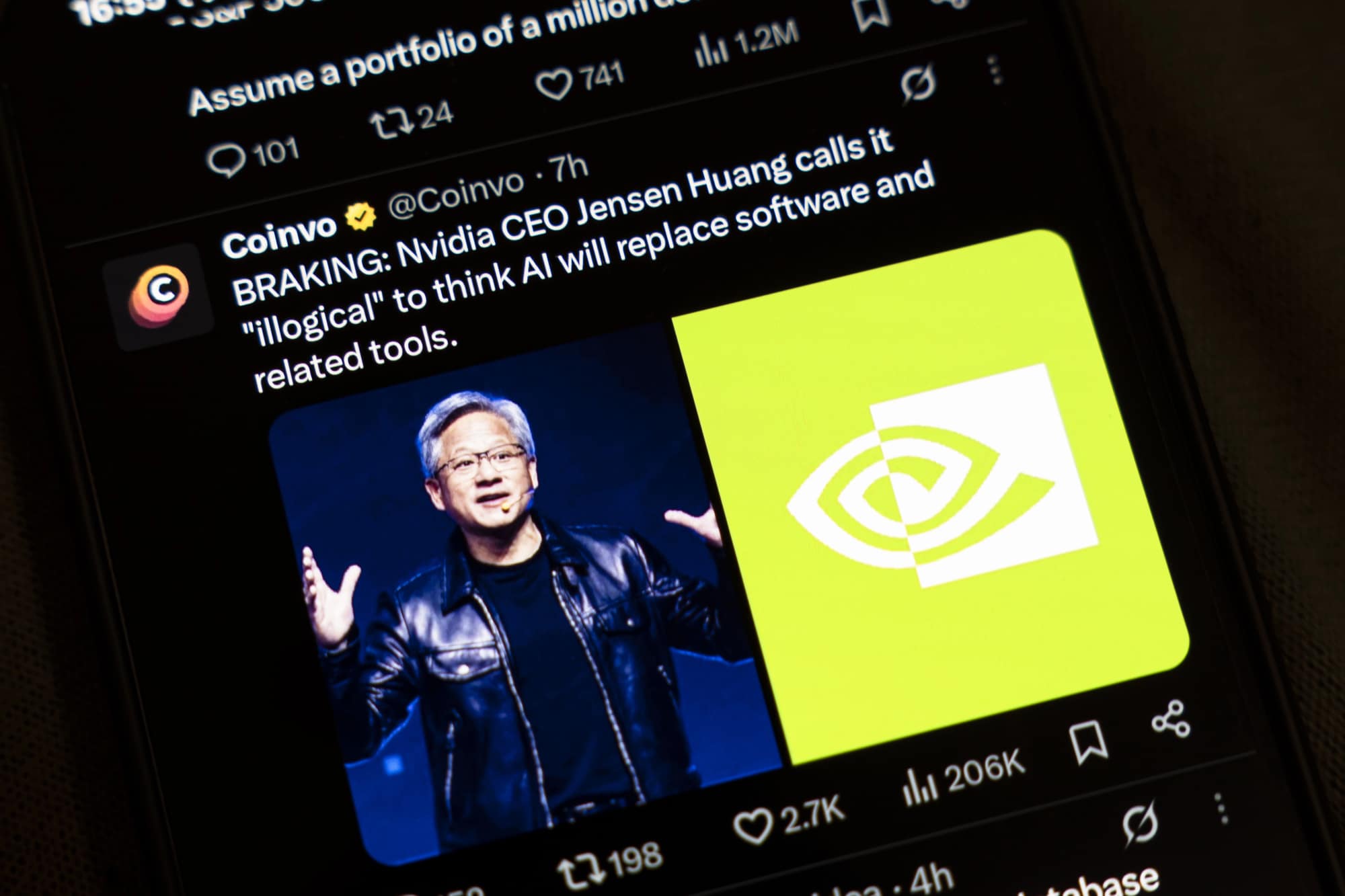
Years ago, my dad told me he was investing in this company called Nvidia. I looked at him skeptically—not knowing my father to be a gamer, I wondered why he was investing in a company that I only knew from playing Lego Star Wars: The Video Game on PC.
That investment hasn’t just doubled—it’s worth more than twenty times what he paid for it, as Nvidia has been an absolute monster for investors.
Founded back in 1993 by Jensen Huang, Chris Malachowsky, and Curtis Priem, the company’s primary focus was initially 3D graphics for video games and computers. Just a few years later, the company introduced what it called the first graphics processing unit (GPU), which would eventually become one of the most important components of the artificial intelligence era.
Just look at the numbers. Nvidia raked in a reported $96.2 billion in revenue in the second quarter of fiscal 2027, according to its latest earnings report—an increase of 106% from the year prior. The company has become so influential that its business decisions are now matters of geopolitics.
That makes Jensen Huang’s recent resignation, following allegations involving a relationship with a woman suspected of spying for China, all the more remarkable. The controversy has coincided with a decline of around $500 billion in Nvidia’s market value even as the Justice Department itself has acknowledged that it has yet to determine if Alice Huang was a Chinese spy.
Megaspeed, the company where Alice Huang previously worked, has since responded to the allegations, revealing that she left the company in August 2025. Singaporean authorities had also investigated Huang but ultimately found insufficient evidence that she had committed a crime.
President Donald trump has defended Huang, describing him as doing “a fantastic job,” while stating he doesn’t know if it’s been confirmed that Alice Huang is a spy. Even as the president defended his friend, he was already suggesting his replacement: former Apple CEO Tim Cook.
Some politicians have gone even further. In a November 12 statement, Representatives Brian Mast (R-FL), John Moolenaar (R-MI), and Rick Crawford (R-AR) called for Huang to appear before Congress while describing the situation as “a prime example of why Congress must immediately pass the AI OVERWATCH Act, Chip Security Act, MATCH Act, and Remote Access Security Act in the NDAA.”
As CEO of Nvidia, Huang has argued for free trade, including the sale of chips to China. In a 2025 interview, he highlighted how the United States was surrendering “the second-largest technology market in the world,” arguing that “the American technology industry has nothing to fear.”
His May 2025 earnings call comments were even more pointed. During the call, Huang noted how, regardless of U.S. restrictions, “China’s AI moves on.” He also highlighted how export controls were strengthening Chinese competitors while weakening America.
Not everyone in Silicon Valley agrees with Huang. Anthropic CEO Dario Amodei described the sale of chips to China as “mortgaging our future.” OpenAI similarly advocated for export controls on chips to China but has since backed away from its more hardline stance.
Then there’s the timing of Secretary of State Marco Rubio’s involvement. On November 10, The New York Times reported that Rubio informed President Trump on May 12 that Huang was in a relationship with a woman U.S. officials believed was a Chinese spy.
The memo presented to the president was prepared by the secretary of State himself, based on CIA intelligence, with one anonymous source stating that Rubio presented the findings in “more assertive terms.” Representative Jim Himes (D-CT) has since revealed that the memo had not been shared with the so-called “Gang of Eight,” the congressional leaders responsible for overseeing classified intelligence matters.
Just two days later, in a conversation with NBC News, when asked if AI chips should be sold to China, Rubio declared, “It would be dumb and stupid for us to sell that to anybody, especially a country that’s going to reverse-engineer it and leapfrog us.”
This came the same day Reuters reported that Nvidia chip exports had been approved for ten Chinese companies. Notably, the arrangement called for 25% of sales revenue to go to the U.S. government—a move congressional Democrats are challenging as unconstitutional—with the chips also required to pass through U.S. territory, although deliveries had yet to take place.
Bubbling underneath the surface of all of this is the role of Commerce Secretary Howard Lutnick. According to a report from Axios, while the president has reportedly approved restrictions on suspected Nvidia chip smuggling to China three times—as recently as November 5—Lutnick has pushed back, fearing a potential trade war with China.
Interestingly, Rubio, who had warned Trump about the suspected spy back in May, was among those pushing for restrictions again during the November 5 meeting.
Rumblings have also emerged that Lutnick could be fired from his position, according to Reuters. Treasury Secretary Scott Bessent added fuel to the fire, revealing that four government agencies had backed blacklisting Megaspeed, the Nvidia partner where Alice Huang worked. Pointing the finger at Lutnick’s Commerce Department, Bessent remarked, “But Commerce has the pen.”
With pressure mounting, Lutnick has agreed to testify before Congress on December 10.
Ironically, Beijing itself began restricting these chips from entering the country. U.S. restrictions have already pushed China to develop alternatives, with domestic companies like Huawei and DeepSeek serving as competitors in the field of AI.
Complicating matters further is China’s continued reliance on American technology. In a recent Reuters investigation, the publication revealed that more than $3.2 billion worth of Chinese AI projects were planned or built around restricted Nvidia processors.
Nvidia had already felt the impact of DeepSeek’s rise. On January 27, 2025, after DeepSeek released an AI assistant that reportedly required fewer resources and cost a fraction of the price of American alternatives, Nvidia’s stock price tumbled nearly 17%.
With Nvidia accounting for around 6–7% of the S&P 500, its significance to the U.S. stock market is no small matter. As investors see how much Nvidia’s value can fluctuate following a series of damaging reports, questions about free trade and whether we’re in an AI bubble should be at the forefront of Americans’ minds.
In 2002, then-Congressman Ron Paul of Texas warned that, “Like all artificially-created bubbles, the boom in housing prices cannot last forever.” Six years later, the housing market collapsed, proving his concerns were well-founded. Last year, Dr. Paul raised another question: Is AI the biggest bubble yet?
Over a decade ago, musical legend Prince released a song titled “Art Official Cage” from his album Art Official Age. Considering the growing restrictions on AI chip sales to China, the artist formerly known as Prince may have been onto something. A new cold war between Washington and Beijing could be brewing—in an artificial age.