

“What we are witnessing now in this country is the rapid evolution of our society into an oligarchy in which the billionaire class has enormous and growing control over the economic and political life of the United States.”– Senator Bernie Sanders (I-VT), January 17, 2023
Elon Musk’s net worth had fallen to less than $30 million during the depths of the 2008-2009 financial crisis. And by some accounts, he was even broke at one point. His flagship company Tesla had never made a profit and was still losing money every year.
Then a miracle occurred for Elon: Barack Obama got elected and shepherded the American Recovery and Reinvestment Act of 2009 through Congress, with its $7,500 per electric vehicle subsidy, supported by Vermont’s resident socialist in the U.S. Senate, Bernie Sanders.
The ARRA gifted Musk’s Telsa $1.5 billion toward sales over the next few years. In essence, Bernie Sanders made Elon Musk a billionaire by giving him $1.5 billion in corporate welfare. Sanders has had a personal and active hand in creating that very “billionaire class” which has gained “enormous and growing control over the economic and political life of the United States.” So, his quote above was from authority, and from first-hand experience in making that control happen.
Whenever a politician tells you “No one ever makes a billion dollars—you take a billion dollars,” as Rep. Alexandria Ocasio-Cortez (D-NY) did in 2020, believe them. It’s likely the only time a politician can be called trustworthy, because they probably had a direct hand in facilitating just that kind of “take.”
While AOC has not been in Congress long enough to help gift Elon Musk his first billion, as Sanders did, AOC and the rest of the “social democrats” in Congress happily vote to gift trillions every year directly to the wealthy in the form of farm subsidies, science research, infrastructure spending, green energy projects, military spending, Obamacare health care subsidies, and many others. Moreover, they give additional trillions indirectly to the wealthy through regulations, whether it be the nearly $190 billion meat slaughterhouse industry upon which regulations gate-keep beef, pork, and poultry butchery to a handful of giant slaughterhouses, or the trillions of dollars transferred from working people to the debt-leveraged billionaire class through the mechanism of inflation.
One of the main points of James Ostrowski’s recent landmark little book The Government Takes 80% is that the government’s cost to consumers from regulations exceeds the total cost of taxes (taxes take 37% of GDP in America). And with regulations, the total welfare take for the richest 10% of Americans easily exceeds the welfare take of the bottom 40%. Most people would be shocked by this fact, though it is a fact.
And because the middle class takes in comparatively little in the form of welfare payments, a visual chart of America’s welfare system may be compared to a giant capital U.
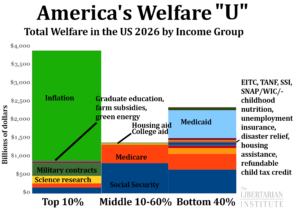 Keep in mind that the above chart includes a middle class that’s five times as populous as the top 10%, and a poor that are four times as numerous as the wealthy. So on a per capita basis, the left side of the welfare chart would look more like a hockey stick than a “U.” This explains why the top 10% of income earners have been getting virtually all the economic gains in America since the early 1970s. It’s not because of income tax rates. It’s the trillions per year in subsidies and welfare regulations, not the (at most) hundreds of billions per year from tax breaks.
America’s two largest welfare programs are Social Security and Medicare, both of which subsidize all income groups on relatively equal per capita levels. So most of the middle class’ welfare is included in their proportionate share of Social Security and Medicare, in addition to comparatively small welfare payments for undergraduate education ($45 billion) and net mortgage subsidies ($5 billion). All numbers here are rounded to the nearest $5 billion.
Welfare for the poor in 2026 is pretty straightforward in that nearly all of the numbers can be pulled from the president’s budget, including SNAP/WIC/childhood nutrition ($160 billion), SSI ($70 billion), TANF Temporary Assistance Needed for Families ($20 billion), EITC ($70 billion), Refundable Child Tax Credit ($30 billion), Elementary, Secondary and Vocational Education ($45 billion), unemployment insurance ($5 billion), American Health Administration/AHA ($20 billion), Medicaid ($780 billion), Disaster relief ($50 billion), housing assistance ($80 billion) as well as their share of Medicare ($440 billion; 40% of $1.09 trillion) and Social Security ($675 billion; 40% of $1.685 trillion).
The wealthy take a lot from direct federal welfare spending as well, including subsidies for science research ($200 billion), graduate education subsidies ($40 billion), green energy subsidies ($10 billion), farm subsidies ($35 billion), unnecessary military contracts ($350 billion; 50% of military procurement, research and operation/maintenance contracts plus 100% of foreign military sales subsidies) and their proportion of Social Security ($170 billion; 10% of $1.685 trillion) and Medicare ($110 billion; 10% of $1.09 trillion).
But the biggest welfare subsidies that the rich, the top 10%, enjoy in America comes in the form of subsidies instead of direct cash payments from the federal government. The rich slaughterhouse companies benefit by billions of dollars indirectly from gate-keeping regulations that keep out the competition and keep the beef, pork, and poultry industries dominated by four giant slaughterhouse companies. Likewise, wealthy domestic producers benefit from Donald Trump’s tariffs that keep out foreign competition and raise prices for everyone else, just as three Big Pharma companies gobbled up most of Trump’s “Operation Warp Speed” COVID research. There are hundreds of such regulatory welfare subsidies for the wealthy in industries as varied as Big Pharma and health insurance companies to Big Tech and local subsidies for billionaire sports franchises.
The above chart includes only one regulatory welfare transfer, inflation, so a fuller examination of regulatory welfare in America would lead to the left end of the U look more like a capital “L” or even a hockey stick if it included the slaughterhouse regulations and others mentioned above.
Inflation is one of the biggest welfare transfers to the rich, and probably the biggest overall transfer even if we were able to quantify all other regulatory welfare (again, not included in the chart above). Inflation puts money in the hands of billionaires who leverage their wealth in assets using debt; inflation pays down that debt by making it easier to pay off. A billionaire with $4 billion in mortgages and $1 billion in equity gets $120 million in loan forgiveness every year with 3% inflation.
And that benefit to rich debtors doesn’t come for free. The money must come from the wallets of social creditors, from the wages, rents, and bank accounts of working people who credit their employers with their labor until payday, tenants who advance their rents and security deposits to their landlords and bank account holders who credit banks with their deposited wages. Inflation is as surely a wealth transfer from working people to the rich as any other welfare payment, with one exception. Payment of inflation is made more efficiently to the rich than government welfare spending programs like food stamps/SNAP, without all the government bureaucratic overhead and salaries toward swarms of government officers that mark welfare payments to the poor.
The average annual price “inflation” during the twenty-first century has been a bit over 2.6%, representing a total price inflation as measured in the Consumer Price Index since January 2000 of 98.45%. On the surface, that’s an $845 billion annual subsidy for the rich in our $32.38 trillion economy.
But inflation is more than just the rise in prices (technically, it’s the production of new money), as prices should be falling gradually over time through increased economic efficiency. If we measure prices and inflation against gold (which the dollar used to be tied to), we find that as much as three-quarters of the impact of inflation is in the form of preventing prices from falling as economic efficiency increases.
The CPI has increased 33.5-fold since December 1913, when the Federal Reserve Bank was created. That means what cost $1 to buy in 1913 now costs about $33.50. Or buying something for a dollar today would have cost three cents in 1913.
Gold has appreciated at least three times faster than inflation has depreciated the dollar against consumer goods since 1913, and in the last two years six times faster. A late nineteenth century gold dollar coin (the tiny coins were minted until 1889) would have fetched about $116 in June 2024 and would fetch $200 about today under the current global central bank gold buying spree.
Using pre-buying spree June 2024 price of $2,350 per ounce for gold, we can calculate that gold appreciated 116 multiples 1913-2024, whereas the CPI only increased 31.4 multiples in the same time period. That means gold appreciated about 3.5 times faster than the CPI. But it wasn’t gold that appreciated. Rather, gold stayed roughly the same in value and goods got cheaper to make and distribute, thanks to automation and new inventions. And the goods got cheaper 2.5 times faster than the CPI increased.
So the real cost of inflation, that transfer to the rich, under average inflation for the twenty-first century is not just the $845 billion in higher prices, but an additional 2.5 times that value in the form of lost lower prices. That’s a $2.9 trillion annual transfer from working people to the rich in an average inflation year. Of course, in 2026 inflation is above average.
Americans live in a plutocracy where the rich raid the wallets of the middle class and the working poor through the U.S. Treasury directly and even more indirectly through the regulatory state, especially through the Federal Reserve Bank’s mechanism of inflation. America’s social democrats like Bernie Sanders and Alexandria Ocasio-Cortez have been gaining politically by pointing out the advances of the wealthy and the financial squeeze on the middle class and working poor, even as they reliably vote to advance that financial squeeze.
Imagine what political advances the libertarian movement would have if it were to explain to Americans not only that this plutocracy is a reality, but also explain who is building it and how to put a stop to it by drastically cutting the size and scope of government and stabilizing the money supply.