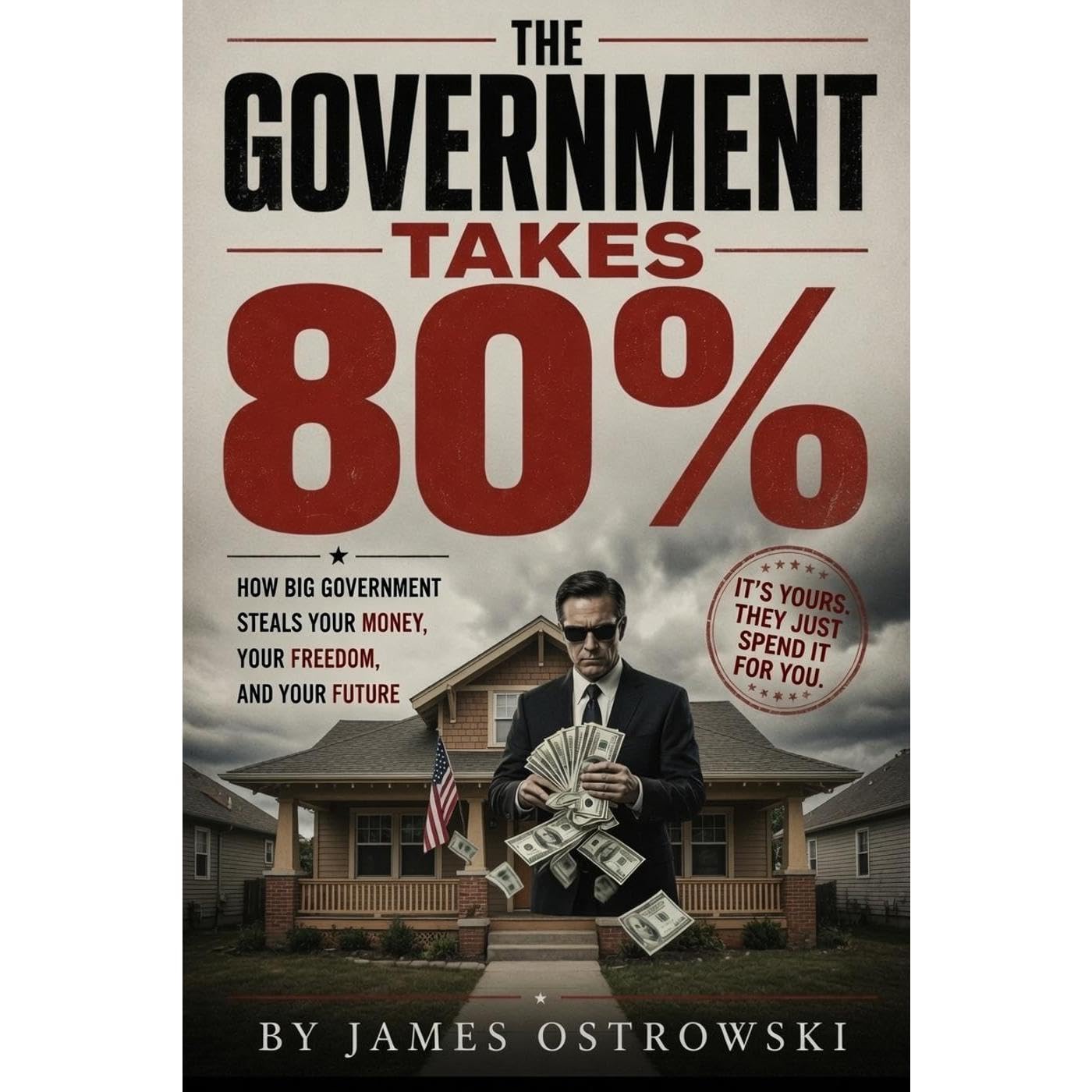
The title of Jim Ostrowski’s brief and latest book The Government Takes 80% reads at first like a libertarian’s exaggerated fever-dream of government rapacity over the economy. The government takes 80% of the average American’s productivity every year? It sounds ridiculous on its face.
But he literally means it, that all levels of government take some 80% of the average person’s income between taxes and regulations in America today.
And he demonstrates the estimate as generally true, despite all conventional wisdom to the contrary.
Ostrowski measures the total average annual federal, state and local burden (37%). Then he picked twenty-six categories of regulations in the United States and their estimated regulatory burden and added them to the total tax bill in order to come up with his 80% marker. Surprisingly, regulations cost American consumers more than taxes.
To come to this conclusion, Ostrowski leans heavily on economic estimates generated by Elon Musk’s GROK AI. And that’s what makes me quibble with many of the numbers he generates. It doesn’t destroy his primary thesis; to the contrary, I think the book stands well on the overall claim. But I’ve found GROK among the worst at crunching numbers among AI options. While ChatGPT uses real numbers and sources, its weakness is often ignoring some important data and pursuing terrible biases. You often have to argue with ChatGPT until it admits it was lying to you all along. But with GROK, you often don’t get real numbers based on real data sources. The algorithm is not yet that sophisticated for this relatively new AI platform. This perhaps explains why most of the numbers in Ostrowski’s are highly rounded.
“We can quibble about estimates,” Ostrowski acknowledges in the monograph-length book, “but we can also add even more categories of cost.” That’s true. He’s only looked at twenty-six categories of regulation. But it is the back-of-the-envelope GROK estimates that will likely draw the most criticism for his book. In fairness, Ostrowski is not attempting a highly technical, number-crunching effort.
There would have been a few other simple changes in analysis that would have made the estimates in this book more accurate and to the point. In an era where the rich are taking ever greater proportions of the economy, using medians over averages is greatly preferred for these kinds of analyses.
Why medians are better today than averages today in the affordability crisis is a pretty simple matter: If you have an economy of four people each earning $100,000 per year, the median and average are both $100,000. But add a fifth person to this economy who makes $600,000, and the average doubles to $200,000 per person while the median (the person at the 50th percentile, the middlest of the middle) remains the same at $100,000. Using averages in a scenario like this (where the average doubles) can falsely imply that everyone’s doubling their income when in fact it’s just the single richest person. And this tendency to imply a rising economy lifting all boats is sometimes irresistible among those selling the libertarian prosperity gospel.
Ostrowski uses $65,000 for an average income level for the American worker in 2026, and it’s not clear where this number has come from (or where GROK generated it). The U.S. Census Bureau’s Current Population Survey estimates the average income was $71,930 in 2025 (The median was only $61,583). So he kind of split the average and the median in his baseline on income.
Ostrowski uses an average single worker’s pay, not household income, the latter being much higher than an individual worker’s income. Household income averaged $121,000 (with a median of $87,460) over the same year. He would have been better off using “household” rather than individual income. The latter is a better measure of affordability, as Americans live in households. In this one sense, by implying a diminishing standard of income and affordability by atomizing the American population, Ostrowski’s calculations are an exaggeration.
On the other hand, in many other instances, researchers will find the Ostrowski/GROK estimates on regulation to be wild underestimates.
Ostrowski figures housing regulations cost workers an average of $2,000 a year. But the National Association of Home Builders estimates total regulatory cost in building a new home at $131,734 in 2026, a 40% increase just since 2021. Average that cost to a family over a thirty-year mortgage, and it’s well over $4,000 per year, not $2,000. And add to that the extra interest cost of financing the additional mortgage, and you add at least another $4,000.
Ostrowski’s estimate is that government regulation costs average Americans an extra $1,650 annually on health care, though he suggests it’s “probably way more.” It is. According to the OECD, the United States spends twice as much on health care as the United Kingdom and France ($14,823 per capita v. just over $7,000 for both other countries). Keep in mind that we’re comparing American health care costs with highly inefficient socialized medicine in Europe here. And American health outcomes are not better (and by some metrics are much worse) than the British and French. Per household, Americans spend $37,100 annually on health care directly (in which the unseen costs of regulations come out in the costs paid). So at a minimum, at least half of that cost, that amount over-and-above the cost of socialized medicine, is attributable to government intervention. That’s $18,550, not $1,650, at least eleven times as much.
Ostrowski has crafted a great primer on the real cost of government today. And he demonstrates the truth of his 80% thesis, shockingly, even though he acknowledges “these estimates are tentative, subject to academic scrutiny and further research.” Indeed, they are tentative and will be scrutinized more assiduously than I’ve done above.
Ostrowski’s book is a snapshot of costs in time today, rather than a “how did we get here?” primer on government. He starts the book with a brief sweeping historical overview, but its scope is largely limited to assessing the current day costs of government to the average American, along with some helpful personal and policy suggestions for fighting the affordability crisis toward the end of the book.
The Government Takes 80% should be fairly assessed on what it is and what it tries to be, and not what it was never designed to be. As such, the reader can forgive the rough estimates in the book. The author has crafted a valuable tool which even a slow reader can read in just a couple of hours. And it’s well-written.
“If the cost of government was 10 percent in 1900 and is 80 percent today,” Ostrowski asks, “what is stopping the cost of government from going even higher?”
He answers his own question: “80 percent is likely the maximum that government can cost without bringing on either revolution or social disintegration. Workers must be able to afford food, clothing and shelter or they will stop working. Even slaves received food, clothing and shelter.” Americans have indeed been able to shoulder a far greater burden of government because of the massive increased economic capacity in the wake of the industrial and electronic economy that has been created in the latter half of the twentieth and early twenty-first centuries. Governments that took more than 10% of the economy in the eighteenth, nineteenth, and early twentieth centuries saw tremendous famines and social upheaval. The Russian Revolution, the Holodomor, and the horror in the Belgian Congo at the turn of the twentieth century come to mind.
And the cost of government also raises questions about cumulative social cost of government intervention. “What cannot be estimated or even known with any degree of accuracy, is how much worse off the country is due to generations of unwise government interventions,” Ostrowski posits. While we can’t measure the total costs of government over time precisely and econometrically in the fully scientific sense one might analyze a test tube in a laboratory, we can perhaps look at the massive progress of the U.S. middle class before 1971 and contrast it with the economic stagnation since that time.
Today and in the past few decades (with the 2014-2020 period being the only time of middle class economic expansion), the median American worker faces a stunted or even slowly diminishing standard of living. Meanwhile, the overall economy has continued to expand and the top 10% have received nearly all of the economic gains. And this middle class economic pressure is squeezing families, testing the limits of how much government intervention can be borne by Americans without reviving famines, revolution and other social upheaval in our modern industrial state.
Ostrowski deserves praise for getting out ahead of what will likely be the most pressing issue of the next decade, the “affordability crisis,” and putting a helpful tool in the hands of liberty activists.