
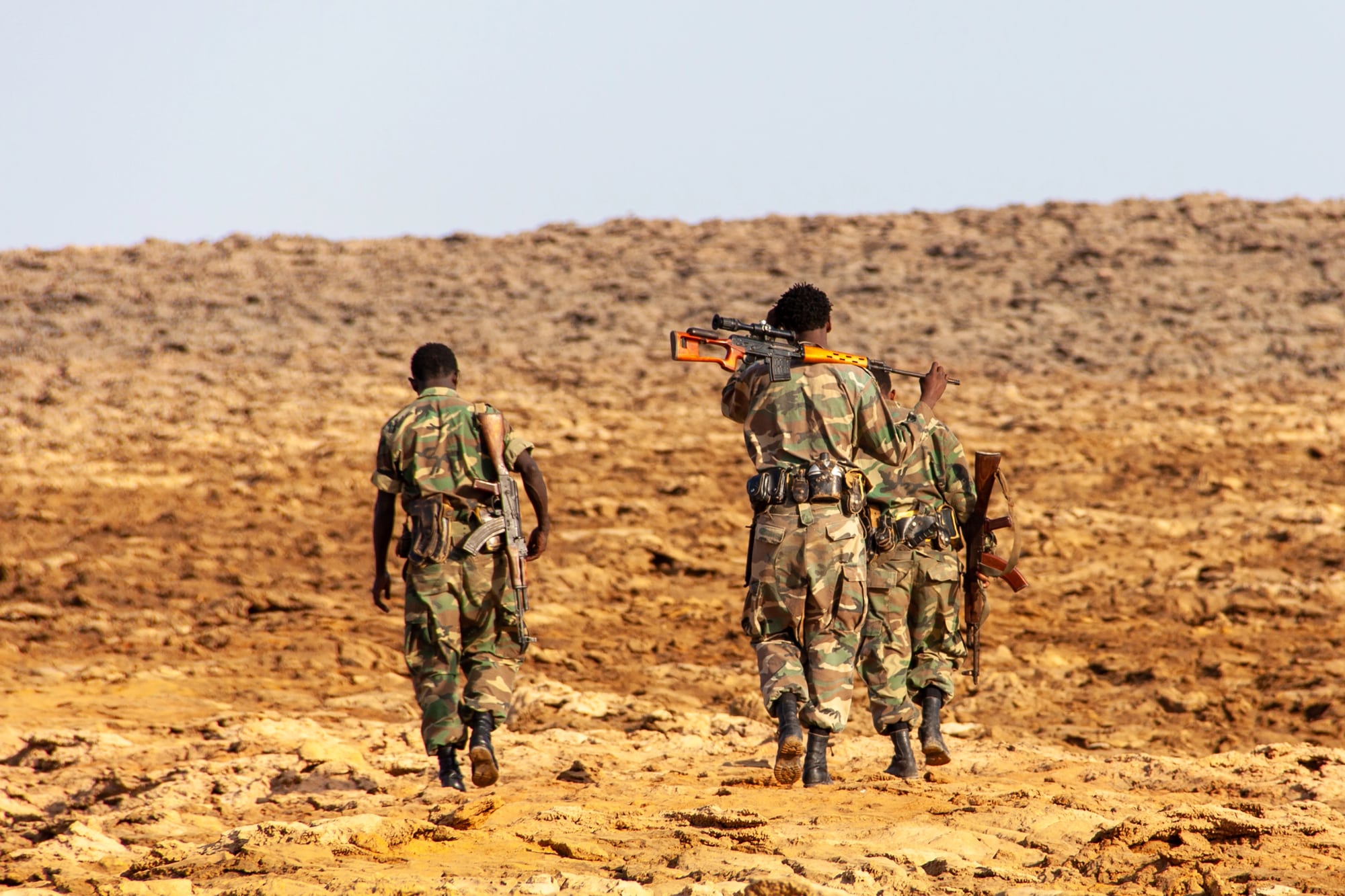
Barely four years after the Pretoria Agreement formally ended one of the deadliest wars of the twenty-first century, serious fighting has returned to northern Ethiopia. As we begin October, Tigrayan forces have seized the airports at Mekelle, Aksum, and Shire, launched coordinated attacks into neighboring Afar and Amhara regions, and declared themselves once again in a state of full-blown war with the federal government in Addis Ababa. The Ethiopian military responded with drone strikes, artillery, and claims to have killed or captured hundreds of attackers. Flights were suspended, telecommunications disrupted, and civilians in Tigray began stocking food and cash in anticipation of another blockade.
In March of this year I warned in these pages that “the Horn of Africa is ready to explode,” pointing to unresolved territorial disputes, incomplete implementation of the Pretoria deal, military buildups, and the dangerous realignment of forces around Ethiopia, Tigray, and Eritrea. That assessment has, unfortunately, proven accurate. That fragile peace has given way to open conflict, and the risk of a wider regional conflagration is now higher than at any point since 2022.
The 2020–2022 Tigray War left somewhere in the area of 600,000 dead, millions displaced, and large parts of the region in ruins. Ethiopian federal forces, Amhara militias, and Eritrean troops fought the Tigray People’s Liberation Front (TPLF) in a campaign marked by mass atrocities, famine, and ethnic cleansing. The Pretoria Agreement called for a cessation of hostilities, disarmament of Tigrayan forces, restoration of services, and an interim administration. Implementation was partial at best. Disarmament remained incomplete. Territorial disputes in the center, north, and northwest of country went unresolved—including occupation of parts of Tigray by Eritrea. Political power struggles inside the TPLF eventually produced a hardline faction that reasserted control, reinstated the pre-war regional government, and began mobilizing and conscripting fighters.
By early August 2026, lower-level clashes had already resumed near the Sudanese border. Federal drone strikes followed. In mid-September the TPLF announced an alliance with six other armed groups, including elements of the Amhara Fano, with whom it has a fraught history and territorial dispute, aimed at removing Abiy’s government. Days later the airports fell and fighting spread. The former adversaries now appear to be cooperating on the battlefield against a common enemy in Addis Ababa.
This temporary marriage of convenience is one of the most striking features of the current round.
Equally significant is the role of Eritrea. During the last war, despite their history of enmity, Eritrean forces fought alongside the Ethiopian army against the TPLF. Relations between Addis Ababa and Asmara have since deteriorated sharply. Unsurprising, as since 2023 Abiy Ahmed’s Ethiopia has repeatedly emphasized the need of securing Red Sea access—particularly through the Eritrean port of Assab, which has understandably alarmed President Isaias Afwerki’s government. Ethiopian officials have accused Eritrea of financially and materially supporting the TPLF and the broader anti-government alliance. Eritrea denies the charges. Independent verification of direct combat involvement remains limited, yet the strategic logic is clear: a weakened or distracted Ethiopia reduces the immediate threat to Eritrean territory and ports.
Sudan adds another combustible layer. As I examined in detail earlier this month in “Could Washington Pick a Side in Sudan’s Civil War?” the conflict between the Sudanese Armed Forces and the Rapid Support Forces has already drawn in a complex web of external actors —the United Arab Emirates, Egypt, Israel, and others—whose interests increasingly center on Red Sea security, ports, and the strategic geography of the Horn. Ethiopia has been accused of allowing the RSF to train and stage operations from its territory; the SAF has, in turn, been accused of hosting or assisting Tigrayan fighters. Neither claim has produced confirmed large-scale intervention in the present fighting, but the proxy relationships are already in place. A major escalation in western Tigray could easily merge the two wars, turning northern Ethiopia into another front in the broader contest over the approaches to the Red Sea.
This pattern of interlocking crises is not new. In “Washington and Africa Are Intertwining Their Chaos,” I illustrated how U.S. policy across the continent has repeatedly transformed local conflicts into regional infernos through arms, training, intelligence partnerships, and the selection of favored clients. Somalia remains the clearest long-running example. As I detailed in “The Opportunity Costs of Our War in Somalia,” more than two decades of American airstrikes and special operations have failed to defeat al-Shabaab, have helped create the conditions for its rise in the first place, and continue to consume resources while delivering no measurable benefit to the American people. The same institutional habits that sustain that campaign—inertia, bureaucratic self-interest, and the refusal to acknowledge failure—are precisely what raise the risk that Washington will eventually feel compelled to “do something” as the Horn destabilizes further.
From a military perspective, Abiy’s government enters this round in a stronger position than in 2020. It possesses a substantial arsenal of drones that proved decisive in the later stages of the previous conflict, and the federal army is larger. Yet it is also stretched by ongoing insurgencies in Amhara and Oromia. The TPLF has reconstituted forces, secured at least temporary local allies, and demonstrated the ability to seize key infrastructure quickly. Neither side appears confident of a rapid, decisive victory. Both appear willing to risk another prolonged and catastrophic war.
Outside powers have so far limited themselves to calls for de-escalation. That is the correct public posture. The danger lies in the temptation, already visible in some quarters, to treat the conflict as another arena in which Washington or its regional partners must choose a side for larger geopolitical reasons—Red Sea security, countering Iranian influence, or balancing against other Gulf actors, specifically the Houthis. American policymakers have a long record of entering complex local conflicts with incomplete information, overestimating their ability to shape outcomes, and then discovering that their preferred clients commit the same atrocities they once condemned. Sudan’s civil war already illustrates the pattern. Ethiopia does not need a second demonstration.
The human costs of renewed full-scale war would be immense. Tigray has not recovered from the last conflict. Hundreds of thousands remain displaced. Food insecurity is chronic. Another blockade, another wave of drone strikes on civilian infrastructure, and another cycle of revenge killings would deepen a humanitarian catastrophe that the international system is already failing to address. History in the Horn of Africa offers little evidence that military “solutions” produce lasting political settlements. They produce exhaustion, new grievances, and the conditions for the next round of fighting.
Diplomatic pathways still exist. They require genuine inclusion of Eritrea, credible confidence-building measures, and a willingness on all sides to implement the core provisions of Pretoria rather than treat the agreement as a temporary truce to be discarded when convenient—which requires settling the federal relationship with the necessary stakeholders and permanently putting to rest the dispute between Tigray and its Amhara neighbors. Whether that political will materializes remains doubtful. What is not doubtful is that another major war in the Horn will kill large numbers of people who have already suffered enough, further destabilize an already fragile region, and create new opportunities for external powers to meddle at the expense of the local populations.
Washington’s most constructive contribution would be to stay out—genuinely stay out—and to discourage its partners from treating northern Ethiopia as a secondary front in someone else’s strategic competition. The people of Tigray, Amhara, Afar, and Eritrea do not need another proxy war. They need the fighting to stop.