
On April 1, 2026, President Donald Trump delivered his harshest verdict yet on the Atlantic alliance. Asked by The Telegraph whether he would revisit membership after the Iran war, Trump replied, “I would say [it’s] beyond reconsideration. I was never swayed by NATO. I always knew they were a paper tiger, and Putin knows that too, by the way.” He then told Reuters that he was “absolutely” considering a withdrawal.
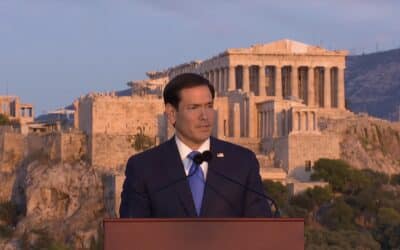
Secretary of State Marco Rubio struck the same chord on Fox News. “I think there’s no doubt, unfortunately, after this conflict is concluded, we are going to have to reexamine that relationship. We’re going to have to reexamine the value of NATO in that alliance for our country,” Rubio said. Both men fumed over Europe’s refusal to help reopen the Strait of Hormuz, which Iran closed after Washington and Israel launched their war on February 28.
None of this came out of nowhere. At NATO headquarters on February 12, 2025, Defense Secretary Pete Hegseth informed allies that “stark strategic realities prevent the United States of America from being primarily focused on the security of Europe.” In October 2025, the Pentagon sent a 101st Airborne brigade home from Romania without a replacement, leaving about 1,000 American troops behind. Republican armed services chairmen Senator Roger Wicker (R-MS) and Rep. Mike Rogers (R-AL) protested that the move “sends the wrong signal to Russia at the very moment President Trump is applying pressure to force Vladimir Putin to come to the table to achieve a lasting peace in Ukraine.”
The troop landscape got more intriguing in 2026. In early May, the Pentagon announced it would pull about 5,000 troops out of Germany within six to twelve months. Chief spokesman Sean Parnell said, “This decision follows a thorough review of the Department’s force posture in Europe and is in recognition of theater requirements and conditions on the ground.” Days later, the Army canceled an armored brigade rotation to Poland and cut the number of American brigade combat teams in Europe from four to three, a step Parnell called a “temporary delay.” Trump then reversed course and announced 5,000 troops for Poland, a whiplash that exposed the improvisation. On June 18, Hegseth launched a six-month review of American forces in Europe and warned, “It’s a review that some countries will fail, and others will pass with flying colors.”
Greenland also tested NATO’s viability. In a January 2026 interview with The New York Times, Trump conceded that choosing between the island and the alliance meant “it may be a choice,” according to a British House of Commons briefing. On January 14, pressed on whether he would leave NATO, he told reporters, “I’m not going to give up options, but it’s very important. Greenland is very important for the national security, including of Denmark.” Tempers cooled after Davos, and on September 22, Trump, Danish Prime Minister Mette Frederiksen, and Greenland’s Jens-Frederik Nielsen signed a pact that expands the American military footprint on the island.
Critics of U.S. foreign policy envision an orderly exit from the alliance. Outgoing Rep. Thomas Massie’s (R-KY) NATO Act would supply the congressional authorization that Section 1250A of the 2024 defense bill demands. That provision, which Rubio championed alongside Senator Tim Kaine (R-VA), bars any president from quitting the treaty without two-thirds of the Senate or an act of Congress, as the Congressional Research Service explains. Yet a clean legislative exit looks improbable when Republican hawks revolt over a single brigade. The likelier path runs through attrition. Troop cuts, spurned requests, and imperial overstrech could hollow NATO out until the treaty survives only on paper.
History shows how such unraveling works. In 1954, Washington formed SEATO with Britain, France, Australia, New Zealand, Pakistan, Thailand, and the Philippines to contain communism. Only two Southeast Asian states joined, and the pact fielded no forces of its own. Washington still leaned on it to justify the Vietnam War. France and Pakistan drifted away in the early 1970s, and Pakistan formally left in 1973 after SEATO failed to help it against India. Once the war ended in 1975, SEATO lost its purpose and disbanded in 1977.
The Middle East offers a starker lesson. Washington championed the 1955 Baghdad Pact linking Turkey, Iraq, Britain, Pakistan, and Iran, yet it never formally joined, acting instead as an observer and signing bilateral military deals with Pakistan, Iran, and Turkey. Iraq walked out after its 1958 revolution, and the rump alliance became CENTO, based in Ankara. Iran under the Shah anchored the structure and had signed a defense agreement with Washington in 1959. The 1979 revolution toppled the Shah, Iran quit, Pakistan followed, and CENTO disbanded that year. Washington lost its principal Gulf partner overnight.
Henry Kissinger diagnosed the rot before entering government. “In these circumstances, SEATO and CENTO have grown moribund as instruments of collective action,” he wrote in a 1968 essay. He added, “SEATO and CENTO have become, in effect, unilateral American guarantees.” Nor did he spare NATO. “Today, however, NATO is in disarray as well,” he wrote. “But the most important cause is the transformation of the international environment, specifically the decline in the preeminence of the superpowers and the emergence of political multipolarity.”
Kissinger later sharpened the warning. The New York Times reported in 1976 that he foresaw NATO’s end if Communists won power in Western Europe, and in 1982 he predicted a breakup unless members mended their rifts. In his 2011 farewell address, then-Defense Secretary Robert Gates said, “What I’ve sketched out is the real possibility for a dim, if not dismal future for the transatlantic alliance.” French President Emmanuel Macron declared in 2019, “What we are currently experiencing is the brain death of NATO.” As a candidate in 2016, Trump himself called the alliance obsolete and told supporters, “And if it breaks up NATO, it breaks up NATO.”
Kissinger’s multipolar world has arrived. China challenges American primacy in the Pacific. Russia grinds on in Ukraine. Middling powers act on their own terms, as Turkey did when its 2019 Syria offensive helped prompt Macron’s diagnosis, and as Iran did when it closed Hormuz and split the West more effectively than Moscow ever managed. Washington, stretched from the Arctic to the Persian Gulf, can no longer underwrite everything.
SEATO and CENTO did not die by congressional vote. Lost wars, local revolutions, and shifting priorities killed them. NATO may meet a similar end, not through the tidy repeal that antiwar activists envision, but through a disorderly unraveling that scarcity and geopolitical shocks force upon Washington. Nothing in statecraft lasts forever, and America’s political class may soon learn that the hard way.