

The U.S. war in Afghanistan began in 2001, shortly after the 9/11 terrorist attack.
That was 16 years ago, and our war there threatens to drag on for many more years.
The endless war is a pointless exercise in death and destruction, yet there is little public discussion about it. Neither Democrats nor Republicans seem particularly interested in talking about whether we ought to stay there forever. Our current political arguments over “culture war” flashpoints seem to interest partisans more than the basic question of whether America should be endlessly at war.
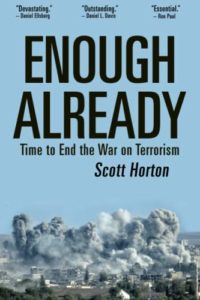
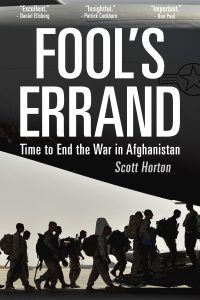
If you are at least willing to listen to the idea that the U.S. should not fight endless Asian land wars, you need to read Scott Horton’s new book, “Fool’s Errand: Time to End the War in Afghanistan.” It’s also a well-researched, interesting book, a lively and interesting read.
Here are some of the things you’ll learn if you read Horton’s book:
• There is nothing particularly Islamic about suicide bombers. Suicide attacks are a tactic used by combatants who have no other means to inflict serious casualties. (The history of World War II in the Pacific illustrates the point. The Japanese resorted to kamikaze attacks after the Japanese navy was at the bottom of the ocean and there were few other options to slow the U.S. advance.)
• The U.S. is no closer to defeating the Taliban now than it ever was.
• The war in Afghanistan is now the longest war the U.S. has fought.
• The U.S. could have fought a limited war to get rid of Osama bin Laden and his allies, getting out of Afghanistan within a few months.
Read more at Sandusky Register.





War Is A Policy, Not An Inevitability
One of the most persistent myths about war is that it is sometimes inevitable. States are carried along by the impersonal forces of history: the balance of power, alliance commitments, ideological antagonisms, the rise and decline of great powers, et cetera. Leaders...