
The 55th Pacific Islands Forum Leaders Meeting, held in Koror, Palau, from August 31 to September 3, offered a revealing window into the limits of an increasingly ambitious external security agenda in the Pacific. The immediate subject was Australia’s expanding network of defense and security arrangements. The larger question, however, was what these arrangements mean as Washington intensifies its strategic competition with Beijing—and whether Australia is becoming an increasingly important vehicle for extending that competition into the Pacific.
The Forum’s Leaders’ Communiqué and surrounding discussions suggested that Pacific governments remain reluctant to allow their region to be organized primarily around the strategic priorities of larger powers. Leaders reaffirmed the Boe Declaration and the Blue Pacific Ocean of Peace framework, while emphasizing member-led implementation and national circumstances rather than embracing a new security architecture directed explicitly against China.
That distinction matters. The Pacific Islands Forum has periodically become entangled in wider geopolitical disputes, including over Taiwan. Taiwan has participated in a recurring Taiwan/Republic of China–Forum Countries Dialogue, while its broader relationship with Forum states has remained politically sensitive. The issue is therefore hardly peripheral: questions of who participates in Pacific institutions can quickly become proxies for the much larger contest between Washington and Beijing.
Unsurprisingly, the leaders in Koror reaffirmed climate change as the single greatest threat to Pacific livelihoods, security, and wellbeing. They endorsed a Regional Peace and Security Action Plan for 2026–2030 while stressing that implementation should remain responsive to national circumstances and capacities.
On traditional security matters, the outcomes were considerably more cautious. The Waqa Moana concept—a proposed regional mechanism for intelligence sharing, coordination, and maritime cooperation against transnational organized crime and illicit drugs—was agreed to in principle, but further national consultations were required. Australian Prime Minister Anthony Albanese announced roughly $600 million in support, much of it directed toward aerial surveillance and policing assistance. The distinction between agreement and implementation is significant: Pacific governments were willing to consider cooperation, but not necessarily to sign away control over how a new regional security apparatus develops.
The same pattern appeared in relation to the Joint Heads of Pacific Security, or JHoPS, an operational forum bringing together police, military, customs, and immigration chiefs. Australia has played a central role in its development, with the United States and Japan participating as observers. Forum leaders agreed in principle to recognize JHoPS within the Forum’s peace and security architecture, but again mandated further consultation over governance, composition, resources, and duplication.
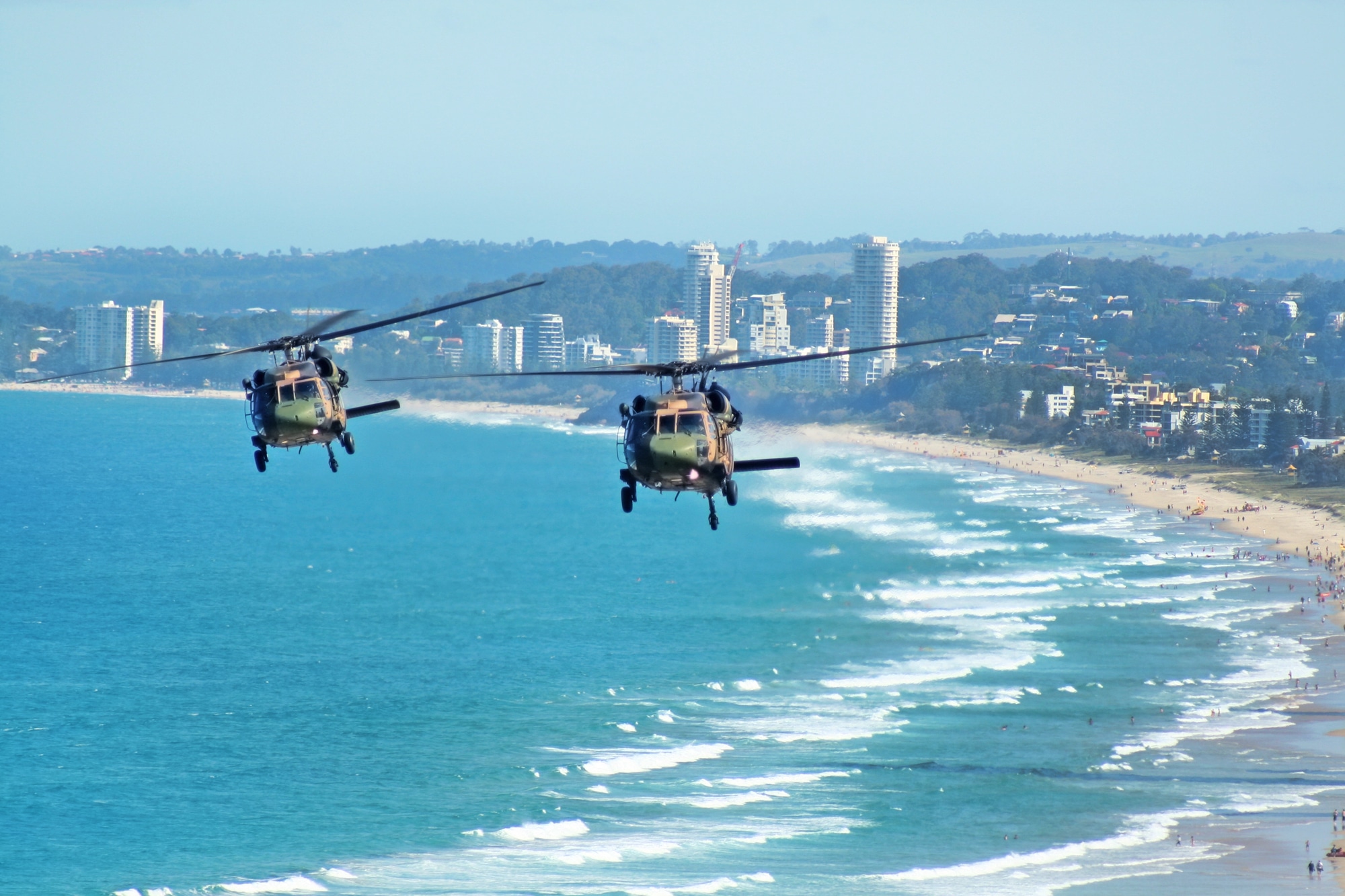
That caution is understandable given the direction of Australian policy. Canberra’s 2026 National Defence Strategy calls for a more capable force able to contribute to the “collective security of the Indo-Pacific,” while its investment program envisages a larger navy, long-range strike capabilities, enhanced surveillance, and deeper cooperation with international partners.
Australia is not, by itself, a military great power. Yet its strategic significance to Washington is considerably greater than its size would suggest. Australian forces routinely train and operate alongside the United States across the Indo-Pacific. In 2026, Australian personnel participated in the U.S.-led Valiant Shield exercise alongside American, Japanese, Canadian, and New Zealand forces, while Australian naval vessels supported U.S. operations and logistics networks in the South China Sea.
That makes the language of Australian “security commitments” worth examining carefully. In isolation, expanded cooperation on policing, maritime surveillance, disaster response, or transnational crime can appear benign. But these initiatives are developing alongside a much broader U.S.-led security architecture in the region. Australia’s defense relationship with the Philippines is deepening; Australian and Philippine officials have expanded intelligence, surveillance, reconnaissance, access, and military-exercise cooperation.
The United States, meanwhile, has spent years making its alliance commitments in the western Pacific increasingly explicit. Washington has repeatedly emphasized that its treaty obligations extend to contested territories involving treaty allies such as Japan and the Philippines, while the Biden administration also repeatedly stated that American forces would defend Taiwan in the event of an attack, even though Washington formally maintained its longstanding policy of strategic ambiguity. Whatever one’s view of those commitments, they have made the possibility of a U.S.-China military confrontation a central consideration in regional planning.
Seen against that backdrop, Australia’s expanding role deserves scrutiny not merely as Australian foreign policy but as part of a larger American strategic network. The question is not whether Canberra has legitimate security interests of its own. The question is whether Pacific institutions designed to give small island states a collective voice are gradually being incorporated into a strategic architecture whose ultimate priorities are determined elsewhere.
The muted response to China’s recent intercontinental ballistic missile test is instructive. Forum leaders expressed concern about the lack of adequate notification and called for advance notice consistent with international practice, while invoking sovereignty and the Ocean of Peace Declaration. They did not name China. That restraint is notable amid increasingly alarmist rhetoric about Chinese military activity in the Pacific.
Pacific governments have their own reasons for maintaining relations with Beijing, Washington, Canberra, and others. Many depend on Chinese trade and investment while simultaneously relying on Australia, New Zealand, and the United States for development assistance, security cooperation, or diplomatic support. Their overriding concern is often less which great power prevails than whether they can avoid becoming the terrain on which great powers compete.
The Ocean of Peace Declaration, adopted in 2025, emphasizes dialogue, peaceful dispute settlement, and a nuclear-free Pacific. Australia’s decision to attach the “Ocean of Peace” label to a bilateral defense arrangement with Fiji illustrates the tension between the region’s preferred vocabulary and the increasingly militarized strategic environment.
For Washington and Canberra, the Forum’s caution should therefore be taken seriously. Pacific governments have demonstrated that they are willing to cooperate on security, but they have also insisted on retaining control over the terms of that cooperation. That distinction becomes increasingly important as Australia’s defense relationship with the United States grows deeper and as Washington’s confrontation with Beijing becomes more institutionalized.
The danger is not that every Australian-funded surveillance aircraft or police initiative is secretly a military operation. It is that individually modest arrangements can, over time, become components of a much larger strategic architecture. Once personnel, intelligence systems, access agreements, command relationships, and operational procedures are integrated, reversing course becomes considerably more difficult.
The Pacific Islands Forum’s response in Koror was therefore less a rejection of security cooperation than a warning about its direction. Pacific states appear prepared to address crime, maritime security, climate threats, and other challenges, but they remain wary of having those priorities subsumed into a great-power contest.
That should concern Washington as much as Canberra. The more regional institutions are perceived as instruments of an American strategic project—and Australia as its principal Pacific intermediary—the harder it becomes to persuade smaller states that these arrangements are genuinely theirs. The Pacific has its own security priorities. Great powers would do well to remember that.
A genuine respect for Pacific priorities would mean less emphasis on binding security architecture they do not want and more on the climate, economic, and human security issues the leaders themselves placed first.
The alternative is the familiar cycle of overreach, crisis, and eventual blowback that has characterized so much of Washington’s post-Cold War engagement.