

The national Republican Party has settled on a campaign against the Democrats, painting the opposition party as a bunch of economic socialists. “Across the nation, socialist policies are increasingly dominating Democratic politics,” Rep. Brian Steil (R-WI) complained last summer as Republicans pushed a vote on the House Rules Committee to condemn socialism. “Socialist candidates are competing for and winning Democratic nominations for key offices at the local, state and federal level.”
But do the Democrats actually increase the size and scope of government when they get into power? The answer is not a clear “yes,” at least historically.
While a unified Democratic government has tended to see the fastest growth in government spending since World War II, government grows faster overall under Republican presidents than Democratic ones. And the only real decreases in the size of government spending happened during those six years where there were Democratic presidents and Republican majorities in Congress, first with the post-war build-down under Harry Truman (1947-48), and next after modest cut-backs from the bloated spending of the financial and COVID crises under Barack Obama (2009-10) and Donald Trump (2020), respectively.
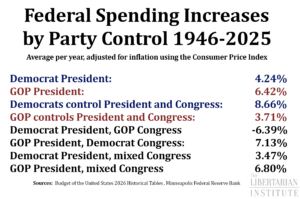 Interestingly, the largest one-year levels of spending increases were in 1952 under the Korean War build-up and 2020 with the bloated COVID bailout money passed enthusiastically by the Democratic Congress and signed just as enthusiastically by President Trump. Both represented more than 30% increases in federal spending after discounting for inflation…in just one year.
In short, President Trump proposed by far the largest one-year peacetime increase in federal spending ever in American history, about twice as much as the next peacetime increase (in 1975). So it’s a bit of a rich accusation to say Republicans are the guard against larger government when the incumbent not only got the largest spending increase passed, but he drummed out the one member of Congress who expressed opposition to the spending increases at the time, Kentucky Representative Thomas Massie.
Of course, the GOP narrative is that the Democrats have turned a corner and become full-blown socialists in the past two years. So one could argue the historical record isn’t as relevant as in the past, even though the GOP has accused the Democrats of being socialists for decades, at least since Obama’s 2008 campaign.
The Tea Party movement emerged as a protest against the threat of socialized medicine when Barack Obama openly campaigned in favor of a “public option” on health care, something that definitely would count as socialism. It was also explicitly in the Democratic Party platform in 2008. But it counted as a campaign lie, rather than an actual policy enacted. Even with control of the White House and a majority in both the U.S. House and Senate, Obama couldn’t get his “public option” enacted into law because of opposition within his own party to this sliver of socialism.
The new Democrats billing themselves as “democratic socialists” are not winning a majority of primaries, though they are winning a surprising number. And they may unseat several dozen incumbents in November, Democrat and Republican. So they will have an influence, but not even a controlling influence over their own party on Capitol Hill.
Socialism, strictly speaking, is defined as “collective or governmental ownership and administration of the means of production and distribution of goods,” according to Merriam-Webster, as well as virtually every other dictionary and longstanding popular understanding.
And in that regard, Democrats have both failed to deliver socialism to America and appear ill-equipped to bring this economic pox to our nation. Unlike the Trump Republicans in the White House today, who have taken shares in more than thirty private U.S. companies, and in some cases copying Chinese Communist Party-style “golden shares” to control the companies.
In that one sense, Republican socialism is as real as Democratic Party socialism is fake and a political front. And while thirty to forty companies with “golden shares” is a small start to socialism, it’s not a start that needs to be encouraged by U.S. voters.