
If you attempt to smuggle heroin into Indonesia, where I happen to be writing this sentence, and you are caught and convicted of doing so, then you will be subject to the death penalty. There are other places in the world as well where smuggling drugs is, by law, a capital offense. The United States of America is not one of them. In no state where drug dealers or mules would need to set foot in order to sell their wares to Americans is drug trafficking a capital offense. It is theoretically possible that smuggling drugs into a U.S. territory could be transformed by legislators into a capital crime, but that seems highly unlikely to happen, especially given the number of states where recreational drug use has been decriminalized or even legalized in recent years.
Notwithstanding U.S. law and the current trend toward decriminalization of drug use, the Trump administration continues to fire missiles at small boats not only in the Caribbean Sea but also in the Pacific Ocean, having by now killed dozens of persons for allegedly attempting to smuggle drugs into the United States. The serial bombing of boats near Venezuela and in the Pacific Ocean was initially characterized by U.S. officials as part of a “noninternational war,” a terminological attempt to confer a semblance of legitimacy on the homicides.
On November 13, 2025, the administration formally announced Operation Southern Spear, as war plans were apparently being drawn up to attack Venezuela directly, on land, with the evident aim of effecting a long-sought coup against the government of President Nicolás Maduro, on whom the U.S. officials had bestowed the label “narcoterrorist” before putting a bounty on his head. In August 2025, the FBI increased its reward offer for information leading to the arrest of Maduro to $50 million. The people in the boats being blown up have also been christened “narcoterrorists.” The label narcoterrorist so indiscriminately applied bears resemblance to unlawful combatant, the term of art used by the U.S. government throughout the Global War on Terror to deny the persons thus identified any and all rights under either domestic or international law.
First-degree murder, which involves the intentional, deliberate, premeditated, and malevolent termination of another human being’s life, is a crime subject to the death penalty, under law, in twenty-seven of the United States. Some states have outright abolished the death penalty in recognition of the many times when innocent persons have been posthumously exonerated, only after their erroneous execution. Others have outlawed capital punishment due to its inconsistent application and/or disproportionate impact on persons of color.
In the case of Trump’s unnamed narcoterrorist targets, no evidence has been provided by their killers to substantiate the crimes allegedly being thwarted through summary execution. What we do know about the victims, ironically enough, is that, if they were indeed transporting illegal drugs, then they were not, in that capacity, premeditated, intentional killers. We know this because drug traffickers are in the business of selling drugs to consumers, who would cease buying anything whatsoever upon their demise. Drug dealers arguably do sometimes commit involuntary manslaughter by negligently providing toxic substances to consumers. That crime, however, is not a capital offense, for it lacks both premeditated intention and malice aforethought.
There is no sense in which anyone involved in the drug trade is trying to murder the customers to whom they are trying to sell drugs. This simple point should be obvious to anyone who has bothered to think through what is being done to the passengers located in what appear to be randomly targeted boats in international waters far from U.S. shores. I say that these boats have been randomly targeted because the Coast Guard regularly stops, boards, and searches thousands of suspicious vessels each year. A small fraction of that number of boats has been selected for annihilation on the basis of secretive intelligence not shared with the public. “Trust us; we know what we’re doing.” That mantra should sound familiar, as it was an oft-recited refrain by the perpetrators of the disastrous wars on Afghanistan and Iraq.
After one of the missile attacks, two survivors were rescued from the sea and repatriated to their respective homelands of Ecuador and Colombia. Curiously enough, these surviving alleged “narcoterrorists” were not detained, indicted and tried for any crimes at all, much less capital crimes the conviction of which would entail the possible infliction of a death penalty. So were the other persons in the same boats guilty of capital crimes, or were they not? How could the sole factor demonstrating the guilt of those killed, and the sole criterion by which they are deemed worthy of execution, be that the government succeeded in killing them?
In all likelihood, the Trump administration repatriated the survivors of their missile strikes in this new Caribbean War on Drugs for the simple reason that they had no evidence admissible in a court of law for any crime whatsoever. Without evidence, there can be no conviction, so the persons who escaped alive, if made to stand trial in a U.S. court of law, would likely have walked free in any case. Could such persons be summarily executed by the government on U.S. soil? Not legally, so long as they were unarmed and not directly threatening anyone else with death.
Is there any, even vaguely plausible, sense in which the Department of War (DOW) is protecting U.S. citizens by bombing small boats in the Caribbean? Based on the official narrative, the return of the targets by the U.S. government to their homelands would seem to imply (if they were in fact guilty) that the lucky perps will get right back to work—poisoning Americans! Meanwhile, Team Trump is effectively terrorizing the fishermen who work in the waters north of Venezuela while likely deterring a good deal of persons from taking southern-bound Caribbean cruises.
The Trump administration’s “narcoterrorist” targets, whether or not they were lucky enough to survive, have all been suspects, as were the “unlawful combatants” killed in Afghanistan, Iraq, Pakistan, and Yemen, among other places. In most cases, the names of the persons at the receiving end of missile strikes have been unknown to their killers. The difference between the Global War on Terror and Trump’s new War on Drugs is that the suspects killed in places where improvised explosive devices (IEDs) were being planted, and suicide bombers were known to reside, were believed to be attempting or plotting to kill U.S. soldiers. In stark contrast, even if any of the boats being bombed are carrying contraband, drug smuggling, to reiterate, is not a capital offense under U.S. law. In other words, the people killed in the Caribbean Sea have all been murdered.
It matters not a jot whether the victims were killed in the initial or the follow-up strike(s). The double-tap strike on what were initial survivors of the first of the series of Caribbean bombings is currently under congressional investigation, as it is widely regarded as a war crime to summarily execute the survivors of a military operation which has already achieved its objective. Even former CIA director and Secretary of Defense (War) Leon Panetta has gone on record to assert that the September 2, 2025, double-tap strike was in fact a crime. Such concerns did not, of course, stop Panetta, who served under President Barack Obama from 2009 to 2013, or anyone else throughout the Global War on Terror, from regularly firing follow-up strikes to annihilate survivors and those who rushed to their aid. Indeed, under Obama’s authority, funerals held for the victims of previous strikes came to be targeted as well, on the grounds that terrorist associates would likely be in attendance.
Deploying the highly charged term terrorist has proven to be a reliable way to garner popular and congressional support for the use of military force against entire nations, even when, as in the case of the crimes of September 11, 2001, the perpetrators comprise a small group of nonstate actors. The grounds for calling drug smugglers “terrorists,” however, are even flimsier than the grounds for calling them murderers. Unlike groups such as Al Qaeda, drug dealers are manifestly not in the business of threatening civilian populations with the hope of achieving political ends. On the contrary, they are attempting to sell wares to willing buyers. Even if the persons onboard the ill-fated boats were in fact transporting contraband, they cannot be said, in any even remotely plausible sense, to have been committing capital crimes, for their aim has been manifestly neither to threaten nor to kill anyone.
Given what has been going on around the shores of Venezuela for some time now, the most likely description of the hapless victims of the war front opened up by Trump would seem to be that they were among the poor fishermen who sometimes agree to transport extra cargo onboard their vessels in order to pocket some extra cash. If that was indeed the case, then the victims were nothing like drug entrepreneurs Pablo Escobar or El Chapo, who conduct themselves in the manner of crime syndicate bosses—and do indeed regularly commit murder in defending their domain of power—but much closer to the poor people who swallow balloons of drugs given to them by handlers on one side of the border, and then extrude them on the other side, in exchange for wads of cash. Such persons facilitate the trafficking of drugs through transporting them across borders, but they do not themselves generally sell the drugs directly to the end users.
Given the severe penalties which drug mules regularly risk, all of the people willfully involved in such schemes can only be mercenarily driven opportunists, some no doubt more desperate than others. In cases where drug mules have been extorted to transport contraband, the question of moral responsibility arises, for if they have no reasonable (read: nonsuicidal) way to avoid acting in the manner in which they do, then it is unclear that they are criminally culpable for their violations of the law. At the very least, it can be said that crimes committed under coercion involve extenuating circumstances or mitigating conditions.
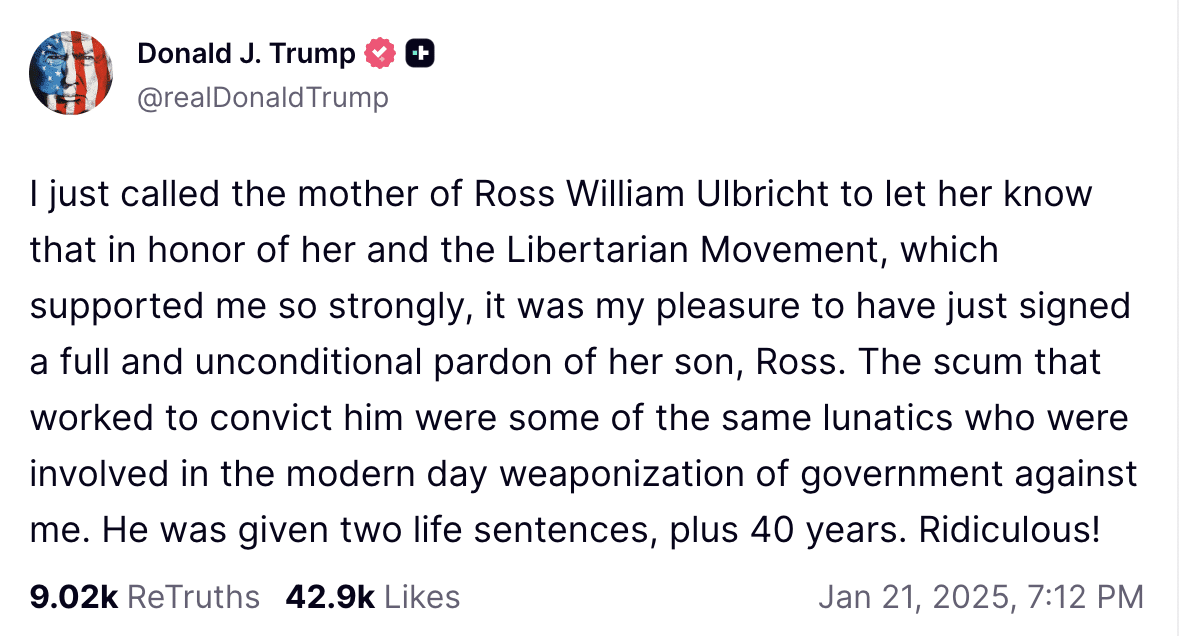
President Donald Trump’s manifest frenzy to kill some among the facilitators of drug trafficking is especially puzzling in view of the fact that, at the beginning of his second term of office, he freed convicted felon Ross Ulbricht, whose Silk Road website was used to facilitate the sale of millions of dollars of illegal drugs and as a result of which some persons were harmed. To his sympathizers, the role that Ulbricht himself played in whatever havoc may have been wrought using his website as a vehicle was more akin to a facilitator than a drug trafficker. Trump commuted the sentence of Ross Ulbricht to time served, presumably in recognition of the fact that he harbored neither malice aforethought nor the premeditated intention to kill anyone. But by that very same logic, Trump should not be executing anyone who is acting in ways which facilitate the sale of drugs to Americans.
By all appearances, having once freed Ross Ulbricht, Donald Trump suddenly became far less tolerant of drug offenders than one might have surmised. The judge who meted out Ulbricht’s unexpectedly harsh sentence of four consecutive life sentences was essentially holding the Silk Road founder responsible for any and all of the harm done to persons through the sale of drugs made possible by his network. There are grounds for thinking that the judge imposed such a Draconian prison term in part because of rumored contract killings allegedly solicited by Ulbricht but for which, due to lack of judicially admissible evidence, he was never indicted. What is beyond any reasonable doubt is that the website was erected precisely in order to make it easier for people to do what they wanted to do, including evade the law, unimpeded by the government. Would Ulbricht be, then, a “narcoterrorist,” according to the Trump administration, and, if not, why not?
Ulbricht has long been regarded as a hero of sorts among libertarians, and the news that Trump had commuted the convict’s sentence to time served was met with a collective sigh of relief and, in some cases, gratitude and even victory laps. By now, however, Trump’s essentially incoherent drug policy has been exposed, along with his faux-libertarian sympathies on other fronts. Always the deal-maker, when Trump promised that on day one of his second term he would free Ross Ulbricht, this was not because he is a champion of liberty but only in order to garner votes from libertarians and those of their ilk.
Some time after freeing Ulbricht, Trump was evidently persuaded to believe that persons equally far from the proximal cause of fentanyl deaths in the United States should be eliminated using missiles. So which is it? Does Trump categorically oppose the sale of recreational drugs, or does he believe that people should be able to buy and sell what they wish to, unencumbered by the pesky federal government? Trump’s Secretary of Health and Human Services Robert F. Kennedy, Jr. has been working hard to make the use of medical treatments a matter of personal choice rather than government mandate. Can Trump (and Kennedy, who has simultaneously worked to outlaw certain substances in food products) at the same time coherently maintain that people have no right to decide which substances they put into their very own bodies?
Looking back, it should be remembered that, among the libertarians who voted for Trump, the hope that the candidate, if elected, would keep his promise to free Ross Ulbricht was only one of the candidate’s apparently pro-liberty and anti-Deep State selling points. Ulbricht was indeed freed, but that’s about it on the liberty front. Trump promised to end wars, not to start them, and he certainly spoke as though he favored free speech and draining the government swamp of redtape-proliferating bureaucrats for life who, despite not being elected officials, have long produced the equivalent of binding laws on the citizenry. Trump also railed against the dire economic situation in the United States under President Biden.
Trump’s second-term policies—the imposition of high tariffs, the refusal to balance the budget or make any effort whatsoever to rein in the national debt spiraling out of control, the large increase in defense spending—have needless to say left not only libertarians but all fiscal conservatives shaking their heads. Perhaps Julian Assange’s plight at the hands of Trump’s first administration (above all, then-CIA director Mike Pompeo) should have been taken more seriously, given that the Wikileaks founder has always been a great champion of free speech and transparency.
By now, the president’s childish tirades against Representatives Thomas Massie (R-KY) and Marjorie Taylor Greene (R-GA) and Senator Rand Paul (R-KY) for daring to defy him on a range of issues—from the release of the Epstein files to the recklessness of the national debt to the insistence of congressional approval of military strikes, etc.—have revealed how far from anything even remotely resembling a libertarian Trump actually is. With his insistence on government intervention in any- and everything, including the effective denial of states rights and the first principles of federalism, Trump has proven to be a social engineering politician as meddlesome as the most socialist-leaning Democrats, albeit heading in a different direction. At this point, it is unclear whether Trump embraces any principles whatsoever, beyond perhaps “L’état, c’est moi,” as he blunders ahead with vanity projects such as the razing of the East wing of the White House to make room for a shiny new gold and glittering ball room, and shares images on social media of himself added to the line-up at Mount Rushmore.
Less laughable, and far more dangerously, Trump has repeatedly threatened to attack Venezuela with missiles on land targets, thereby terrorizing the entire population and doing so under the completely bogus pretext that Venezuela is somehow responsible for the fentanyl overdose crisis in the United States. Undeterred by either U.S. or international law, Trump appears to believe that “the leader of the free world” does not require the approval of anyone before acting on his (read: Secretary of State Marco Rubio’s) war plans. Venezuela does not produce fentanyl, so this is a diaphanous pretext for the regime-change war which Rubio has been dreaming of and scheming about for years.
Further evidence that Trump is, at heart, an unprincipled deal maker may be seen in his recent pardon of former Honduran President Juan Orlando, who was serving a forty-five-year sentence for facilitating the free-flow of cocaine into the United States. Given the flagrant contradiction in Trump’s professed drug policies, highlighted by his pardoning of convicted felon President Orlando while simultaneously issuing menacing threats against President Maduro, cynics may see in Trump’s opening up of a new war front just another diversionary (but nugatory) tactic to get people to forget all about Jeffrey Epstein.
King Donald seemingly changes his opinions on every matter under the sun, and often in very little time, so the only thing we can be sure of at this point is that the egocentrist president is extraordinarily vulnerable to flattery and, therefore, subject to manipulation by anyone who has figured this out, as Secretary of State Rubio evidently has. Throughout history, elected leaders run amok have sometimes been removed from power. In order to commit mass homicide with impunity, however, it suffices for the U.S. president to claim that he is acting in “national defense,” just as did Trump’s immediate predecessor, Barack Obama.
Will Trump’s regime-change war in Venezuela be worse than Obama’s in Libya? One difference might be said to inhere in the intentions of the presidents. Obama appears to have been convinced by a variety of persons (including then-Secretary of State Hillary Clinton) that military action in Libya was necessary to avert a genocide. Trump, in contrast, appears to have been advised that Venezuela, like Gaza, is a prime business opportunity waiting to be capitalized upon. But no U.S. president has ever been held responsible for any of the regime-change debacles and campaigns of mass homicide perpetrated by the U.S. government, and there is little reason for thinking that the War Party duopoly will ever make Trump answer for his crimes.
There is nonetheless room for a modicum of hope. Perhaps, as a result of his administration’s outrageous and self-contradictory comportment, Trump will end by galvanizing a long overdue public debate on the moral and legal status of drone strikes.