
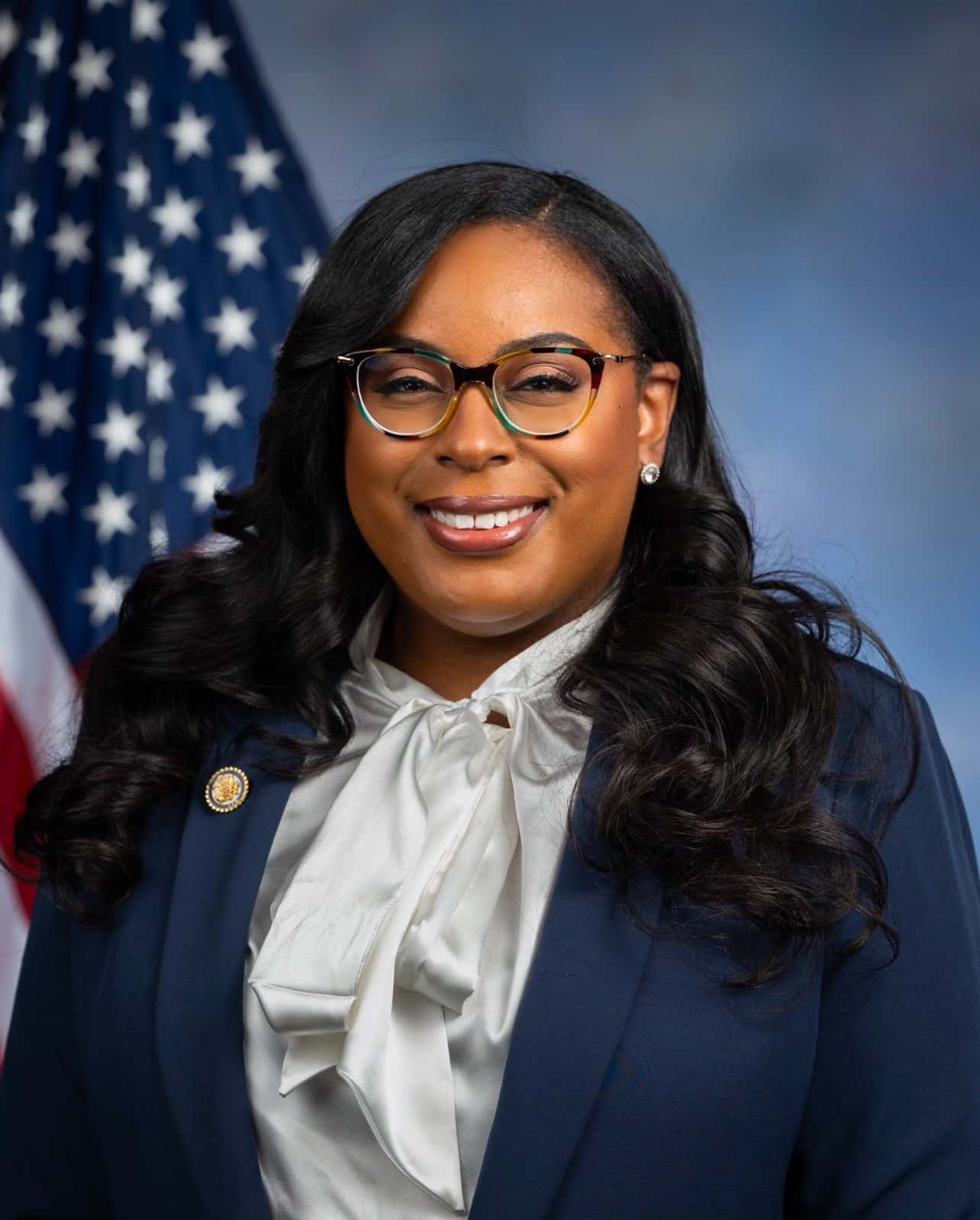
U.S. Representative LaMonica McIver (D-NJ) was born in 1986 in Newark and has lived there ever since. She grew up in a public high rise with three younger siblings and a mother who struggled with substance abuse. She looked instead for guidance to her fifth grade teacher, Ras Baraka, since 2014 the mayor of Newark, who “hooked” her on public speaking: first on theater (Macbeth) and then, when he started his electoral career, on politics.
In 2004, McIver became the first of her family to graduate college: Bloomfield College, with a degree in English literature, then Seton Hall University, with a Masters in Education and Public Policy. She worked in public schools and founded a leadership nonprofit for young women, and in 2018 ran for and won a seat on the Newark City Council. In 2022 she became council president, a position she held until she resigned in 2024 to run for the congressional seat for New Jersey’s 10th District to replace an incumbent who had died in office. She won the special election and entered the U.S. House of Representatives in September of that year, then won a full term in November, and was sworn in for a two-year term on January 3, 2025.
This is not a CV that suggests the commitments of a constitutional conservative, but its resolute focus on the local over the national and on community over institutions can be extremely relatable to people with those values and views. Perhaps even more relatable is a late and surely unexpected entrée onto LaMonica McIver’s CV. For the last year and a half, McIver has been one of the more prominent targets of federal, executive overreach via ICE and the Department of Homeland Security.
On May 19, 2025, 136 days after McIver was sworn in for her first full term, interim U.S. Attorney for the District of New Jersey Alina Habba announced that McIver had been charged “with two counts of assaulting, impeding or interfering with a Homeland Security officer.” The charges flowed from an incident on May 9, outside an ICE detention center in Newark, when McIver, who was shielding Ras Baraka from being arrested by Homeland Security officers and ICE, allegedly “struck one federal agent with a forearm, ‘slammed’ her arm into another and ‘reached out and tried to restrain’ the arresting officer.” Habba’s is an indictment which McIver has tried without success to get dismissed by the Courts: if McIver is convicted, the charge carries a maximum prison sentence of seventeen years.
Federal indictments of members of Congress for alleged violations of public trust are not as rare as one might expect. Between 1980 and 2015 alone, more than two dozen representatives or senators faced prosecutions: most of them on charges of bribery or misappropriation of funds, several others on charges of sexual misconduct. But the case of LaMonica McIver is not one of those cases. As The Washington Post put it, it is “the highly unusual action by the Justice Department” of “charging a sitting representative after a heated clash in which there have been no reported injuries.” The Trump administration justified its action by asserting that McIver had been part of a woke mob intent on gaining access to the ICE facility. According to then-Department of Homeland Security Secretary Kristi Noem, testifying to Congress a few days after the May 9 incident, a “mob of protesters including three members of Congress stormed the gate and they trespassed into the detention facility.” According to a Department of Homeland Security press release, “lawmakers used an arriving ‘bus of detainees’ as a decoy to gain entrance, then ‘holed up in a guard shack’” and “lawmakers attacked officers, including ‘body slamming a female ICE officer.’” According to President Donald Trump, commenting directly on McIver, “She was out of control. Those days are over, the days of woke are over.”
This is a cinematic narrative, and almost none of it is true. Investigating the actual facts of the case of LaMonica McIver does reveal several arguable errors of judgment by her and the two other congresspeople who visited the detention facility that day. But the majority of the facts point to a different, more disturbing narrative: layers of overreach from Washington DC that culminated first in the incident of May 9, then in the indictment of May 19, and then in an accelerating chain of abuses and dysfunctions at the ICE detention facility in Newark which continue to the present day. The majority of the facts also suggest that the main actors on May 9 were not errant members of Congress but corporate-government bureaucrats—ICE agents, Department of Homeland Security agents, private security contractors—who flouted laws and constitutionality, then used minor misjudgments by the congresspeople to justify an outsized response. This story is considerably more dramatic than the Trump administration’s cinematic narrative when it comes to its implications for the legal and political underpinnings of our constitutional republic, because ICE’s layers of overreach did not happen in a vacuum.
I have reported for the Libertarian Institute on some of ICE’s actions and how they represent an acceleration of domestic militarization by the Executive with the aid of private security contractors with monopolies on government contracts. Less obvious is the way that this domestic militarization has converged with and helped enable the erosion of local and state authority to the benefit of Washington DC and the disempowerment of Congress to the benefit of the Executive and the federal courts. ICE’s actions in Newark represent these processes at work in miniature, in a single location, with concrete consequences. In LaMonica McIver, these trends have converged into a perfect, symbolic storm over a single person standing up for her community—a storm that should alarm anyone who cares about constitutional republican government.
The story of the prosecution of LaMonica McIver starts with the ICE detention facility in Newark. Delaney Hall is located at the Eastern edge of the city between I-95 and the Passaic River, with a truck stop and an energy terminal across the street. Initially a public prison, it was bought by GEO Group, the largest private prison contractor in the country, in 2011. GEO Group operated it as a 450-bed ICE detention center for six years, then the facility went dormant. In 2025, ICE gave GEO Group a contract valued at $1 billion to reopen Delaney Hall, again as an ICE detention facility, this time with 1,000 beds. This was a period of high growth for GEO Group: at the end of 2024, GEO Group had 80,000 beds in ninety-nine facilities, and, in 2025, it opened at least three more in vacant or disused buildings, including the 1,000-bed Delaney Hall. According to The New York Times, reporting on the contract with GEO Group for Delaney Hall in May 2025, “hours after ICE announced it would reopen Delaney Hall, the GEO Group held an earnings call for its investors. The Newark facility was mentioned repeatedly as a core component of the company’s long-term business strategy.”
As I have reported for the Libertarian Institute, the second Trump administration’s dealings with GEO Group and Core Civic, the first and second largest private prison companies in the United States, were ad hoc affairs. They were no bid contracts that ended up over-expanding the supply of private facilities, pushing GEO Group’s and Core Civic’s stock price down because detainments were not keeping pace with space. At this point, the Trump administration, which was a recipient of both companies’ campaign donations, upped immigrant arrests and overstocked the facilities, leading ICE to go so far as to pay public prisons to store the human overflow. With all of the confusion, the building of these private facilities was haphazard and sometimes lacked municipal approval, and conditions in those completed facilities which held inmates quickly declined, even as profits increased. Delaney Hall was no exception.
New Jersey had objected to ICE’s construction and privatization spree during the first Trump administration, and had sometimes objected with a broad legal brush. In 2021, the state passed a law barring public prisons and private contractors from working with ICE; a federal judge struck down the part of the law disallowing private contracting off of a case brought by Core Civic. But in the second Trump administration ICE was the one operating with a broad legal brush, in a way that seemed to invite challenges. In 2025, not long after news reports broke about GEO Group’s refurbishing of Delaney Hall, Newark brought a local lawsuit. It alleged that GEO Group was “renovating the building without securing proper permits, has barred city inspectors from entering the facility, and is flouting city code to finish construction” and that its “‘wanton and unlawful occupation’ of Delaney Hall…exposes Newark to potential liabilities.” According to Ras Baraka, commenting on the lawsuit and sounding what for a Democratic mayor might seem an unusually constitutionalist note, “We will not tolerate federal attempts to ignore or evade our laws and statutes, which apply to everyone.”
The lawsuit began its way through the courts; in the meantime, GEO Group finished refurbishments on the building and began housing detainees there, and Newark’s citizens responded. Newark is an unusually cohesive political community: in 2020, it was the rare city where the protests over George Floyd’s death did not get out of hand. According to a New York Times article at the time, this was “a victory that city officials and residents attributed to a combination of tactical decisions” and “community and political leadership.” This communal cohesiveness surfaced again in May 2026 as GEO Group repeatedly refused city inspections even as detainees began being shipped into the facility. Pro-immigrant Newark civic groups began protesting outside the facility, and Baraka turned up there every day, posting a list of code violations on the gate. The people on the other side of the fence responded, obliquely: by May 9, more guards had shown up, wearing masks and zip ties, some of them with GEO Group, some with ICE, and some with the Department of Homeland Security.
This confusion between outside and inside the facility, and between the different cohorts of government agents and contractors inside it, was the order of the day on May 9. When McIver, who sits on the Homeland Security Committee in Congress, arrived that day for an oversight inspection with two other congresspeople, a GEO Group adviser at first would not let them in, a violation of Congress’s right to oversight. After waiting outside, one of the other congresspeople followed a car in through the gates; the other two congresspeople followed and found an ICE agent who knew the rules, and who sat the three representatives in a waiting room. They were kept waiting for an hour and thirty minutes after the warden, a GEO Group employee, informed them that he needed authorization from his “client,” ICE, to allow them an inspection, and called ICE headquarters. The lead ICE agent on site, Ricky Patel, who apparently did not have the authority to allow the inspection, was also in the room. But Patel’s attention was on protestors on the lawn and on Ras Baraka, who was walking to the gate to meet the congresspeople, whom he assumed would be finished with the tour and had arranged to join him at the protest.
Just inside the gate, a GEO Group employee and Baraka spoke about keeping the crowd in check, a skill Baraka had honed in 2020 during the George Floyd protests. But then Patel appeared, telling Baraka that he was on private property and was under arrest. The three congresspeople walked outside and spoke on behalf of Baraka, who agreed to leave the facility; then, as Baraka walked away from the building, Patel placed a call to Deputy Attorney General Todd Blanche, who ordered him to arrest Baraka. This is when the wheels came off the wagon. ICE and Homeland Security officers walked to the facility’s public parking lot and approached Baraka. The three congresspeople followed and they and the protestors formed a protective wall around him and a number of people, including McIver and a DHS employee, were caught up in the melee. According to The New York Times, “video of the scrum showed [McIver] pushing toward the gates and being pushed from behind after Mr. Baraka was handcuffed.”
This is where things might have ended—a series of unfortunate exchanges brought on by obscurancy, confusion, and aggressiveness from ICE, DHS, and GEO Group; but also exacerbated by irritations and interferences from their congressional visitors, who arguably let their impatience get the best of them. But things did not end there, because the Trump administration had not only primed ICE to make such events more likely through aggressive behavior but also primed the DOJ to make as much hay as possible out of these events if they occurred, using “a new directive to increase immigration-related arrests” that “encouraged [agents] to investigate and charge citizens and public officials if they ‘obstructed’ immigration agents.” Along these lines, the DOJ decided to charge LaMonica McIver after she rejected a plea deal in which she would have admitted to assault, a charge on which both she and video of the incident cast doubt. The case has not yet gone to trial.
McIver not only rejected the charges and the plea deal which would have compelled her to admit to them. She has also made the case into a test of the power of Congress. She has cited ICE’s stalling regarding inspections and oversight and argued that her prosecution is an attempt to intimidate congresspeople from exercising their constitutional role. Her lawyers have argued for congressional immunity:
“…that the Constitution’s ‘speech-or-debate clause,’ which protects members of Congress from legal liability when they are conducting legislative business, protects her from prosecution.”
Even though supporters in the legal community say that it is “a landmark case, which has the potential to re-energize and invigorate the application of the clause,” judges have not been encouraging. In the past, congressional immunity has been interpreted narrowly by the Courts, and last month a divided three-judge panel for the U.S. Circuit Court of Appeals for the Third Circuit rejected McIver’s claim.
McIver now spends “more than 20 hours a week in meetings with lawyers, or raising money to pay for them” and “has laid off campaign staff because she cannot afford to pay them and is relying on more volunteers instead.” She “is months behind on lawyer fees, just recently having paid off a July invoice for $200,000”; and, though “her legal expenses are already expected to top $1 million,” “House ethics rules dictate that she cannot accept any pro bono legal help.” She, a congresswoman whose responsibility is to oversee both DHS and Delaney Hall on behalf of Congress and her constituents, remains the one individual facing legal peril over the rolling catastrophe that Delaney Hall has become.
And rolling catastrophe is not an exaggeration. In the nearly year and a half since the incident on May 9, conditions inside Delaney Hall as well as ICE’s relationship with Newark have deteriorated rapidly. On June 12, 2025, thirty-four days after the arrest of Ras Baraka, four men escaped from Delaney Hall, according to The New York Times, amid a quasi-uprising there “after the dismal conditions inside precipitated an uproar among detainees” which “stemmed from days of anger about meager and sporadic meals and overcrowding that forced some detainees to sleep on the floor.” In December, “a 41-year-old man from Haiti died soon after arriving at the center because of what federal officials called a medical emergency”: an incident which raised more questions, in the absence of inspections, of conditions in the facility. In May of 2026, “protesters rallied in support of detainees reportedly staging a hunger strike over conditions at the center,” leading to scenes in which GEO Group contractors used truncheons and pepper spray to attempt to disperse the crowd.
In June, “New Jersey sued Geo Group, the private company that operates the detention center, after state health officials were denied access to the medical unit and several other areas at Delaney during an inspection.” In July, The New York Times ran a story about Delaney Hall, where GEO Group had largely “restricted access,” based on “health inspection reports, court filings, and other public records” reporting on “unsafe meals, dirty living quarters, and bad medical care” which “renewed broader concerns about migrant holding cells from Arizona to New York.” And in August, after two more detainees died in Delaney Hall, “the New Jersey attorney general…opened a civil rights investigation” as to “whether employees at the center violated the civil rights of detainees.”
What the case of LaMonica McIver and Delaney Hall has brought to the foreground is dramatic but none of it is truly out of the ordinary. The higher register of problems experienced at Delaney Hall, and the federal Executive’s draconian responses to attempts at overseeing the facility, are simply useful illuminations of a broader trend. This trend has been an unfortunate part of American life for more than forty years, as the Executive branch of the federal government and its chosen contractors have used first the War on Crime, then the Global War on Terror, and finally the “War on Illegal Immigration” to expand their military footprint into localities and states. One shorthand for this acceleration is neoliberalism, but a more accurate one would be military oligarchy. Its mechanism has been a partnership between the security apparatuses of government and “private” enterprise to address real but narrow threats to the American body politic (inner city crime, Muslim terror attacks, undocumented immigration) in outsize ways that maximize power and profit. Its result has been the stealth transformation of local communities by state security.
Between 1980 and 2004, 936 new prisons were built off of federal funding or in response to federal crime laws, including Delaney Hall. (Between 1811 and 1979, by contrast, state and federal governments built 711 prisons.) After 2004, as the prison building boom foundered, Washington incentivized the expansion of existing local prisons and an increasing number of private prisons run by operators like GEO Group and Civic Corps, which “faced controversy, including riots, deaths, and allegations of improper financial influence.” This, again, was the fate of Delaney Hall. Beginning after September 11, 2001, federal funding also flowed to cities across the country for surveillance systems; Silicon Valley startups like Palantir were founded with CIA funds to streamline the process; and security behemoths like the Department of Homeland Security were created to expand the reach of the security state.
Since 2025, the War on Crime and the Global War on Terror have converged in the “War on Illegal Immigration.” Today, Delaney Hall and other prison complexes are being helmed by private contractors with the aid of ICE, which is under the purview of the Department of Homeland Security. These complexes house detainees arrested using advanced surveillance capacities provided to ICE by companies like Palantir, which, along with the weapons contractors General Dynamics and L3 Harris, holds multimillion dollar contracts with ICE. The operators of this surveillance-security-detention nexus don’t have to care about relating to local communities, or about the finer points of constitutional oversight. Their loyalty is to their paychecks from Washington’s war machine, and their prerogative is to feed that system, which means keeping any sort of transparency at a minimum no matter the cost.
And there are more plans to expand this security state, again at local communities’ expense. According to the Left journal n+1, ICE has succeeded at “renting local jail space via a sort of carceral structural adjustment program for counties that are in debt and rely on per diem payments from ICE and the US Marshals.” This is a process in which, “to raise money for [detainment] infrastructure, state and local governments will usually sell bonds to investors” called “debt obligations [that] promise that the government will repay the loan over a certain period, with interest.”
There is also in circulation an internal ICE memo for the ‘Detention Reengineering Initiative’ whose “overall vision” is to spend $38.3 billion on 8, 92,600 bed “large-scale detention centers, 16 processing sites, 10 existing facilities, all to be operational by the end of the fiscal year” and which “relie[s] on a Navy contract vehicle…normally used for military operations — to bypass normal contracting rules and public notice.” Worse, the “federal ownership” of facilities inherent in the Detention Reengineering Initiative means that, according to ICE, “local zoning and sewer laws as well as environmental review would not apply.” According to a city manager in Georgia, “We simply do not have the water and sewage capacity to handle the demands which would effectively tripl[e] the population of our city practically overnight.” Protests have erupted in many locations, and “Maryland, Arizona, and Michigan sued DHS for skipping environmental review.”
Congress, of course, has the power of the purse to fund these expenditures—or not to fund them. But in the case of the trends that created Delaney Hall, that power remains latent: a glaring example of bipartisan agreement in what is commonly called a toxic partisan era. Significant congressional majorities passed the 1994 Violent Crime Control and Law Enforcement Act, shepherded through Congress by then-Senator Joe Biden and signed into law by President Bill Clinton, which powered the prison boom. Even larger majorities did the same for the Homeland Security Act of 2002, a project of Rep. Tom DeLay and President George W. Bush which created the Department of Homeland Security. Democrats universally opposed Trump’s and Speaker Mike Johnson’s (R-LA) “Big Beautiful Bill” of 2025, which secured unprecedented funding for ICE. But Democrats’ opposition was because Trump controversially rolled ICE funding into a bill stuffed with corporate tax cuts and cuts to healthcare. Many “centrist” or “New” Democrats have been supportive in one way or other of a tougher approach to immigration.
And, though federal courts have become more active politically as Congress has become more passive, they have not helped matters either. Judges, Republicans but also powerful Democratic jurists, have been largely deferential to administrations exercising their authority against alleged threats to American security. When faced with legal theories like LaMonica McIver’s on congressional immunity, a theory for which “there is little legal precedent” because past allegations against congresspeople “have generally involved corruption, bribery or sexual harassment,” the courts have, rightly or wrongly, been cautious. All of these trends have emboldened the Executive, to the detriment of people like McIver trying to exercise oversight on behalf of their communities and of Congress.
Worse, the rising bipartisan crop of politicians are familiar with the state security apparatus to a far greater degree than their predecessors, and committed to its expansion. Defense Secretary Pete Hegseth’s Rambo-fication of the Pentagon and White House senior advisor Stephen Miller’s weaponization of ICE are the tips of the Republican iceberg. Vice President J.D. Vance is a protégé of venture capitalist Peter Thiel and Secretary of State Marco Rubio a beneficiary of hedge fund manager Paul Singer, meaning that both are tied into oligarchic players benefiting from Trump’s domestic deportations and foreign wars. Ed Gallrein, Donald Trump’s latest recruit who defeated Thomas Massie in the Republican primary for U.S. representative from Kentucky’s 4th District, is a former Navy seal who has lived much of his life outside his district, spoke often on the campaign trail about the benefits of Trump’s foreign wars, and was funded by a consortium of militarist oligarchs including Paul Singer.
The Democratic side the picture is, if possible, more alarming, as I reported in several investigations last year. U.S. Senator from Michigan Elissa Slotkin, New Jersey Governor Mikie Sherrill, and Virginia Governor Abigail Spanberger (styled “The Democrats’ Patriotic Vanguard” by Anne Applebaum in The Atlantic, Washington’s premier general interest magazine for the military corporate class and its dependents) are all former intelligence agents; and Spanberger’s husband works for L3 Harris, which is one of the defense firms contracted with ICE. U.S. Representatives Jimmy Panetta of California and Pat Ryan of New York, and San Antonio Mayor Gina Ortiz-Jones also hail from military intelligence, making for an unprecedented number of former intelligence operators among elected Democrats.
None of these players, despite many of them serving or having served in Congress, are familiar with their communities in the way of LaMonica McIver, who has made her life and career in her district, nor do they owe their success to the communities they nominally represent. Instead they trained in national institutions as managers and entered politics with the backing of the corporations and organizations which service or benefit from America’s domestic and foreign security apparatus. Their instinct, in every situation, is to expand the parameters of what is permissible for the military oligarchic state. The new normal of American political life, one in which a U.S. congresswoman is being prosecuted for imperfectly attempting to exercise oversight and protect the mayor of her community from private security contractors, is not unwelcome to these politicians’ backers. And this outlook does not bode well for those politicians who choose to stand up against military oligarchy for their community and on behalf of representative government. This is why the case of LaMonica McIver, and the new, perhaps dominant divide in American politics it points to—between politicians who believe in self-government and those who serve military oligarchy—should concern us all.