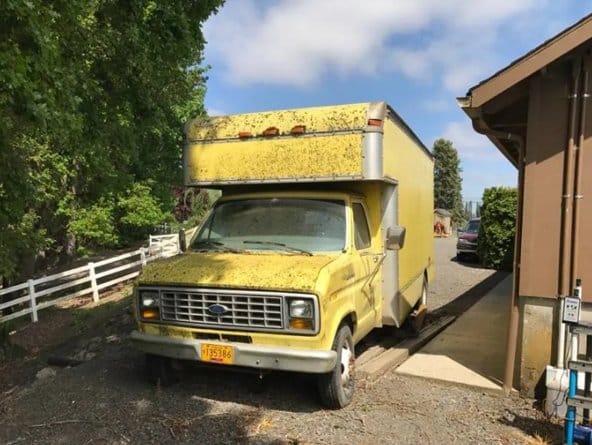
One of the enduring mysteries of the 1995 Oklahoma City bombing case is the little-known but well-documented and indisputable fact that Timothy McVeigh and the “others unknown” involved in the bombing used two different Ryder trucks in the later stages of the bombing plot.
What happened to this second truck, where it was obtained (FBI documents indicate that the bureau may have believed it was purchased at auction—more on those documents in a moment), and its final purpose remain unknown today.
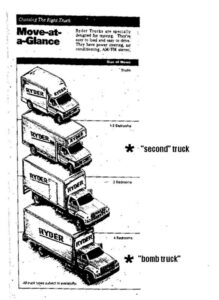
Dozens of witnesses in Kansas observed two distinctly different Ryder trucks between April 11 and April 18—both parked at Geary Lake and the Dreamland Motel. One of the trucks was smaller, frequently described as “faded yellow,” with either no visible Ryder logo or one that was barely visible, and with a cab-overhang on the front of the truck. This detail would also capture the attention of the FBI, who began asking witnesses whether the truck they saw had the cab-overhang and showed them a Ryder company flyer depicting several trucks, asking which type they had observed.
The other of the two trucks was described as much larger—the 20-foot model—and by witnesses as “cleaner” and “newer,” even “more aerodynamic.” This was the truck rented from Elliott’s body shop on April 17 and ultimately used to deliver the bomb.
The second truck, with a few exceptions, is generally omitted from most contemporary accounts of the bombing, yet its existence is confirmed in numerous FBI documents.
A half dozen people at the Dreamland Motel—where McVeigh stayed the week before the bombing—place McVeigh parking the smaller Ryder truck at the Dreamland Motel on Easter Sunday and Friday and Saturday—days before the larger bomb truck was rented at Elliott’s on Monday, April 17.
Consider the following account from Apache helicopter mechanic Shane Boyd, who stayed in room #28 at the Dreamland Motel for several weeks in April 1995 while working at nearby Ft. Riley. Boyd told FBI SA Mark Bouton that around 6:00 AM on Friday, April 14, he saw a Ryder truck with a steel-framed trailer pull out of the Dreamland Motel’s parking lot. Boyd also told the FBI that he is sure he saw the Ryder truck parked at the Dreamland Motel again on Saturday and on Easter Sunday.
Consider the accounts of Dreamland residents David King and his mother, Herta King. Both Kings saw the smaller Ryder truck the weekend before the bomb truck’s rental. FBI special agents Robert Knox and Leslie Gardner interviewed David King on April 27 about activities at and around the motel. David told the FBI that on Easter Sunday, his mother visited him at the Dreamland around half past noon. King stated that both he and his mother saw a yellow Ryder truck parked directly in front of his room that Sunday afternoon.
Herta King later testified at the McVeigh trial that she saw the Ryder truck parked at the Dreamland on Easter Sunday. She stated that she was friends with the motel owner, Lea McGown, and that they had discussed the truck being there on Easter Sunday. King said that Lea McGown told her, “it doesn’t make sense that a truck was there on Sunday, if McVeigh rented it on Monday.”
Indeed, it doesn’t make sense. McVeigh rented a truck on Monday, April 17, yet we have a half dozen witnesses who saw a yellow moving truck with McVeigh prior.
Consider what makes sense: the truck seen before April 17 was a different truck. This is what the evidence suggests. Supporting this theory is David King’s statement that he saw two different Ryder trucks at the Dreamland. King’s observations are crucial to understanding the multiple Ryder truck sightings that occurred before Monday, April 17.
On April 16, Easter, David King saw the older “faded yellow” Ryder truck parked at the Dreamland. King then noted a change in the truck from Sunday to Monday: on Monday, McVeigh arrived driving a “brand new” and “more aerodynamic” Ryder truck. (Evans-Pritchard, Ambrose. The Secret Life of Bill Clinton. Regnery Publishing, Inc., 1997. p. 31.) This was the bomb truck rented from Elliott’s, and it looked distinctly different: much larger than the truck David and his mother had seen that weekend.
David King also saw McVeigh and two other men attaching a trailer to the new Ryder truck and working on the truck and trailer. He recalls this because the Ryder truck blocked access to his parking spot. He noted that something inside the trailer was wrapped in a dirty white canvas tarp. “It was a squarish shape, and it came to a point on top, about three or four feet high,” King told The New York Times.
Witness Connie Hood described a similar scene involving the older Ryder truck that weekend: it had a trailer attached, and a group of men was working around it. Hood told McCurtain Gazette reporter J.D. Cash:
Witness Shane Boyd also observed a trailer attached to the older model truck that weekend, watching it as it pulled out of the Dreamland parking lot. Whatever its purpose, it seems the trailer was moved from the older truck and then attached to the new one when McVeigh arrived with that new truck on Monday.
In addition to Shane Boyd, Herta King, David King, and Connie Hood, the owners of the Dreamland Motel also noticed the older-model truck. Motel owner Lea McGown and her son, Eric, described the truck to the FBI and reporters, and their accounts were published in the newspaper.
It was shortly after an Easter lunch when the McGowns saw McVeigh trying to park the Ryder truck. Lea McGown’s recollection, shared with reporters, was vivid, saying, “He backed in jerky, jerky, jerky. Like somebody who doesn’t know how to drive a truck. I thought he was going to smash my roof!” (Evans-Pritchard, 30.)
Upon watching this, Lea McGown sent her son, Eric, to tell McVeigh to move the truck to the open area in front of the office. Eric McGown got a good look at the truck as he did and described it in detail:
Note that Eric observed a cab-overhang on this model truck, consistent with other accounts. Equally consistent with other sightings of this second truck, it had a trailer attached, appeared older, with faded and worn yellow paint, and had no writing on the back.
Alongside the Dreamland witnesses, a handful of people observed a Ryder truck parked at Geary Lake days before the bomb truck was rented.
According to the official story, McVeigh built the bomb with Terry Nichols at Geary Lake on April 18. However, FBI interviews with witnesses reported seeing a distinct yellow Ryder truck at Geary Lake fishing park for four straight days the week before: April 11-14.
An FBI roadblock set up on the highway adjacent to Geary Lake gathered testimony from multiple, credible witnesses who recalled seeing the truck parked there every morning, a sight motorists observed during their commute to work, with some also spotting the truck in the evening during their commute back home.
Two of these witnesses were Kansas real estate agent Georgia Rucker and retiree James Sargeant, with the latter spending the week from the April 11 to 14 fishing at the lake each morning. Sergeant testified at trial that “it’s pretty hard to forget something you see four days in a row”—much less something so out of place as a yellow moving truck parked at the shoreline.
Rucker said much the same, spotting the truck parked at the lake each morning on her commute.
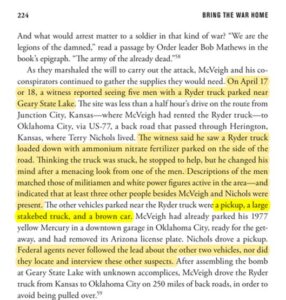
Perhaps the most interesting account from the Geary Lake witnesses is that of Charles Farley, who said that he drove into Geary Lake on the evening of April 17 or 18—he wasn’t sure which day. It was there that he saw the Ryder truck, surrounded by several vehicles, with a group of four to five men.
Farley testified in the McVeigh trial about what he had seen, and his account was later cited in Kathleen Belew’s 2018 book Bring The War Home, excerpted below:
When the FBI interviewed witnesses who saw a Ryder truck—either in Kansas or downtown Oklahoma City—they showed the witnesses a Ryder company flyer illustrating four different Ryder truck models. The FBI asked the witnesses to identify which type of truck they saw—was it the smaller 1-2 bedroom model with the cab overhang (like the older truck?), or was it the larger 20-foot truck used to deliver the bomb?
Below is the flyer introduced as an exhibit at the Nichols trial. I have marked the exhibit to identify the “second truck” and the “bomb truck.”
The Tucker Carlson Network is airing a new documentary series titled “The OKCBOMB Files,” and episode two covers many of the witnesses described here. Aired on September 17, 2026, the episode recounts what Georgia Rucker, James Sargeant, and Charles Farley saw. Carlson narrates, “James Sargeant was not an outlier; he was one of more than fifteen sightings of the Ryder truck at that same lake before the government claims the truck was even rented.” Following this, Carlson identifies other witnesses to the Ryder truck: Sharon White (Thursday April 13), Ricky Glessner (Sunday April 16), Raymond and Kevin Siek (Monday April 17).
Kathleen Belew’s account of the truck in Bring The War Home states that the feds never “followed the lead of a second vehicle”—but that isn’t entirely correct: FBI documents from the OKBOMB investigation indicate a serious investigation that lasted many months.
FBI documents from the investigation include a November 1995 FBI teletype that has FBI agents describing places where someone might purchase a used Ryder truck on the private market—this is a full seven months after the bomb truck had been identified as an Elliott’s rental.
By this time, the FBI had clearly discerned that another truck was part of the bombing operation, perhaps not a rental but an aftermarket used truck purchased at auction.
If the FBI was looking into the purchase of used Ryder trucks this far into the investigation, that is telling. We can reasonably conclude that it’s because the FBI knew—just as much as anyone reading this will know—that the bombers used a second truck.
Another FBI document, dated May 1996, shows that over a year after the bombing, the FBI was still investigating the lead, acquiring all records for the sale of used Ryder trucks at one auction between January 1994 and April 19, 1995.
These records indicate that during the investigation, the FBI was actively looking into a bombing scenario involving a second Ryder truck that may have been used or purchased on the aftermarket. The two FBI documents cited here, from November 1995 and May 1996, show that leads were being followed well into the long-running investigation.
Witnesses also saw a trailer attached to a Ryder truck driven by Timothy McVeigh and John Doe #2, in a convoy, departing Kansas in the early morning hours of April 19.
Witness Richard Sinnett, a gas station attendant at Sav-A-Trip in Kingman, Kansas, stated that McVeigh and John Doe #2 stopped for fuel sometime after 1:00 AM.
Both suspects entered the convenience store, and Sinnett said he saw the trailer attached to the Ryder truck in the lot. Sinnett noted that the trailer had a large tank mounted on it, with some kind of liquid sloshing inside.
When McVeigh and John Doe #2 left the station, Sinnett stated that they pulled out of the parking lot in a convoy: the Ryder truck, a pickup truck, and a sedan, all traveling together.
This brings the group’s total to at least four: perhaps some of the others were among the four or five men spotted at Geary Lake a day or two earlier? If so, that would align with the descriptions from the downtown Oklahoma City witnesses, many of whom said they saw McVeigh with four or five other people the morning of the bombing.
What all of this constitutes is compelling evidence that there is more to the Oklahoma City bombing than we’ve been told: more people involved and, at some point, a second Ryder truck that was smaller than the truck eventually used on April 19, 1995.
The FBI and prosecutors at trial were unable to account for these other suspects observed by the witnesses or for the other truck.
The second truck, like the accomplices, remains unresolved in the Oklahoma City bombing case; yet both are crucial pieces of the puzzle that independent researchers and investigators will need to focus on and, perhaps one day, identify.