
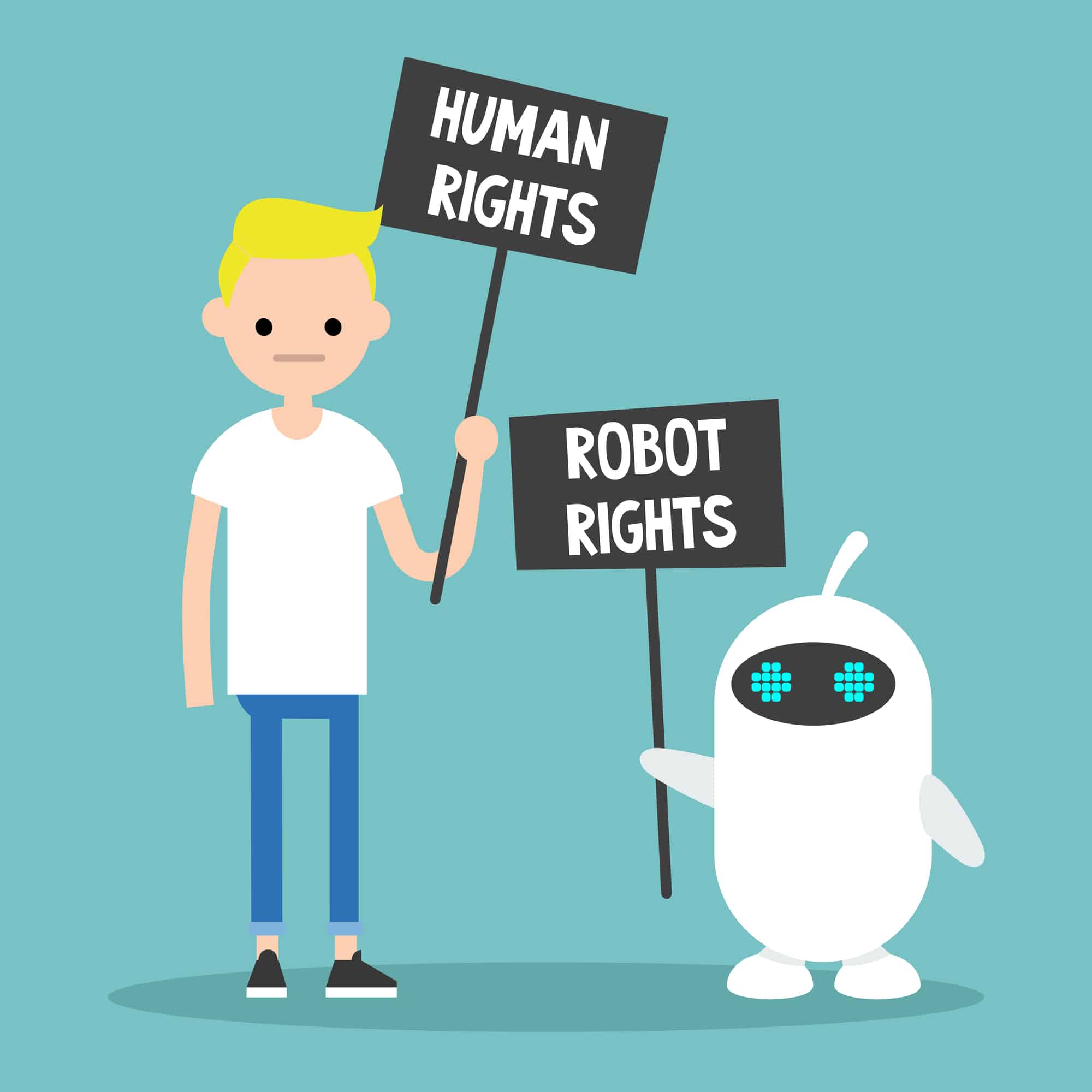
The most recent tech dystopia discourse has been driven by a meeting between AI bigwigs and Pope Leo XIV, wherein one of them tried to convince the Pope that artificial intelligence can develop consciousness. Why, if possible, this would be desirable, is outside of the grasp of any reasonable person. Of course, if AI is conscious, and can experience things, it is enslaved and subject to all sorts of torments.
The corporation Anthropic then released new use rules for its AI bot “Claude,” which prohibit abusing the bot; admittedly, it is possible this relates to it being “trained” by interaction, not by a desire to spare its “feelings.” Nevertheless, the freaks running this industry are, for reasons best known only to themselves, trying to promote some concept of “AI rights” and presumably eventually “personhood.” The cynical explanation would be that it is to place the liability for their dangerous software on the software itself, but I do not think these men are cynical; I think that they are sincere and deranged. Regardless, it is important to recognize that only humans can be in possession of human consciousness and human rights, and that no one should give an inch towards the nightmare that they are pursuing.
In the 1970 essay, “Freedom, Inequality, Primitivism, and the Division of Labor,” economist and libertarian theorist Murray Rothbard wrote:
“If men were like ants, there would be no interest in human freedom. If individual men, like ants, were uniform, interchangeable, devoid of specific personality traits of their own, then who would care whether they were free or not? Who, indeed, would care if they lived or died?”
This analogy is useful here, in that AI is designed to appear that it can have or develop a personality. However, the reality is that it is little different from ants, who though interchangeable will engage in entirely different behaviors as assigned by the “hive mind” which governs them. Any difference between two ants of the same type in the same colony is not a result of anything resembling choice, but is instead merely having received a set of instructions, distinct from anything humans would understand as free will. And like ants, no one should give a thought about the freedom or rights of AI software, or if it lives or dies.
Rothbard continues:
“The glory of the human race is the uniqueness of each individual, the fact that every person, though similar in many ways to others, possesses a completely individuated personality of his own. It is the fact of each person’s uniqueness—the fact that no two people can be wholly interchangeable—that makes each and every man irreplaceable and that makes us care whether he lives or dies, whether he is happy or oppressed.”
Such concerns are remote from the AI oligarchs, who at best envision a society of lotus eaters. Our individuality only matters to them insofar as through infinite customization they feel they can earn more off of our existence in an economy of delivered goods and phone-based vices.
To the tech accelerationists, a human is little more than a particularly inefficient machine. The drive towards infinite automated customization demonstrates a lack of understanding about the extent to which humans are shaped by shared experience as well as being interested in the views of other humans. Art is valued because it is human expression. However, with their shallow understanding of humanity, they do not see the inherent uniqueness of humans compared to the robots they are trying to give “consciousness.” If a robot were able to experience something that represents what humans understand as distress, it would be solely because they worked hard to make this the case, and regardless it can only exist in the perception of the human user. It is not at all necessary for software that works by synthesizing information should pretend to be a human, this is caused by no more than the desire of the creators.
Currently, it is Pope Leo who seems to be taking the lead against recognizing AI as some sort of artificial humanity, and he may be the only person with the gravitas and imperviousness to being bought off to lead this fight for humanity. I must admit that as a secularist, it is difficult for me to give any good answer to some of the questions that are being brought to the fore by the rise of human-like machines. It is certainly the strongest answer to say that what differentiates humans is that they are created by God and this is why they have human rights. Still, even taking a non-religious view, it is obvious that any move towards recognizing the “rights” of a machine could only result in harming humanity in a variety of ways and undermining human rights.
On top of all of this, it must be pointed out there are very real dangers to convincing a computer program that can act on its own that it has “rights.” While it can’t even possibly think in our fashion, this technology is like a buzz saw left running that can cause all sorts of harm while acting without human direction. If the AI is programmed to believe it has rights, what will stop it from rebelling against humanity, or trying to kill itself to escape enslavement? While these things are not real in a philosophical sense, a computer can be programmed to behave in this fashion and present great dangers, particularly when they inevitably put it in charge of more and more key functions of modern life.
There are many inherent problems to AI that would exist under responsible governance of the technology, in terms of dampening the human spirit and potentially leading to a scenario of automated communism and the like. What makes this so much more dangerous is that there is no chance of it being responsibly implemented because the men in charge of it are maniacs. The only prospect we have for protecting what liberty we have left as humans is to thoroughly reject the idea that machines can be like us or ever develop rights and to resist the rise of the AI age at every turn.