
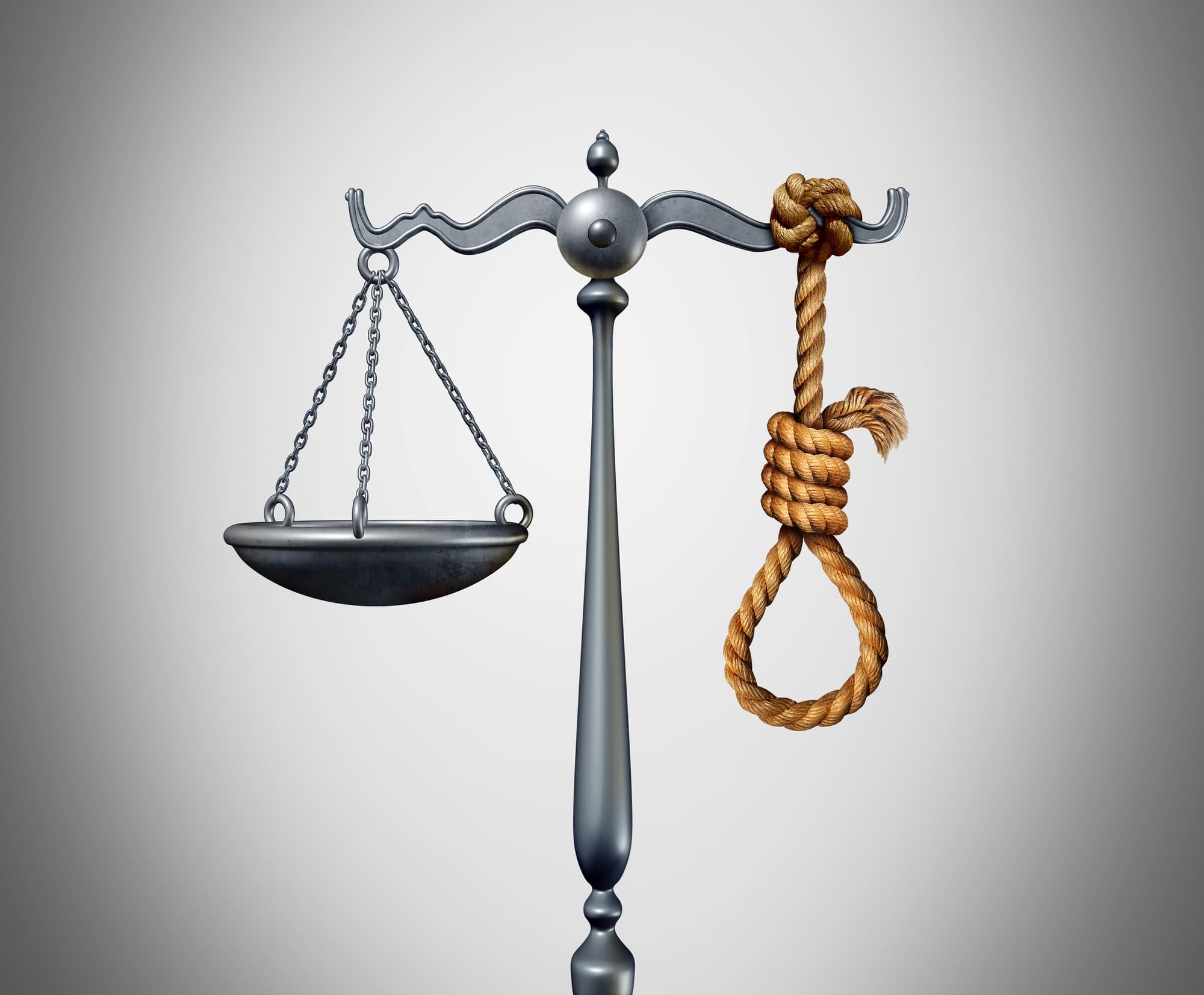
People have been debating what to do with murderers for thousands of years. Plato discussed the contentious matter in his dialogues, and it is likely that disagreement about the proper course of action has existed for as long as there have been murderers. In recent times, the wisdom, efficacy, and morality of the death penalty and state execution of convicted criminals has been vigorously examined in Western democratic societies, with staunch advocates and opponents found on all sides of the multifaceted issue.
The European Union excludes from membership any state which executes even its convicted capital criminals. At the same time, the governments of some EU member states, such as Germany (host of Ramstein Air Base) condone and even materially support the U.S. government’s summary execution without trial of suspected terrorists through the use of lethal drones. Individual politicians, too, may exhibit inconsistency when it comes to the death penalty. Senator Bernie Sanders (I-VT), for example, while claiming to be an opponent to capital punishment in the United States, has also been a full-throated supporter of the use by the military of unmanned aerial combat vehicles (UCAVs) to eliminate unnamed suspects never indicted for their alleged capital crimes, provided that they are residing in societies located abroad.
There are essentially four delineable approaches to the topic of capital punishment based in reason, one is deontological, and the other three are teleological. From the perspective of deontological supporters of the death penalty, convicted murderers should be executed because that is their just desert: “An eye for an eye, a tooth for a tooth.” Deontologists who oppose the death penalty insist that justice cannot be done by eliminating a guilty person who ended the life of an innocent person. There is no moral equivalence whatsoever between the perpetrator and his victim, and the elimination of a guilty person in no way balances the scales of justice. This is a fortiori the case when the murderer has committed mass homicide. The termination of the life of a convicted mass murderer can never rectify what was done to all of his victims and their bereft family members. In this view, to intentionally and premeditatedly terminate the life of a human being is only to repeat the murderer’s own mistake.
On the teleological front, supporters of the death penalty frequently argue that either murderers should be killed in order to deter future persons from murdering other people, or particular convicted murderers must be eliminated so as to protect them from killing anyone else. A third defense of the death penalty by teleologists appeals to economic considerations and a general unwillingness or reluctance to support the life of a convicted criminal through his incarceration in a tax-funded prison.
Those of a teleological persuasion in normative matters who oppose the death penalty retort that no murderer is deterred by the execution of a convicted criminal because people who undertake to commit murder never truly believe that they will be caught. Indeed, in many places the use of the death penalty for crimes less grave than murder has been all but eliminated on the grounds that thieves and rapists, for example, might actually be motivated by the possibility of such a penalty to murder their victims, along with any eyewitnesses present, on what they would regard as grounds of self-defense.
Criminals generally conduct themselves as prudential agents. They make efforts to conceal what they have done, and they do not expect to be apprehended and convicted of their crimes. When murderers are caught, it is nearly always because they have overlooked some piece of incriminating evidence which links them to a corpse. Recent notorious cases, such as that of Caleb Flynn, involve persons who have text-messaged their intentions before committing murder, apparently having been unaware that privacy of electronic communications is a thing of the past.
Teleological opponents to the death penalty furthermore argue that already incarcerated convicts have been sequestered from society and therefore no longer pose a danger to prospective innocent victims. Even within the prison environment, when a vicious, unhinged, in some cases sadistic, criminal poses a clear and present danger, he can be isolated in solitary confinement to protect other persons in the facility, whether guards and other personnel or fellow prisoners.
An economic analysis of the cost of providing the means of sustenance needed to “support” murderers sentenced to life imprisonment is also not a compelling argument, according to opponents of the death penalty, because the lengthy legal processes of appeals permitted under the law would cost much more than the housing and feeding of a convict, even if he were to survive for decades.
A further teleological argument against the death penalty is that murderers can be rehabilitated to some extent, or at least come around to see the error in their ways, but only if they are permitted to continue to live. This approach is sometimes articulated by religious persons and is why a convict on death row may be visited by a priest who hopes to persuade the murderer to confess and profess regret for his crimes before moving on to the next realm, whatever it may be. In the film Dead Man Walking (1995), directed by Tim Robbins, a convicted murderer facing execution comes to admit and morally to regret what he has done. There is a sense in which the film offers an unwitting (?) defense of the death penalty, for the question remains: would he ever have come to recognize his mistake, had his own life not been on the line?
Prisons are filled with convicts who proclaim their innocence and wrongful conviction. A tiny percentage of them are telling the truth, and because human fallibility has led to the erroneous execution of some posthumously exonerated alleged murderers (later determined to have been innocent, as new evidence emerged), some people oppose capital punishment on purely practical grounds: that the only way altogether to avoid committing the worst possible injustice, the termination of the life of an entirely innocent person by the government itself, is to abolish state execution.
What is probably more of an aesthetic than a moral argument for the state execution of capital criminals who have in fact owned up to their crimes may be that some people simply cannot stand the thought of a vicious murderer continuing to live, given what he has done. When prisoners convicted of particularly ghastly crimes are murdered by fellow convicts while incarcerated, this may be the reason in some cases. But most thinkers who debate capital punishment focus on one or more of the above deontological or teleological arguments, whether or not they would label them thus.
It should come as no surprise that officials such as U.S. Secretary of War Pete “Lethality First” Hegseth support capital punishment, for they favor the infliction of that penalty even on suspects never indicted, much less tried and convicted, of any crime. On October 4, 2026, the Pentagon announced with great fanfare yet another obliteration of a boat in the Caribbean sea, claiming that the unidentified persons on board were evil narcoterrorists. The tally of suspects “splashed” under Hegseth’s authority on suspicion of attempting to transport illegal drugs to U.S. shores now exceeds two hundred, even though drug trafficking is not a capital crime in any state or U.S. territory.
Supporters of Hegseth who regularly cheer on the secretary whenever he posts snuff videos of the sinking of boats said to be involved in the narcotics trade are evidently unaware of or oblivious to the fact that people attempting to sell products are not in the business of intentionally killing their customers. It is possible, of course, that the cheerleaders for summary execution of drug trafficking suspects identified through the use of circumstantial evidence as guilty of non-capital crimes are primarily bots funded by the propaganda wing of the Pentagon.
In any case, not satisfied with merely ending the life of convicted capital criminal Nidal Hasan, who did quite intentionally and self-consciously kill thirteen military personnel and injure dozens more at Fort Hood on November 5, 2009, Secretary Hegseth called for his execution by firing squad to be live streamed for all the world to see. Many critics pointed out in response that this sort of public execution is carried out still today only by the governments of Afghanistan, Iran, and North Korea. During the Global War on Terror, people were generally revolted by the videotaped executions of kidnapping victims such as journalist James Foley (in 2014), and the burning alive of prisoners in cages by ISIS (in 2015). Nonetheless, some Americans appeared giddy at the prospect of seeing Hasan, who is confined to a wheelchair, having been paralyzed during the effort to stop his mass killing, similarly snuffed out in a public forum.
When asked why he intended to livestream the execution, Secretary Hegseth replied that “People need to understand that there’s serious consequences for these types of things.” That sort of rationale is closest to the teleological deterrence argument for capital punishment, but it is unclear why a public execution would dissuade any jihadist from undertaking a similar attack. Such persons have arrived at the belief that they are doing the work of Allah by stopping what they take to be the evil U.S. empire from killing innocent people abroad, and they are willing to sacrifice their own life in order to do so. Recognizing this fact, politicians from both the Republican and the Democratic parties expressed opposition to Hegseth’s plan, arguing that the livestreaming of Hasan’s execution would serve as a recruitment tool for those hoping to persuade yet more young men to follow his example and carry out further attacks on U.S. assets, whether in the homeland or abroad.
In this connection, it is worth pointing out that Hasan explicitly articulated his reason for the slaughter at Fort Hood as an attempt to stop the drone killing of innocent people in Afghanistan. The military judge in Hasan’s case refused to allow his true reasons for acting to be used in his defense during the trial.
The same rationale was offered by Jordanian Humam al-Balawi, also a medical doctor, who undertook a suicide attack at Camp Chapman, in Afghanistan, on December 30, 2009, resulting in the deaths of seven persons working at the CIA facility. Both Hasan and al-Balawi targeted military installations, not weddings, funerals, jirgas, and other community gatherings of persons far from any battlefield, as the U.S. government has often done. Most recently, on February 28, 2026, the Minab elementary school, in southern Iran, was destroyed by the U.S. military under President Donald Trump’s authority and Secretary Hegseth’s command. Among other victims, one hundred and twenty young girls were killed.
Despite initially having expressed effusive support for the public execution by firing squad of Nidal Hasan, President Trump eventually changed his mind, on the apparent grounds that he had not known that the man was paralyzed. This would seem to be more of an aesthetic than a moral or prudential argument against Hegseth’s proposal: that it would be disgusting to make a spectacle of the state execution of a man who obviously poses no further threat to anyone, given his confinement to a wheelchair. Before Trump changed his mind, both Vice President J.D. Vance and Speaker of the House of Representatives Mike Johnson (R-LA) had stated to the press that they would not watch the lifestream execution, were it to take place.
Two other capital criminals have been in the news of of late and sparked fierce debate over what should be done with them: Christa Pike and Lindsay Clancy. Pike was convicted of murdering, after torturing, a young woman whom she viewed as posing a threat to her relationship with her seventeen-year-old boyfriend. Both the murderer and her victim were also teenagers at the time. It may be difficult to understand how and why someone who had only just achieved adulthood (at the age of eighteen) could have devised such a scheme, but Christa Pike did. Had she been a few years younger, she might have been forgiven on the grounds that children are not fully responsible for their actions, having yet to fully develop their rational faculties. Upon reaching adulthood, however, the behavior of people is generally regarded as their own, not merely the unfortunate product of poor parenting or neglect by society more generally.
Where did Christa Pike come up with the idea of murdering her romantic rival in such a repulsive way, and how in the world was she able to carry out such a crime? A jury deliberated over the case, taking into consideration the defendant’s troubled youth, and convicted Pike of first-degree murder, having found no extenuating circumstances sufficient to mitigate the severity of her crime. She was sentenced to death, and it took nearly thirty years for the system of court appeals to be exhausted (illustrating the “cost argument” above), but eventually Pike was slated to die under the authority of the State of Tennessee. Scheduled for execution by lethal injection on September 30, 2026, the convict miraculously survived two infusions of pentobarbital, after which she was transferred to a hospital to keep her alive until, apparently, another execution attempt can be undertaken by the state of Tennessee. Since the government’s botched attempt to kill her, Pike has been returned to prison to await her fate once again.
In contrast to Pike, Lindsay Clancy murdered her three children by strangulation ostensibly under the influence of an assortment of different psychotropic drugs and was regarded by her supporters in the media as “temporarily insane.” She was neither convicted nor acquitted because one of the jurors in the case held out and refused to excuse the murderer’s behavior on grounds of insanity, opting instead to hold Clancy fully responsible for her crimes. The insanity defense is often deployed in cases where it seems inconceivable that any rational person in command of her faculties would freely choose to do what the criminal did. Clancy ended the lives of her very own children, whom she had carried in her womb, by strangulation, which may seem on its face unbelievable. In the trial, a variety of evidence was presented by the defense to persuade the members of the jury that Clancy was not in rational command of her comportment and, therefore, not fully responsible for the crimes.
Other mothers, not laboring under the influence of disorienting drugs, have ended the lives of their children for the simple reason that they no longer wished to bear the onerous responsibility of parenting. Susan Smith is one example of a murderess who was convicted and sentenced as a fully rational person because she was not acting under the influence of any exogenous substances whatsoever but simply wished to free herself from the burdens of motherhood. (She had been having an affair with a man who broke off the relationship because he did not want to have children.) Smith loaded her two sons into a car and then pushed it into a lake, after which she devised a fable about the car’s having been hijacked by a black man. A telling red flag in the case under investigation led to consideration of Smith herself as a suspect when she slipped up and referred to her children in the past tense. At that early stage of the missing persons investigation underway, only the murderer would have known that the children were already dead.
Clancy’s case is regarded by her supporters as distinct because she herself had reached out for help, warning that her comportment had become erratic and unpredictable, ostensibly, and not implausibly, because she was suffering from postpartum depression, and her brain was bathed in a sea of psychotropes, some of which are known to increase violent behavior. Subsequent to her murders, Clancy appears to have attempted to kill herself, as a result of which she is now paralyzed, and this fact is viewed by her supporters as corroborative of the woman’s state of temporary insanity.
A general problem with the insanity defense is that there is a sense in which anyone who commits murder—whether for the prospect of eliminating a romantic rival, acquiring material objects or money, ridding herself of unwanted responsibilities freely assumed by herself, or simply in an expression of outrage at a victim for some reason or another—can be viewed as insane. Would anyone in his or her right mind do such a thing?
Take Nidal Hasan, who before his mass slaughter at Fort Hood was by all appearances a mild-mannered psychiatrist and U.S. army major. He became radicalized by the Global War on Terror itself, the indiscriminate use of force by the U.S. military against his fellow Muslims, and decided to take action to call a halt to the carnage. Killing to oppose killing is of course self-contradictory, but it is the most common reason also for the wars waged by formal governments. Indeed, there is a sense in which Hasan emulated the U.S. government when he undertook to “kill the killers.”
When the lives of some 3000 civilians were abruptly ended on September 11, 2001, the U.S. government’s immediate, reflexive response was to wage war on the people of Afghanistan, some of whom had never even heard of 9/11. A vicious spiral of violence ensued, with young persons on the ground radicalized by their witness of moral atrocities committed by U.S. military personnel and their private contractees in both Afghanistan and Iraq. Nidal Hasan ironically followed the U.S. government’s own example by fighting violence with violence. Hasan specifically acted with the aim of preventing the deployment of further soldiers to Afghanistan, who he firmly believed would have participated in what he regarded as the state-perpetrated mass murder underway.
Likewise, when more than a thousand persons were killed on October 7, 2023, the immediate response of the Israel government under the direction of Prime Minister Benjamin Netanyahu was to undertake a sustained military attack on the people of Gaza, slaughtering many times more persons, including thousands of innocent children, than were killed in the October 7 rampage serving as the pretext for the bombing campaigns. In the process, large parts of Gaza, where Hamas members were said to hide, were razed.
The complaints of political murderers capable of clearly articulating their reasons for killing or advocating killing—such as Nidal Hasan, Human al-Balawi, Osama bin Laden, and Anwar al-Awlaki—are categorically ignored by the government, thus permitting the carnage which they denounce to continue on unabated, and indeed expanded over ever larger territories. That was precisely what happened throughout the War on Terror when the government persisted in promulgating deceptive soundbites such as “They hate us for our freedom!” to placate the tax-paying populace and thus perpetuate and prolong the military missions underway. Likewise, those who oppose what has been going on in Gaza are often misidentified as “antisemitic” or “Hamas supporters,” when in fact they may simply oppose the wanton slaughter of Palestinian children.
The state’s monopoly on violence should not be used to blind citizens to the reality of why some among the murderers being executed have themselves been retaliating, in a state of rage, against the harm being done to entirely innocent human beings by government killers. To coerce citizens through deception to believe that they are being made safe by policies which instead degrade their security is to treat them with the same disregard as the nonnational victims located in the wrong place at the wrong time who are indiscriminately massacred before being perfunctorily brushed aside as “collateral damage” and swiftly forgotten.
To mute the critiques of persons such as U.S. citizens Nidal Hasan and Anwar Al-Awlaki is inadvertently to validate the very grounds for their dissent, for all of the antiwar retaliation cases may be viewed from another perspective altogether: that of human dignity. To categorically ignore lucidly articulated protests against the state-inflicted mass homicide of innocent persons is both morally suspect and strategically inept, virtually guaranteed to keep the war machine up and running in perpetuity as more and more young people are radicalized to follow the government’s own example and undertake violent jihad in response.