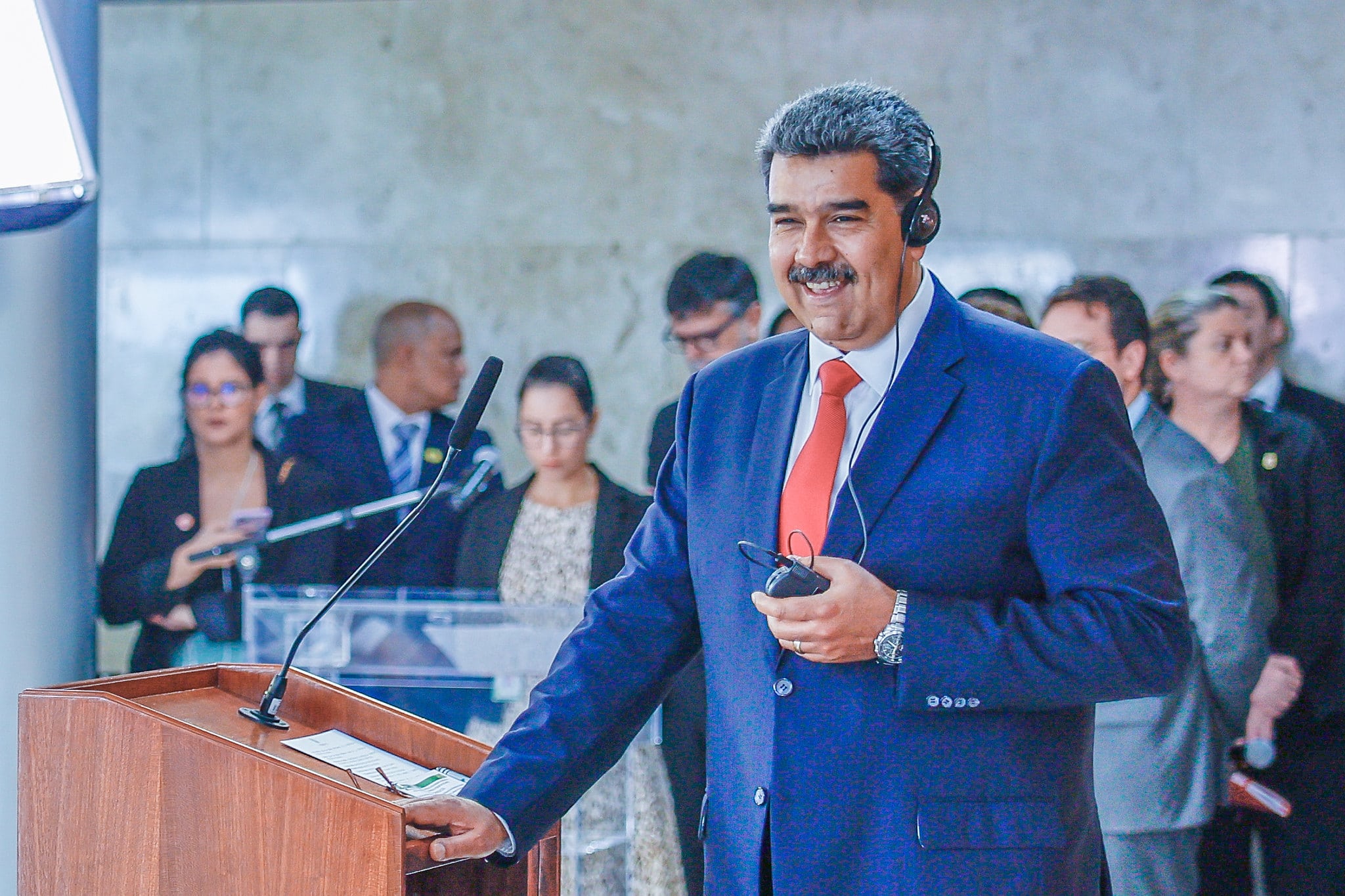
President Donald Trump’s January kidnapping and deposition of Venezuelan President Nicolas Maduro and the subsequent “government-by-coercion” in the name of economic “development” is arguably America’s most dramatic imperial action in Latin America in history. But it is merely one in a series of moves of an operation that was set in motion five months before, and whose pieces were being arranged years before that. The hinge of this operation is Argentina’s Isaac Accords, which were announced in August, and which use financial-philanthropic investments in Latin American countries to turn Israel into a regional hegemon in America’s backyard.
Applying as seed money $1 million awarded to Argentina’s President Javier Milei via his acceptance of Israel’s Genesis Prize, the Isaac Accords establishes a nonprofit, the American Friends of the Isaac Accords, run by the Genesis Prize Foundation and headed by former U.S. ambassador to Costa Rica Stafford Fitzgerald “Fitz” Haney. The American Friends of the Isaac Accords aims to provide Latin American countries “Israeli expertise in water technology, agriculture, cyber defense, fintech, healthcare, and energy,” while also “aim[ing] to encourage partner countries to move their embassies to Jerusalem, formally recognize [Iran’s proxies] Hamas and Hezbollah as terrorist organizations, and shift longstanding anti-Israel voting patterns at the United Nations.” It “will initially focus its efforts on three Latin American countries: Uruguay, Panama and Costa Rica” and “ultimately aims to expand its mission to Brazil, Colombia, Chile and potentially El Salvador by 2026.”
This Zionist-arbitrated “leveling up” or “raze-and-rebuild” effectively means diluting countries’ sovereignties and markets to serve Israel and its American military-corporate backers—and it is not an unfamiliar process. As I have reported for the Libertarian Institute, it already stretches from Gaza and Abu Dhabi in the Middle East to New York and Miami in America. Its most formal instantiations are the Abraham Accords, which since 2020 have used the promise of favors from American institutions to incentivize Arab countries to open themselves to development at the hands of Israel, Saudi Arabia, and the United Arab Emirates—and to marginalize Iran, a center of opposition to western “development.” The Isaac Accords, which are openly modeled on the Abraham Accords, are something else entirely. They establish Israel as an arbiter of development in a region entirely outside its orbit: a region of around 660 million people populated by around 300,000 Jews where America is the decisive arbiter and hardly needs an Israeli proxy. For opponents of Zionism, the Isaac Accords are the equivalent of a multi-jump win in checkers where, as the other player sits back shocked, the winner systematically removes that player’s pieces from the board.
But the Isaac Accords are also an opportunity—to measure the tactics of our Zionist adversary. The Isaac Accords did not, appearances aside, materialize out of nowhere. They are reliant, as are all Zionist plays, on something our Founding Fathers would recognize from their experience with the British. Namely, the subtle, sometimes hidden, and always profoundly anti-democratic and unconstitutional marshalling of support from an empire’s military-corporate complex by connected players running their own agenda on the inside.
Investigating the background of the Isaac Accords and their connections to plays against Iran and Venezuela reveals their source in two distinct yet connected Zionist plays run over four decades. These were not conspiracies in small rooms so much as operations of like- minded players with similar loyalties in positions of power pursuing self-interested ends. The first, beginning in the 1980s, was political and economic: the Zionist cooption of two policy values of the United States, anti-communism and the free market, to lay siege to Latin American countries with the aims of marginalizing Israel’s rival Iran and empowering Zionists. The second, beginning in the late 1990s, was philanthropic: the Zionist use of religious philanthropy to co-opt Latin Americans of influence, some of them true believers in genuinely worthy causes like genocide prevention and promoting free markets, whose causes Zionists helped and who gave Zionists loyalty to Israel.
The clearest genesis of the inking of the Isaac Accords is Zionists’ adoption and promotion of America’s 1980s anti-communist activities in Latin America. These activities flowed in many ways from the work of Jeane Kirkpatrick, Ronald Reagan’s first ambassador to the United Nations, whose influential 1979 essay, “Dictatorships and Double Standards,” arguably set the framework for the Reagan administration’s Latin American policy. In “Dictatorships and Double Standards,” Kirkpatrick argued that, so long as what she saw as a totalitarian regime, the Soviet Union, was spreading its Marxist ideology via client nations, America should be willing to ally with self-interested authoritarians to push it back. This was a familiar type of argument, and equally familiar was the disastrous collateral when it was put into practice—in the 1950s and 1960s in Guatemala, Iran, Cuba, the Congo, and Vietnam. In 1985, the Libertarian Institute’s Ted Galen Carpenter argued, with what turned out to be extraordinary prescience, that caution was in order when it came to Kirkpatrick’s agenda. But Kirkpatrick was allied with powerful people interested in advancing her view. These were Zionists working to advance the interests of the American military-corporate complex which upholds Israel; people who assiduously worked to pair American proxy wars against left-wing Latin American governments like Nicaragua’s with efforts to neuter Israel’s main regional adversary, Iran.
These Zionist player operated in the political-intellectual sphere. Kirkpatrick’s article, “Dictatorships and Double Standards,” was published in Commentary Magazine, edited by the late Norman Podhoretz, along with Irving Kristol the most famous Jewish neoconservative of the era. Kirkpatrick wrote “Dictatorships and Double Standards” when she was a fellow at the American Enterprise Institute, an increasingly Zionist holdover from 1930s anti-New Deal politics which was just then beginning to seed the neoconservative Zionist players who created the Iraq War. The views expressed in “Dictatorships and Double Standards” were promoted by Kirkpatrick’s ally William Casey, a Wall Street operator with deep and longstanding connections to Zionists who in 1978 founded the think tank the Manhattan Institute to promote corporate interests in the name of the free market. But political-intellectual operations were not the limit of Zionist influence; Zionists also became the operators who ran Kirkpatrick’s plays.
As I recently reported for the Libertarian Institute, within several years of Podhoretz running Kirkpatrick’s article, Elliott Abrams, Podhoretz’s son-in-law, had turned up at the State Department running versions of Kirkpatrick’s recommendations in conjunction with William Casey, who was running the CIA. During these same years, Podhoretz’s and Abrams’ fitful Zionist allies, Martin Peretz and Leon Wieseltier of The New Republic, Washington’s most influential magazine, were promoting Abrams’s arguments for funding the Contras, rebels against the Nicaraguan government, and promoting a representative of the Contras in Washington who gained access to the White House. Within several more years, Abrams and Casey were running Iran-Contra: the play in which funds from weapons sales to Iran were used to support the Contras of Nicaragua despite a congressional law forbidding such support. And Israel was playing Iran-Contra middleman: sponsoring operators to run the arms to Iran and then funneling the payments from Iran back to America en route to the Contras, with anti-Castro Cuban exiles middlemen for the Latin American end of the play.
Iran-Contra failed to coopt Iran into American empire or reduce the Left in Latin America, and associated plays against the Left by Washington mainly succeeded in leaving Latin Americans with the scars of imperial brutality. But the internal dissolution of the Soviet Union a few years after Iran-Contra left the Soviets’ allies in the Middle East and Latin America in the lurch and gave America’s military-corporate complex an opening in both regions. As with Jeane Kirkpatrick’s “Dictatorships and Double Standards,” the main imperial movers were Zionists: people interested in expanding American imperial reach, which would further secure Israel. And, as with Kirkpatrick, there was a theoretical groundwork for Zionists’ moves. Namely, the work of Robert Bork, also a fellow at the American Enterprise Institute who in the 1970s during his stint there wrote an influential treatise against antitrust regulation arguing that corporate conglomeration was a positive free market development so long as it lowered consumer costs.
Bork’s thesis, which arguably shaped many of the Reagan administration’s deregulatory policies, is widely debated. But, whatever one’s view, what is less arguable is that the Zionist academics and policy practitioners who operated off Bork’s impact in the late 1980s and 1990s had a different set of priorities. Alan Greenspan, Robert Rubin, Lawrence Summers, Kenneth Rogoff—these economists’ theories did not free the market or reduce government power. Instead they encouraged government to promote the growth of and in some cases subsidize companies in select sectors, especially technology and finance, which in their telling would power America’s consumer economy. Applied to former Soviet client countries in Eastern Europe and Latin America, this approach meant administering “shock therapy” capitalism. Namely, “ripping the band-aid” off socialist or communist political economies newly dependent on American loans by privatizing them across the board and all at once, while deliberately isolating American-backed politicians from popular feedback to “protect” the free market from what “shock therapists” saw as dangerous populistic energies. In Libertarian Institute Director Scott Horton’s description of the process, Summers, Rubin, and other “Harvard Boys’:
“…abolished all subsidies and price controls in the formerly completely Communist economy, induced hyper-inflation, destroying all available capital for real investment and used “voucher” and “loans for shares” schemes that handed over entire industries to connected gangsters and oligarchs. The consequences for the economy and civilian population were beyond severe. They were devastated. Life expectancy fell by double digits across the country.”
Not surprisingly, Zionist operators in media, finance, and international relations helped these economic approaches bear fruit. Leon Wieseltier brought to Washington Mario Vargas Llosa, giving the Peruvian writer and future Nobel Prize winner an American platform just as Vargas Llosa entered Peruvian politics on a pro-“shock therapy” line that was soundly rejected by Peruvian voters. The World Bank, which was run in these years by the Zionist financer James Wolfensohn and the Zionist foreign policy operator Paul Wolfowitz, pursued similar agendas with similar results. It lent to countries grappling with debt to help them develop their economies, but in ways and on terms that made these countries ever more dependent on American largesse. Zionist financiers also involved themselves in this process, and were less hooded about their intentions. Paul Singer, the Jewish Zionist hedge funder who would later help fund the Manhattan Institute, accelerated his finance career buying sovereign debt from economically struggling nations including Argentina and Peru, then avidly pursuing full payment using lawsuits. Zionist political operators involved themselves, too. In 2002, a political consulting firm, Greenberg, Carville, Shrum—founded by James Carville along with two Zionists (Stanley Greenberg, Robert Shrum) who had helped The New Republic’s chosen presidential candidates Michael Dukakis, Bill Clinton, Al Gore, and John Kerry—ventured down to Bolivia to help swing a presidential election in favor of a pro-shock therapy candidate advised by the World Bank.
Latin Americans with ties to Zionist-arbitrated institutions in America also brought the agenda back home. A case in point is Harvard, where, as I have reported for the Libertarian Institute, Zionist operators accrued power beginning in the 1970s and which, in the 2000s, graduated two Argentinians who later rose to influence pushing Zionist economists’ agenda. The first was Demian Axel Reidel, who served as Head Advisor to Argentina’s Office of the President until July and now serves as the president of Nucleoeléctrica S.A., the state-owned company that manages nuclear power plants. Reidel wrote his dissertation for a PhD in economics at Harvard in 2006 under the instruction of Kenneth Rogoff, and, unlike the populist libertarian Javier Milei, took the line of Rogoff’s school of economics that populism leads to instability and disorder. The second was Martin Peretz’s mentee Pierpaolo Barbieri, who helped Peretz’s ally Niall Ferguson start the advisory firm Greenmantle, then founded Uala, an Argentinian “fintech” (financial technology) company which calls itself as “mobile banking startup” and doubles as a digital debit card and a bank, with investments from Peretz and George Soros. Not coincidentally Reidel and Barbieri are also ardent Zionists.
Their views are not the views of most Latin Americans. As early as 2003, mass protests in Bolivia against the president installed with the help of Shrum, Carville, Greenberg in 2002 paralyzed the country and led to a series of events that put the Leftist candidate Evo Morales into power. And the Bolivia case was predictive for the region, where backlash to Zionist-arbitered empire came in the form of rising socialist or communist movements advocating for wealth redistribution to the working class. It was this backlash that powered the rise of Hugo Chavez and Nicolas Maduro in Venezuela; Nestor and Christina Kirchner in Argentina; Evo Morales in Bolivia; Luiz Inacio Lula Da Silva and Dilma Rousseff in Brazil; and Andrés Manuel López Obrador and Claudia Sheinbaum Pardo in Mexico. Not surprisingly, many of these movements were anti-Zionist. Many were also, in a re-articulation of the 1980s alliances of the Latin American Soviet bloc, pro-Iran.
But as these movements gained power in the 2000s and 2010s, Zionists were developing another tool to handle Latin American dissent. They were using the power they’d gained over national security and economics in America to co-opt Latin Americans via religious philanthropy, inducing figures of influence from the region into the Zionist orbit.
The case in point when it comes to the Isaac Accords is Eduardo Eurnekian, one of Argentina’s richest men: an Armenian-Argentinian committed to memorializing that Armenians’ genocide at the hands of the Ottoman Empire, which his family survived. As his business prominence grew, Eurnekian became, via an Argentinian Jewish Zionist named Baruch Tenembaum, the stalwart chairman of the International Raoul Wallenberg Foundation. This Foundation was founded by Tenembaum and had powerful American Zionist backers including Samuel Pisar, the stepfather of former Secretary of State Antony Blinken. It was named after a figure whom Tenembaum describes “plung[ing] himself into…saving the lives of tens of thousands of Hungarian Jews” from the Nazi regime. The Foundation is, in Tenembaum’s telling:
“…a global-reach NGO with a mission to preserve and spread the legacy of Raoul Wallenberg and of people like him who saved lives in the Holocaust, the Armenian genocide and other tragic chapters of history.”
It is also part of a wider network of Zionist NGOs, often with deep connections to American politics and finance, which memorialize the Holocaust and enfold other minority groups in their work. This enfoldment is predicated on shared enemies (many Muslims see Israel as an adversary; it was the Muslim Ottoman Empire which genocided Armenians, the majority of whom are Christian). It is also predicated on a trade that is only articulated implicitly, in which a less powerful minority attaches their struggles to the struggles that justify Zionism in exchange for “legitimacy” at the financial-philanthropic table. This is the trade Eurnekian made, and, judging by his published writings and statements, the International Raoul Wallenberg Foundation is a deep emotional commitment besides. What makes this philanthropic conversion significant is that Eurnekian was Javier Milei’s first real backer: the reason Milei became a public figure long before the 2020s and the person who shaped his career at crucial moments in much the same way Kenneth Rogoff shaped Demian Reidel’s. In the telling of the Jewish journal K.: Jews, Europe, the 21st Century:
“Milei would not have been able to reach his ultimate position…if he had not also been able to expand his network of contacts far beyond academic and journalistic circles. This was the starting point of his true transformation. Milei began his career as a news commentator for America TV, owned by Eduardo Eurnekian…Milei’s employer since 2008. In addition to entertaining Eurnekian with his irreverent jokes, [Milei] was [Eurnekian’s] economic analyst and financial advisor…It was Eurnekian who decided in 2015 to install Milei on [Eurnekian’s] America TV channel to criticize [Argentina’s left-wing] government, with which [Eurnekian] was in conflict.”
Eurnekian gave Milei the connections and notoriety that allowed his presidential run. He also likely incubated in Milei, who grew up middle class and Catholic, a comfort with elite Argentinian Jews, almost all of whom are Zionists. These connections and this comfort came in useful as Milei started his political career. In June 2021, according to K., “Milei was the target, on social networks, of accusations of Nazism and comparisons with Hitler that deeply wounded him.” To address the accusations, Milei:
“…called economist Julio Goldstein, a leading figure in the like-minded Jewish community, to work out a strategy. Goldstein suggested introducing him to his friend Shimon Axel Wahnish, chief rabbi of the Moroccan-Argentine Jewish community of Acilba, who belongs to the Modern Orthodox movement. As Goldstein later recounted, their first meeting quickly turned into a ‘cabalistic meeting’ in which Wahnish even came to tell Milei, a year before he announced his candidacy, that he was the leader of a ‘liberation movement.’ The future president came out of the meeting ‘enthusiastic,’ to the point of deciding to devote his entire life to the Torah, after fulfilling the political mission God had given him.”
And Milei is not the only person connected to Israel’s new rapprochement with Argentina who has experienced a personal religious turn. So is the other main player in the rapprochement, Friends of the Isaac Accords President “Fitz” Haney: a Black American who grew up an observant Catholic, converted to Judaism, visited and lived in Israel, married an Israeli rabbi, and brought Israel’s interests to Latin America. According to Haney, describing his conversion, he”
“…worked for almost a decade in Latin America for companies including Procter & Gamble, PepsiCo and CitiBank. In the late 90s he was living in Mexico, and finding it difficult to fit into a faith community, despite the dominance of Catholicism…So he started looking around for a rabbi who would sit and learn with him, finding an assistant rabbi at an Orthodox community who agreed to the proposal — after clearing it with the country’s chief rabbi and ensuring that Haney was not dating anybody…After two years of study and growing Jewish observance in Mexico, Haney traveled back to Chicago to formally undergo conversion, and then headed to Israel for further study.”
Like Milei’s conversion, Haney’s has a secular context, which is to say his conversion made possible his subsequent career. It allowed Haney to be, in his own telling, a link for the Barack Obama presidential campaign between the black and Jewish communities, before he was asked by the Obama administration to serve as a member of the U.S. Holocaust Council and then as Ambassador to Costa Rica. After his ambassadorship, Haney took on a role as Group Partner, Head of Strategic Development, at Viola Group, “Israel’s leading technology-focused investment group with $3B [assets under management].” And all of this was before Haney’s hiring by three Russian-Jewish Zionist monopolists of the class which benefited from American Zionists’ “shock therapy” in the former USSR to work in an outgrowth of their Genesis Philanthropy Group: the Genesis Prize Foundation. Each year since 2014, the Genesis Prize Foundation awards the Genesis Prize to “honor those people who attribute their success to Jewish values,” with the selection committee “led by the speaker of the Knesset, Israel’s Parliament, and include[s] two retired Israeli Supreme Court justices.” It was this Award that Javier Milei received in 2025, the first head of state to be honored in this way. And it was this award that was the basis for Milei’s proposal of the Isaac Accords, which Fitz Haney is set to bring to fruition via his stewardship of the American Friends of the Isaac Accords, which exists under the umbrella of the Genesis Prize Foundation.
In light of these multiyear Zionist campaigns in foreign policy, economics, and religious philanthropy, aspects of recent Latin American and American history appear in a different light. Namely, a nearly two-year series of apparently disconnected events beginning not long after October 7, 2023 and not long before Milei assumed office that December takes on the appearance of a Zionist play: the arrangement of the checkers pieces for the multi-jump win that is the Isaac Accords. This was an operation so worn into the grooves of power that it didn’t need to be coordinated so much as a series of connected individuals simply needed to act on what they perceived their shared interests to be—creating the sequence of events that follows below.
In November 2023, a group of writers and intellectuals led by Mario Vargas Llosa endorsed Milei for the presidency in an open letter. In December 2023, Jay Newman, Paul Singer’s point man on sovereign debt litigation who had extracted $2.4 billion from Argentina told New York Magazine that Milei’s election was “an opportunity for the U.S. to claw back a strong relationship with an important country in South America.” In June 2024 the Manhattan Institute, where Paul Singer is now the most influential funder, ran a report praising Milei’s economic policies and advocating their spread beyond Argentina. In September of 2024, Elliott Abrams wrote on the website of the Council on Foreign Relations praising Milei’s speech at the 79th session of the United Nations General Assembly for “truth telling” in the “swamps of Turtle Bay.”
In January 2025, the Genesis Prize’s selection committee awarded the $1 million Genesis Prize to Milei. In April, Paul Singer’s sovereign debt litigation point man Jay Newman wrote a Financial Times article in support of Argentina in a court case between Argentina and sovereign bond holders, an article that was retweeted by Milei and which generated extensive controversy and coverage. In June, six days after Milei actually received the Genesis Prize, Shimon Axel Wahnish, Milei’s rabbi whom Milei had appointed Argentina’s Ambassador to Israel, gave an interview with The Jerusalem Post floating the idea of the Isaac Accords. In late July, Pierpaolo Barbieri and Niall Ferguson met with Milei and pronounced themselves confident about his chances of success reforming Argentina’s economy—and Ferguson also made this point in several articles in The Free Press, which is edited by the Zionist Bari Weiss and now owned by the Zionists Larry and David Ellison.
In early August, Milei launched the Isaac Accords and the Genesis Prize Foundation hired “Fitz” Haney to run the American Friends of the Isaac Accords. In October, Treasury Secretary Scott Bessent, a former career employee of Pierpaolo Barbieri investor George Soros, announced significant American assistance to Milei’s government to help Milei achieve the success predicted by Barbieri and Ferguson. That same month, Elliott Abrams’ longtime ally Marco Rubio, the son of Cuban American exiles, accelerated the American effort to depose Venezuela’s president Nicolas Maduro, Iran’s principal ally in Latin America. In December, Donald Trump ended a meeting with Benjamin Netanyahu by threatening further strikes on Venezuela’s key ally Iran.
And, in early January 2026, with Zionist–linked newspapers reporting on protests in the streets of Iran (protests some Iranians suggested were engineered by outside operators or overblown) Trump threatened American military intervention on behalf of Iranian protestors. This was less than a day before America actually militarily intervened in Venezuela and achieved regime change there. “At this rate, Iran’s going to be free soon,” tweeted the Zionist financier and Trump backer Bill Ackman, a Harvard mentee of Martin Peretz and a recent investor in Pierpaolo Barbieri’s Uala. “FREEDOM ADVANCES,” tweeted Javier Milei that same morning of Maduro’s deposing, “LONG LIVE FREEDOM DAMN IT.”
This sequence of events, made possible by the forty years of operations that preceded it, has accelerated history to the point that, between the Iran-Venezuela plays and the Isaac Accords, America is undertaking versions of both the foreign interventions of the 1980s and the “shock therapy” of the 1990s at the same time. Only now these plays are being made not by Jewish Zionists via American empire but by Israeli Zionists with American imperial support. They are also being made using Javier Milei: by all accounts a genuine and innovative champion of free markets and populist politics whose models are not the “Harvard boys” of the 1990s but free market conservatives of the 1980s whose aim was to cut government not redirect its investments in ways that made corporations “too big to fail.” But Milei has been convinced, much as Eduardo Eurnekian and Fitz Haney were convinced, that allying with Zionists is the fastest and truest path to achieving his agenda.
Whether this is actually the case remains to be seen. Indeed, Thomas Eddlem wrote at the beginning of last December in the Libertarian Institute, “Billionaires, Not Socialists, Are the Biggest Threat to the Free Market.” And this may be the case not just in America but in Latin America, where the real threat of left-authoritarianism has been used by Zionist operators backed by monied networks of empire to prop up and expand their influence at the expense of nations’ markets and sovereignties. Whether true believers in constitutional republics and freedom of exchange allow that manipulation to repeat itself in the future is in some sense up to us.