
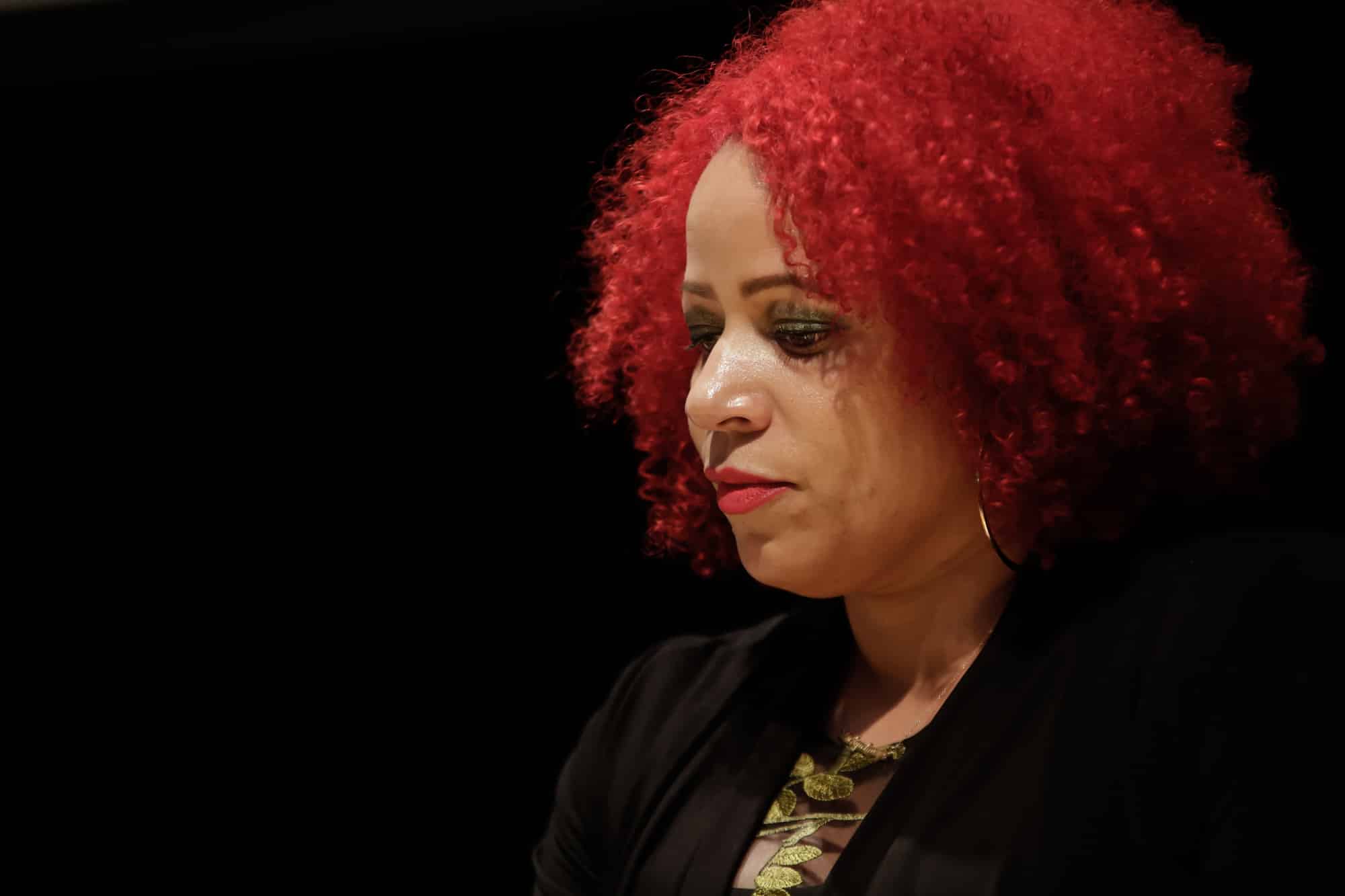
The New York Times Magazine recently published an essay by Nikole Hannah-Jones, the “brains” behind the 1619 Project, titled, “By Fighting for Every Black Child, Did I Betray My Own.” It has become the discourse du jour for a variety of reasons, particularly that this aggrieved woman was so ideological that she and her husband sent her daughter to a school that sounds little better than a juvenile hall.
Hannah-Jones, being a rich and influential person, could have sent her daughter to any school she wanted, but instead sent her to the local majority-black elementary school, believing she could buy off the PTA into providing a good education. (How she expected this to work is unclear.) Her basic justification is that New York City schools are heavily “segregated”—a word she manages to use twenty-five times in the article—something which her and her husband had themselves avoided growing up, instead attending better “integrated” schools. She writes:
“This segregation exists because policymakers and affluent parents….shed their advocacy at the schoolhouse door and refuse to take or support any substantial action to integrate the city’s schools…Our role in this struggle meant upending the status quo and sending our child not to a wealthy white school but to a poor Black one.”
Hannah-Jones claims the problem is that black schools are underfunded, something she perceived one affluent student could meaningfully improve. Her daughter, now in high school, unsurprisingly resents having been sacrificed at the alter of whatever this muddled thinking could be said to represent.
Deprived of an early education by her ridiculous mother and surrounded by poorly behaved peers, her daughter is now attending an elite high school while the public debates the merits of her previous schooling, which has been chronicled in a major newspaper going back a decade. However, one aspect has been noticed less than others: the school to which Hannah-Jones’ daughter went is not itself poor, but is wildly over-funded. The Daniel Hale Williams Elementary School has per-student spending of $52,349 and only ten students per teacher according to 2024-2025 school year data available at DistrictFacts, a website which tracks school statistics in the Northeast. Never have I seen a more ludicrous example disproving the liberal orthodoxy that the problem with underperforming schools is a lack of money.
The above figure is so astounding it first must be explained how any public elementary school came to have per-student funding higher than the median personal income. New York City inexplicably has a unified school system governed by a board where the majority are appointed by the mayor, giving parents the least control over how schools are run anywhere in America. This body, with the Soviet-esque name, “Panel for Education Policy of the New York City Department of Education,” is made up twenty-three people, thirteen of which are appointed by the mayor, five appointed by borough presidents, and five appointed by borough education board presidents. Incredibly, Nikole Hannah-Jones’ husband Faraji is on this board as the Contracts Committee Chair, something that The New York Times did not feel compelled to disclose. While his name is mentioned eleven times in this article, it is only stated that they have “connections.” It is not clear if he had this position at the time their daughter went to the failing school, but nevertheless it should have been disclosed as she is discussing an organization he oversees.
This is the undemocratic way in which New York City manages 1.1 million students, whereas the school district I live in rural, Eastern Washington state contains perhaps 1,400 total citizens and has five directly elected board members. In school districts like mine, the local income does greatly impact school funding, but in New York, due to the enormous district in a wealthy city, and what they call the “Fair Student Funding” system, schools in poor neighborhoods get more funding than affluent students.
On top of this, New York State as a whole had the highest education funding in the nation at $31,918 per student in 2024, compared to $12,324 in Mississippi, the lowest spending state. Of course, Mississippi has become so famous for improving education the progress has its own Wikipedia page, whereas New York has sinking scores for this enormous pricetag. It should be noted though that to any generally intelligent person who went to public school and remembers the absolute ease of standardized tests, the rates at which they are passed even at the best schools are extraordinarily bleak.
Regardless, one wonders what the school is doing with all this money, particularly given that Nikole Hannah-Jones describes the lunch room as lacking adult supervision and the teachers not grading any homework. (She reports that math was her daughter’s favorite subject, but when she went over her work, she discovered her daughter was unaware she was getting many homework answers wrong.) One must acknowledge that New York City has a much higher cost of living than Mississippi, and you have to pay teachers more to have a decent life, but this cannot explain why the school is so bad—particularly given that its per pupil spending is almost 50% above the average New York City school. It’s hard to even imagine the administrators are stealing that much money.
There is surely no single cause for this horrible educational environment, and certainly not one that Hannah-Jones could in any way improve by sending her child there, particularly given her own lax attention to her daughter’s education. What we can safely assume is that the money has not been spent hiring effective teachers—though perhaps it has been spent hiring overqualified ones with stupid but fashionable ideas. What is incredible is the premise of elementary schools: one teacher, a job requiring average qualifications, in a room with children that somehow costs over $500k a year for ten student classes.
It is also a matter of faith that class sizes must always be smaller, but in the rural area where I live it is universally considered a bad thing if classes are this small, since students are supposed to be around different kids and do group projects and see diverse presentations and the like. If a teacher of only ten students cannot teach them to read and do math while enforcing order, there is probably something seriously wrong with the teacher, the students, and with the district’s educational and discipline policies that cannot be fixed by throwing money at them. It should be noted that during the post-war Baby Boom there was such a high ratio of children to adults—and thus a shortage of teachers and classrooms—that Boomers commonly were in class of forty or more students; say what you will about that generation, but they typically learned how to read and do arithmetic.
It is beyond my scope here, or indeed my knowledge, to credibly explain which things make schools work better. What I do know is that all the polices that the Nikole Hannah-Joneses of the world have advocated for years, such as ending suspensions, considering disparate test scores an artifact of racism, demanding ever smaller class sizes with ever more funding, not holding failing students back, and teaching students a silly version of history, has done nothing to make students more successful. What it has done instead is create a gaping maw of an education industry—from expensive but pointless software to overpaid teachers to administrative bloat—that has grown fat and useless while being lauded by the liberals whose civic religion prevents them from ever thinking schools are well enough funded or teachers are ever paid enough. We don’t know which much nicer high school Hannah-Jones’s daughter now attends, but there is every reason to believe that it may spend under half as much money per pupil as her previous, failing elementary school.
It is a common saying among libertarians that government is the only enterprise which measures success in the amount of money spent, but with public schools there is an even more perverse logic: they are proud of themselves for wasting money. They produce endless statistics showing their failure which always justifies more spending. Nevertheless, it is incredible that New York City has somehow hooked taxpayers on per-student spending for some of their worst schools on par with the lower tuition range of elite boarding schools. If it was possible to change a dogmatic belief with logic, the appalling conditions of Daniel Hale Williams Elementary School would finally convince the liberals that urban schools don’t just need more money.