
Before dawn on January 3, 2026, American warplanes pounded military targets across Venezuela while U.S. Special Forces kidnapped President Nicolás Maduro and his wife, Cilia Flores, in Caracas. The raid drew on more than 150 aircraft flying from twenty land and sea locations. Venezuela’s interior minister counted more than one hundred dead, and Havana acknowledged losing Cuban personnel. President Donald Trump then declared that Washington would “run the country” until a “judicious transition” takes place in the oil-rich nation.
Cuba came next. Trump urged Havana to “make a deal, BEFORE IT IS TOO LATE” and told reporters that “Cuba is going to fall of its own volition.” On January 29, he signed an executive order threatening tariffs against any nation shipping fuel to the island, and The New York Times described the resulting squeeze as the first effective American blockade of Cuba since the Missile Crisis. CBS News later reported that Pentagon planners had examined an Army-led air assault involving thousands of troops from the 101st Airborne Division, the only U.S. unit trained for that type of operation, even as a February YouGov poll found that only 13% of Americans backed attacking Cuba.
None of this came out of nowhere. Starting in August 2025, the Pentagon deployed the Iwo Jima Amphibious Ready Group, the 22nd Marine Expeditionary Unit, stealth fighters, and Reaper drones to the Caribbean, with the USS Gerald R. Ford carrier strike group ordered south in late October and arriving in November. The New York Times reported that about 15,000 troops were in the region by December. Puerto Rico absorbed roughly 10,000 of them, and the military reactivated Roosevelt Roads, a naval station shuttered since 2004. Washington had also posted a $50 million bounty on Maduro, began seizing Venezuelan tankers from December 10 onward, and let the CIA destroy a dock on Venezuelan soil. Trump, asked who pulled the trigger, said “it doesn’t matter.”
Meanwhile, the sea became a shooting gallery. Since September 2, 2025, American forces have destroyed alleged drug boats across the Caribbean and eastern Pacific as part of Operation Southern Spear. The very first strike left two survivors clinging to wreckage for roughly 45 minutes before a second strike killed them—a “double-tap” that prompted bipartisan concern in Congress over whether it violated international law. Just Security tallied seventy-one strikes and 238 dead as of October 4, 2026, with only three known survivors. Families in Colombia and Trinidad and Tobago insist their slain relatives were fishermen, not traffickers. The Lead Inspector General pegged the cost of Operation Southern Spear at $820.9 million through June 2026, and officials acknowledged that the command’s mission statement and effectiveness metrics are classified.
Venezuela and Cuba merely sit at the sharp end of a hemispheric campaign. In April 2025, Defense Secretary Pete Hegseth signed a memorandum with Panama restoring rotational American access to Fort Sherman, Rodman Naval Station, and Howard Air Force Base. “Together, we are going to take back the canal from China’s influence,” Hegseth declared, while conceding that “the Panama Canal is in Panama.” Panama’s opposition party denounced it as a “camouflaged invasion.”
Ecuadorian voters rejected foreign military bases by roughly 61% in a November 2025 referendum, yet American commandos began joint operations there in March 2026, conducting an airstrike on a suspected drug camp near the Colombian border without any publicly stated legal basis. The Dominican Republic opened San Isidro Air Base to U.S. aircraft. Trinidad and Tobago hosted a Marine radar on Tobago from November 2025 until its removal in March 2026. Paraguay signed a status of forces agreement in March 2026. Peru’s Congress authorized armed American personnel to operate inside the country throughout 2026. The USS Nimitz drilled with Argentina’s navy in the South Atlantic in late April. And in October, nearly 200 soldiers from Fort Drum headed to Panama for jungle training.
Mexico faces its own squeeze. More than 10,000 of Mexico’s own troops now patrol the border after Sheinbaum deployed them to hold off U.S. tariffs, and National Defense Areas have turned “more than 800 miles of previously public land—about 42% of the U.S.-Mexico border—into military zones,” according to a War Horse and Border Chronicle investigation. Trump vowed in January that American forces would “start now hitting land” against cartels. President Claudia Sheinbaum answered in April that “[t]he people of Mexico will not, under any circumstances, accept intervention.”
The Pentagon rebuilt its machinery to match. Admiral Alvin Holsey announced his retirement from Southern Command in October 2025, troubled by the strikes, and relinquished command in December. His successor, Marine General Francis Donovan, stood up Joint Task Force Western Hemisphere in August 2026, promising to “locate, close with, and destroy” enemies and apply “total systemic friction.” The Army created a Western Hemisphere Command at Fort Bragg to serve both Northern and Southern Command.
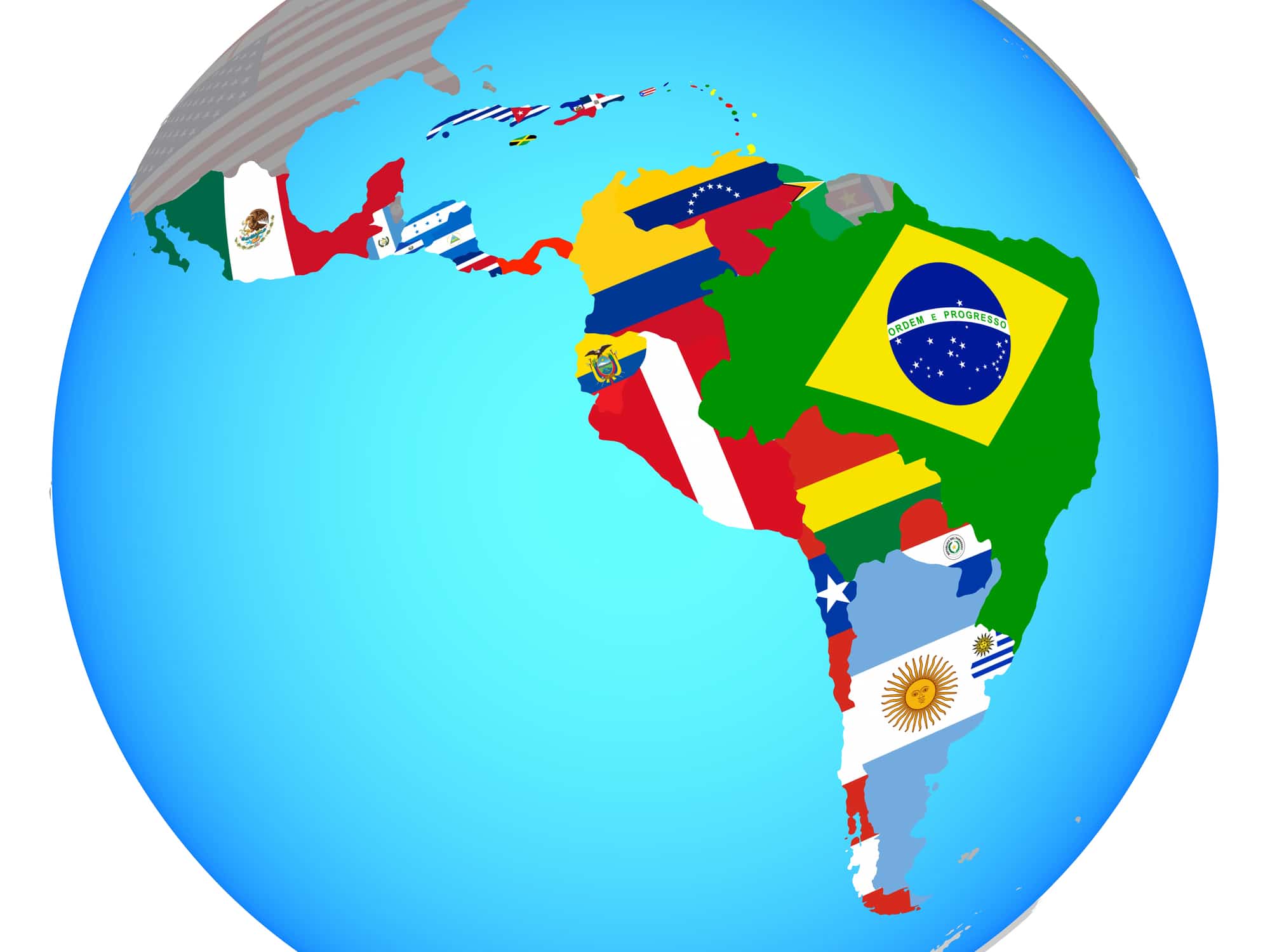
A rightward political shift across the region greased the wheels. Governments in Argentina, Ecuador, Paraguay, Panama and, since August 2026, Colombia have welcomed American power. Trump’s Shield of the Americas grew to nineteen members, leaving Mexico, Brazil, Uruguay, Nicaragua, Cuba and Venezuela outside the fold. Hegseth warned that “America is prepared to…go on the offense alone if necessary,” summed up the coalition’s purpose as “We do bad things to bad people,” and tied the project to a “Trump Corollary” to the Monroe Doctrine in an official Pentagon release. In August, he promised land operations, telling traffickers that they are “a target just like ISIS or al-Qaida.”
Latin America should treat all of this as a wake-up call. The United States, losing its influence in Eurasia, has retreated to its own hemisphere to reassert its hegemony in the region. Congress offers no brake. A Senate war powers resolution on Venezuela died after Vice President J.D. Vance broke a 50-to-50 tie, and a U.S. House version failed 215 to 215. Regional diplomacy proved just as feeble. Brazil’s Lula said the Maduro operation “crossed an unacceptable line,” yet an emergency CELAC meeting on January 4 ended without a statement because Argentina and roughly 9 other governments blocked consensus.
The tragedy is that Latin Americans saw this coming two centuries ago. In 1824, Simón Bolívar summoned the new republics to build a brotherhood of nations united and powerful enough to sustain themselves against aggression by a foreign power. The 1826 Panama Congress produced a treaty with army and navy contingents, but only Gran Colombia ratified it. Argentine revolutionary Bernardo de Monteagudo argued for a federation that would coordinate external defense, and a Lima congress in 1848 drafted another defensive confederation that died unratified.
After William Walker’s filibusters seized Nicaragua, Ramón Castilla’s Peru joined Chile and Ecuador in the 1856 Continental Treaty, the first pact aimed squarely against American expansion, while Chilean thinker Francisco Bilbao called for a federal congress of the republics. Colombian diplomat José María Torres Caicedo advocated a common inter-American army in the years around 1865.
That same year, seven republics signed a Lima treaty pledging to treat aggression against one “as if the injury had been committed by a foreign power.” Nobody ratified it. Yet when Spain seized Peru’s Chincha Islands, a separate alliance of Peru, Chile, Ecuador and Bolivia fought until Spain withdrew in 1866. It remains the only multi-state Latin American alliance that ever fought a Western power, and it prevailed.
Later voices kept the dream alive. Argentine Foreign Minister Luis María Drago insisted in 1902 that “the public debt can not occasion armed intervention nor even the actual occupation of the territory of American nations”—a direct response to Britain, Germany, and Italy’s gunboat blockade of Venezuela—giving birth to the Drago Doctrine. Peruvian political leader Víctor Raúl Haya de la Torre’s American Popular Revolutionary Alliance (APRA) demanded “Action against Yankee imperialism” as its founding principle when he established the movement in Mexico in 1924. While fighting the Marines in 1929, Nicaraguan revolutionary Augusto César Sandino proposed joint land and sea forces built from 250 citizens of each of twenty-one states. Juan Perón pushed for an Argentina, Brazil and Chile bloc in his November 1953 speech at the National War College—titled “United or Dominated”—only to watch Brazil get cold feet in the end.
Venezuelan leader Hugo Chávez sought a force equivalent to NATO, with the region’s own doctrine rather than one handed down by Washington. In April 2008 he asked: “If NATO exists— the North Atlantic Treaty Organization—why couldn’t SATO exist?”—using the Spanish acronym OTAS, for Organización del Tratado del Atlántico Sur, meaning South Atlantic Treaty Organization. OTAS is simply the Spanish rendering of that same concept: a collective defense pact for the Americas, independent of Washington.
Bolivarian Evo Morales proposed a Bolivarian NATO in 2013, and in August 2016 declared that “an attack on one of our peoples is an attack on all.” In November 2025, Colombian President Gustavo Petro called for a “South American NATO independent of the United States and Russia, able to speak in the world in its own voice, according to its own interests, and seek dialogue with humanity.” Every proposal has withered thus far.
That failure now carries a steep price. Complaints to the United Nations or the Organization of American States will not turn back carrier groups. The strong gods of hard power have returned, Washington tramples international law, and great powers everywhere assert themselves without apology. A bully stops only when someone stands up to their aggression.
Wailing and complaining will simply not cut it.