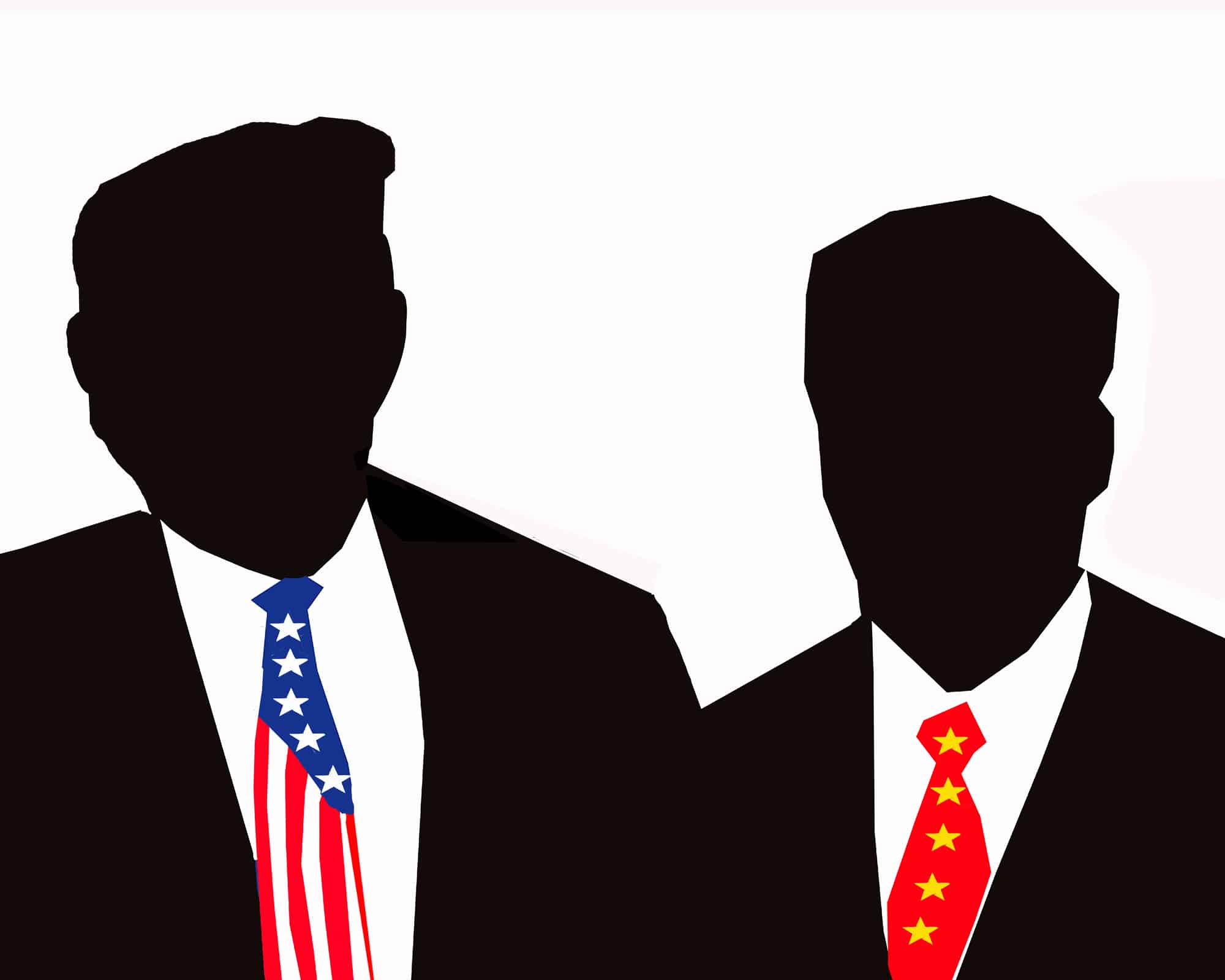
When President Donald Trump and Chinese President Xi Jinping met in Beijing this past May, the outcome was largely as anticipated: ceremonial pomp, a handful of commercial commitments, rhetorical emphasis on “stability,” and little progress on the structural frictions that actually define the relationship. Trump invited Xi for a reciprocal state visit, and that visit is now underway. Xi arrived in the Washington area on Wednesday evening for a tightly choreographed program of White House ceremonies, closed-door talks, a state dinner, and a brief National Archives tour before departing Friday.
The script remains familiar. The underlying reality is unchanged.
The issues most likely to dominate the remaining bilateral talks are the same ones that have shaped every recent U.S.-China encounter: the fate of the October 2025 Busan trade truce, rare-earth and critical-mineral flows, artificial intelligence and technology controls, limited tariff adjustments on non-strategic goods, and Taiwan. Secondary items—agricultural purchases, Boeing orders, and possible investment facilitation mechanisms—will continue to provide the usual photo opportunities and press releases.
On trade and tariffs, a practical development has already occurred. Just as Xi was arriving, Treasury Secretary Scott Bessent announced that Washington and Beijing had agreed to extend the October 2025 Busan trade truce by two months—from its previous November 10 expiration date to January 10. Bessent framed the move as a temporary extension that would allow time to pursue a “bigger deal” down the road, while noting that China was meeting its soybean purchase target but lagging on broader agricultural commitments. Chinese media have yet to confirm the details. The short extension prevents an immediate return to higher tariffs and renewed rare-earth restrictions, yet it leaves the harder questions of reciprocal tariff reductions and fuller Chinese delivery unresolved for another two months.
Rare earths remain a key line item in the talks still to come. China still dominates processing capacity for materials essential to advanced manufacturing, defense systems, and the energy transition. Beijing has already demonstrated its willingness to tighten and then partially relax export controls as a negotiating instrument. The Trump administration is investing in alternative supply chains, including mineral consortia and partnerships with allies aimed at diversifying processing and reducing near-term dependence, but those efforts will not mature overnight—if at all. U.S. officials have explicitly ruled out trading away American technology export controls in exchange for mineral access. And China has no incentive to surrender its strongest non-military lever without significant reciprocal movement elsewhere.
Artificial intelligence has climbed higher on the agenda since May. There is talk of “guardrails,” safety dialogues, and mechanisms to keep the most advanced models out of the hands of non-state actors. Such conversations are useful and low-cost. They are also unlikely to produce meaningful relief from U.S. semiconductor and AI-related export controls, which remain a core instrument of American technology policy and continue to restrict advanced chips and related tools even as limited licenses are occasionally granted. Washington continues to view technological superiority as a core national interest; Beijing continues to view those same controls as an attempt to lock it into permanent second-tier status. The gap is structural, not rhetorical.
Taiwan will almost certainly be raised by the Chinese side, as it was in Beijing. Xi has repeatedly described the issue as the most important in the bilateral relationship and has warned that mishandling it risks clashes and even conflicts. At the moment, however, neither side appears eager to let the issue derail the economic track. Both have domestic political incentives to avoid open economic warfare in the near term—midterm elections in the United States, and Xi’s need to project competent stewardship of a slowing economy and a complex domestic agenda. Expect restated positions rather than new understandings.
The broader pattern is consistent with the May summit and with the limited détente that has prevailed since the Busan meeting. High-level diplomacy between the United States and China in the mid-2020s has been primarily an exercise in management, not transformation. After the acrimony of the late 2010s and early 2020s, polite if mostly fruitless conversation is most welcome. Keeping channels open and conversations continuing is all the more important given the multiple areas of serious friction in their relationship. While they cannot wish away technical competition, the minerals asymmetry, the industrial-policy rivalry, or the unresolved status of Taiwan, the two governments can at least pause escalatory measures, announce purchase commitments, create working groups, and issue joint statements about “constructive strategic stability.”
A successful summit, therefore, is one that does not produce fresh crises. The two-month truce extension already secured, modest commercial announcements still possible, continued high-level contact, and the absence of new escalatory measures would constitute a modest but real achievement. In a multipolar environment where neither side can dictate terms, the preservation of working channels and the prevention of deterioration is itself a form of progress. Expectations of transformative deals only set the stage for later disappointment and for the familiar chorus of China-threat maximalists to declare the entire effort a failure.
Trump and Xi will meet, smile for the cameras, and issue carefully worded statements. The structural limits that defined their Beijing encounter remain fully present. Managing those limits without making them worse is the realistic horizon of this diplomacy. In the present circumstances, that is success enough.