
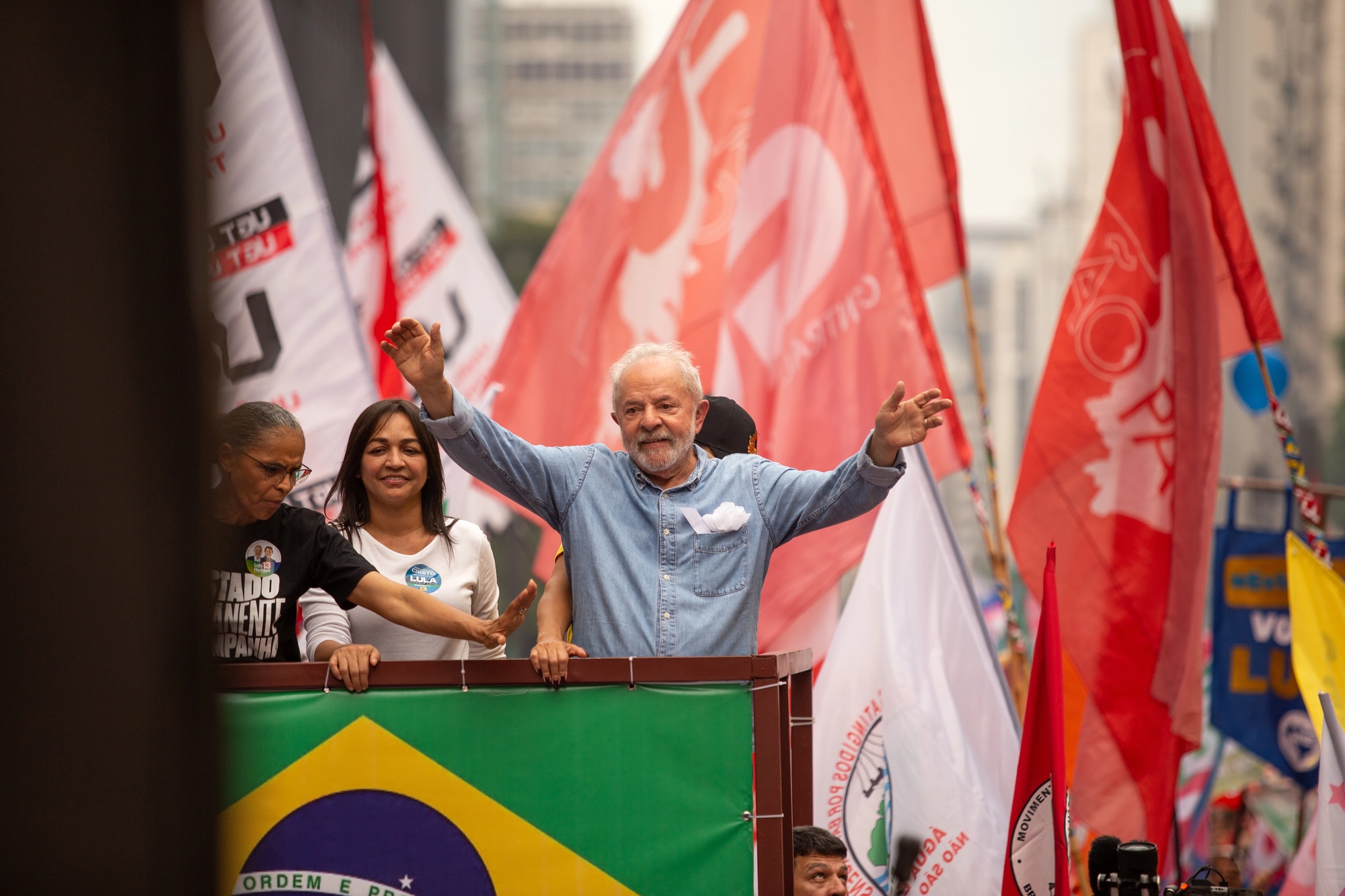
On October 25, the left-wing incumbent Luiz Inácio Lula da Silva, who came second in the first round of elections, defeated the right-wing Flávio Bolsonaro, who had defeated him in round one. The result was always possible, since millions had sat out expressing their opinion in the first round, but it was not expected. It is Brazilians who have chosen their leader. But their choice will have broad implications for the world.
The Brazilian election will have implications for relations with the United States, for multipolarity, for the environment, and for the region.
The choice of Lula over Bolsonaro will likely have significant implications for Washington’s role in Brazil. Bolsonaro was a declared Donald Trump ally and had framed the election as a “fork in the road” where the United States will either “have the most powerful ally in the hemisphere or an antagonist.” Lula had framed the election as a choice between a Brazil that is sovereign or a Brazil that is subordinate to Washington. He said that the election was “a demonstration that this country refuses to be anyone’s backyard.”
Bolsonaro, at first, called for the election to be annulled, claiming that “foul play…took place.” He seems to have since backed down, settling for filing a lawsuit against Lula for abusing the power that comes with his incumbency to influence the vote. “I wasn’t the one who lost,” Bolsonaro said, “the system won.” Though Bolsonaro continues to object, his party has now recognized the result while maintaining that the concerns need to be addressed.
The White House and State Department are yet to recognize Lula’s election. The State Department reportedly decided to delay the release of a statement congratulating the winner and assess the situation following the results and Bolsonaro’s claim that the election was dirty. President Trump complained that “it looked like another rigged election” that looked “so corrupt, so terrible.”
After successfully intervening to help several Trump friendly leaders win recent elections in Latin America, Brazil’s election has put the brakes on the White House’s influence. Trump has openly boasted that “we have numerous people [in Latin America], lots of people that I got elected.” Those Latin American countries included Honduras, Columbia, Argentina, and Chile. But though Washington heavily inserted its influence into the Brazilian election, the result went the other way. Trump’s Midas touch has been tarnishing of late. There is a growing list of countries where Trump endorsements have gone limp. Trump gave Hungary’s Viktor Orbán his “complete and total endorsement.” He also gave Israel’s Benjamin Netanyahu his “Complete and Total Endorsement,” adding that any other leader would be “wrong” and that the United States is “demanding” that Israel elect him. Orbán lost, and Netanyahu will struggle to form another government after losing seats in Tuesday’s election. In Serbia, too, a Trump-friendly candidate recently lost.
Bolsonaro pledged to join Trump’s Shield of Americas; Lula has pledged not to. Lula has opposed Trump on interventions in Venezuela, Cuba, Iran and the bombing of alleged drug trafficking boats. He will not be a compliant U.S. partner.
The election of Lula could also have a profound effect on the emerging multipolar movement. Brazil is a founding member of BRICS, an international organization whose primary purpose is to balance U.S. hegemony and foster a multipolar world. During his campaign, Bolsonaro said he would reconsider Brazil’s BRICS membership and that he was open to leaving the organization. Lula is a dedicated member and leader of BRICS who will keep Brazil firmly embedded in BRICS and committed to balancing U.S. hegemony and challenging U.S. dollar dominance, a cause he has championed. Lula has called both for a common South American currency and a common BRICS system of payment. A Bolsonaro victory could have led to a contraction of BRICS; Lula’s victory will continue to strengthen it.
Regionally, Lula’s victory could put the brakes on a recent swing to the right, meaning that Mexico’s Claudia Sheinbaum will not be isolated and Cuba has a chance of not being abandoned. Bolsonaro pledged to continue the political legacy of his father, former President Jair Bolsonaro, a captain in the military during Brazil’s dictatorship and who celebrated that regime. He once said prisoners should have been killed instead of tortured. Flávio Bolsonaro promised an “iron fisted” response to crime, including building maximum security prisons modeled on those built by Nayib Bukele, president of El Salvador. Before announcing his candidacy, he travelled to El Salvador for ideas and told supporters that “El Salvador isn’t tough enough.”
Brazilians voted for Lula largely for domestic reasons. But his election will have an impact well beyond Brazil.