
Washington is preparing for a new round of talks in the Indo-Pacific. The South China Morning Post reported on October 22 that Philippine ambassador Jose Manuel Romualdez anticipated possible meetings of the informal “Squad” security grouping ahead of regional summits in Manila. Meanwhile, Secretary of State Marco Rubio confirmed that the Quadrilateral Security Dialogue, or Quad, would hold its first leaders’ summit in more than two years. Both developments come as President Donald Trump prepares for another meeting with Chinese President Xi Jinping.
The timing is revealing. For even as Washington seeks to navigate its fraught but improving relationship with Beijing, these meetings represent a strengthening of its network of partnerships intended to counter Chinese influence. While the Quad and Squad are two distinct components of that effort, there is little doubt that Washington’s expanding regional security commitments will do nothing to make Americans safer and will rather serve only to draw them further into a potentially catastrophic great-power confrontation.
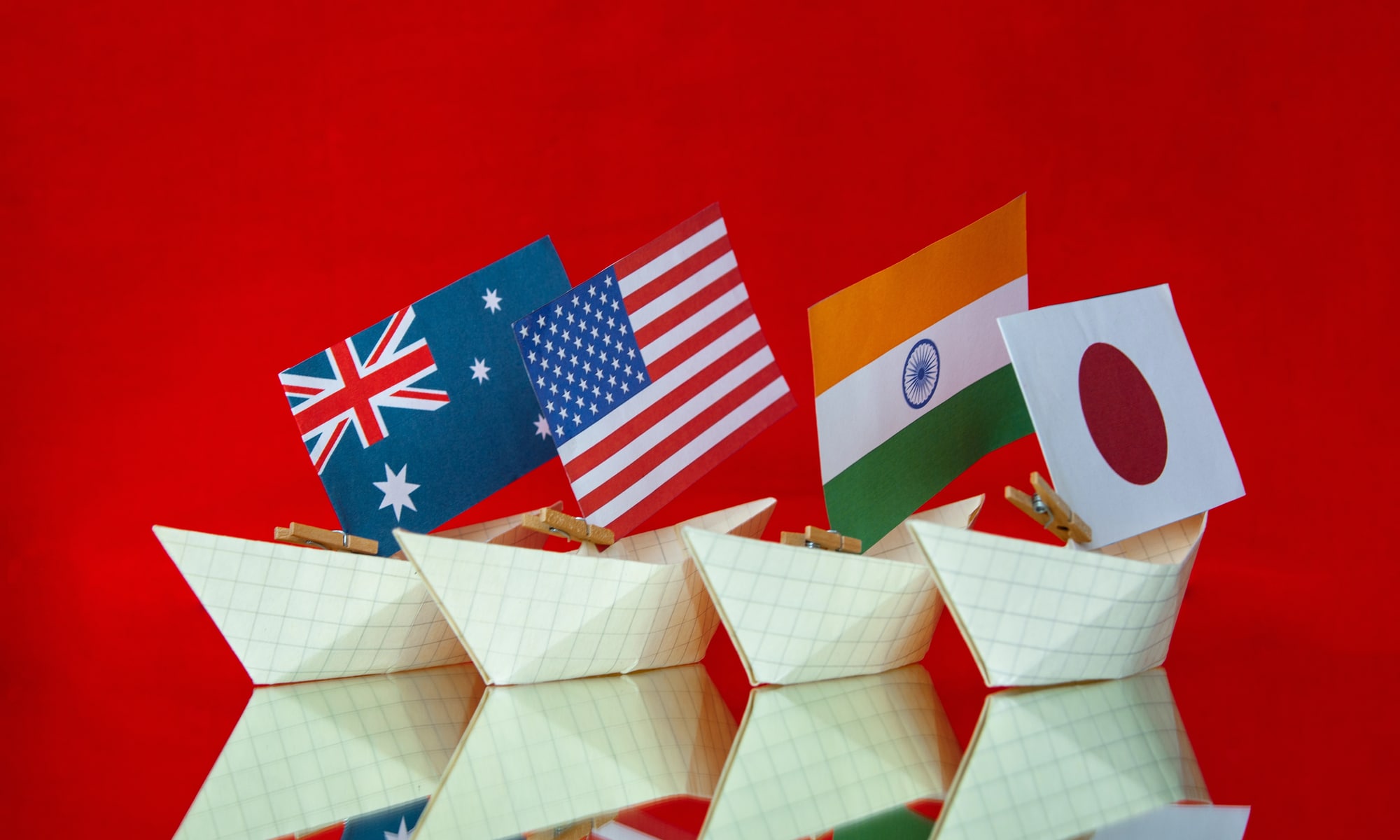
For those in need of an understandable refresher, recall that the Quad comprises the United States, Japan, Australia, and India. Its origins lie in the four countries’ cooperation following the devastating Indian Ocean tsunami of 2004. After taking shape diplomatically in 2007, the grouping languished before being revived in 2017 amid mounting American concern about China’s regional influence.
To be clear, the Quad is not a formal military alliance, with no NATO-style obligation for members to defend each other. However, alongside its agenda items of infrastructure, critical technologies, disaster relief, and other areas of cooperation it does also include maritime security, which entails the risk of Washington becoming further embroiled in the territorial disputes of the region. This is particularly relevant to those concerned about foreign entanglements because at its most fundamental the Quad’s development was and remains a function of Washington’s desire to coordinate the activities of regional powers whose interests increasingly intersect with its own desire to contain Beijing.
Conceived in the early 2020s, as the fake China threat hysteria was reaching its apogee, the Squad swaps out India and brings the Philippines together the United States, Japan, and Australia. Unlike the Quad, it is an informal grouping centered directly on defense cooperation and maritime security in the western Pacific. Its first defense-ministerial meeting took place in 2023, as the four governments sought closer coordination amid rising tensions in the South China Sea.
The Philippines’ inclusion is consequential and fraught. This is because Manila has faced increasingly serious confrontations with Beijing over disputed maritime claims in recent years, and Washington maintains a mutual-defense treaty with the Philippines which it has clarified very much covers disputed bits of rock and sand in the South China Sea.
Concerning as well is that unlike the Quad, which features the independent minded New Delhi, which eschews commitments, in the Squad Washington has put together a grouping with whom it has mutual defense treaties with all the members.
And so, while the Squad is not itself a mutual-defense treaty among the members, its joint exercises, other maritime activities, and consultations are intended to demonstrate a collective resolve—a situation that bears the unmistakable appearance of then likewise informal Anglo-French military and diplomatic activities in the years leading up to 1914.
Indeed, enhanced cooperation and the expectations it creates, can easily lead to informal arrangements deepening military coordination without requiring the political scrutiny that might accompany a new formal alliance. They have, likewise in the past, led participating governments to interpret local disputes as tests of American friendship and credibility, raising the stakes of incidents that might otherwise remain regional affairs.
Alert Americans are therefore right to be concerned.
Fort both the Quad and Squad are functions of a strategic vision that treats the preservation of American primacy as inseparable from the containment of Chinese power. Washington would do better to distinguish the defense of Americans from the management of Asia’s balance of power.
The upcoming meetings should prompt a more fundamental question in the Beltway than whether Washington can coordinate its partners more effectively: rather, lawmakers should be demanding to know what, precisely, Americans are being asked to defend, and at what cost?
In a world where China cannot simply be subordinated to American preferences, peaceful coexistence requires more than assembling additional partners—nor does it follow that the accumulation of security partnerships necessarily produces greater security (the familiar security dilemma is at least as likely). Rather, it requires recognizing the limits of American power and abandoning the presumption that every challenge to American primacy everywhere must be answered. Restraint is not surrender; it is an acknowledgment that the risks of great-power conflict are too consequential to be treated as the price of maintaining an empire.
Though the case for restraint is plain enough, there is little reason to expect Washington to change course. Defense contractors profit from expanded procurement, fund think tanks, congressional campaigns, and enjoy a revolving door with the military bureaucracies eager for additional missions and resources. Politicians, meanwhile, can cheaply demonstrate their supposed “resolve” to “defend America” by pledging to defend partners abroad, leaving the American public to bear the risks and costs. These incentives are deeply embedded in Washington’s foreign-policy establishment, making it all but certain that policy will continue to serve the interests of the politically connected at the expense of the American people.