
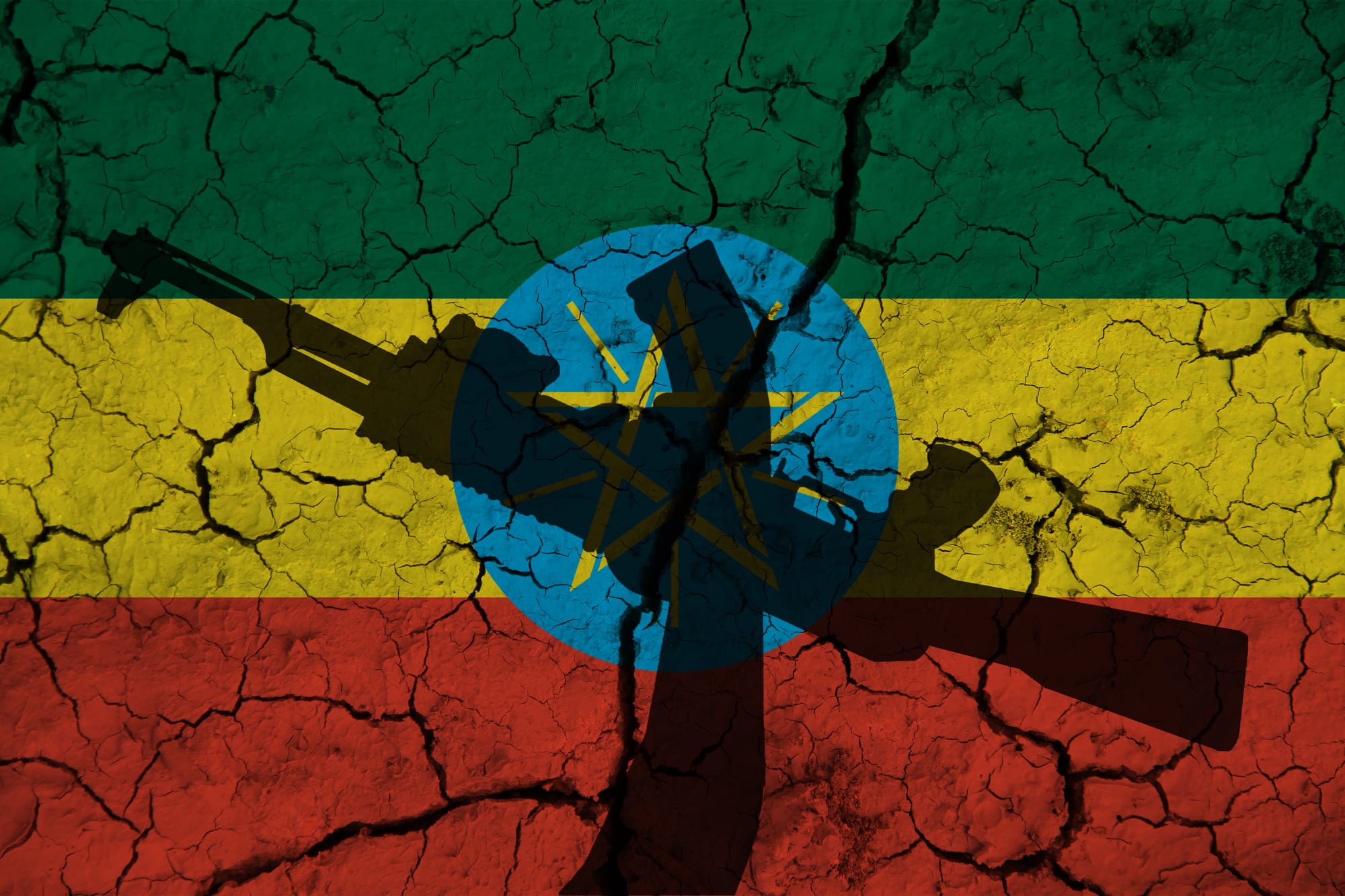
Barely four years after the Pretoria Agreement formally ended one of the deadliest wars of the twenty-first century, large-scale fighting has returned to Ethiopia. In late September the principal anti-government force, the Tigray People’s Liberation Front (TPLF), seized key airports in Mekelle, Axum, and Shire, launched attacks into Afar and Amhara, and declared itself once again at war with the federal government in Addis Ababa. It did so days after joining six other armed groups in the Ethiopian Peoples’ Forces Alliance for Survival, which aims to remove Prime Minister Abiy Ahmed. By early October, however, government forces and a pro-government Tigrayan splinter group, the Tigray Peace Force (TPF), had reversed most of those gains. After the TPLF withdrew its administration from the regional capital, federal and allied fighters entered Mekelle and took control of the city and its main airport. Fighting continues elsewhere in Tigray with airstrikes, artillery, and ground clashes, while reports of Eritrean troop movements into northern Tigray have sharply raised the risk of direct interstate conflict.
As I warned in March, the Pretoria deal was never fully implemented. In the north, disarmament of Tigrayan forces remained incomplete. So, too, the Eritrean occupation of parts of Tigray went unresolved. Perhaps most horrifically, in the case of the long-running contest with Amhara forces, the government has been at war against its recent allies since early 2023, when it attempted and failed to disarm the Amharan defense forces – many of whom joined the insurgency of the Fano militias. For years, the government and its forces have carried out a range of horrifying atrocities.
As this slow-motion tragedy unfolded, political power struggles inside the TPLF produced a hardline faction that reasserted control, began mobilizing fighters, and eventually forged a temporary alliance with elements of the Amhara Fano and other armed groups aimed at removing Abiy Ahmed’s government. Lower-level clashes near the Sudanese border in August, followed by drone strikes and the mid-September alliance announcement, made the return to open war all but inevitable.
The underlying drivers were never mysterious. Prime Minister Abiy’s centralizing ambitions, to say nothing of his authoritarian tactics and ethnic chauvinism, have understandably collided with Tigrayan and Amharan demands for security and autonomy. Eritrea, which fought alongside Ethiopian federal forces against the TPLF in the last war, has since turned hostile. Relations between Addis Ababa and its former province turned neighbor deteriorated sharply as Abiy began again to discuss openly Ethiopia’s dire need for cheap and secure Red Sea access – particularly through the Eritrean port of Assab. Ethiopian officials have accused Eritrea of financially and materially supporting the TPLF and the broader anti-government alliance; Eritrea denies the charges, but the strategic logic is clear. A weakened Ethiopia reduces the immediate threat to Eritrean territory and ports. Diplomatic ties have now been fully severed: Ethiopia closed its embassy in Asmara and expelled Eritrean diplomats; Eritrea reciprocated. On October 7, multiple residents, a local official, a Tigray Peace Force commander, and the conflict monitor ACLED reported Eritrean troops crossing at Zalambessa and moving through Adigrat toward Idaga Hamus, with Ethiopian drones reportedly striking some of the vehicles. Eritrea denies any such presence and calls the accounts a pretext for aggression. The reports remain only moderately confirmed, yet they mark a dangerous new threshold.
Sudan adds another combustible layer. As previously detailed here, the conflict between the Sudanese Armed Forces and the Rapid Support Forces has already drawn in the United Arab Emirates (backing the RSF), Egypt (backing the SAF), and others whose interests center on Red Sea security, ports, and strategic geography. As documented by Reuters, Ethiopia has been credibly accused of allowing the RSF to train and stage from its territory; the SAF, meanwhile, has been just as credibly accused of hosting high-ranking TPLF members and using Tigrayan fighters. Neither claim has produced confirmed large-scale intervention yet, but the proxy relationships are in place. A major escalation, particularly in the northwest, could easily merge the two wars.
Outside powers are already entangled. Egypt watches the Grand Ethiopian Renaissance Dam and Nile waters with deep suspicion and maintains ties with Eritrea and the SAF—the latter of which dislikes the GERD as well. The UAE’s port and commercial interests in the Horn, including Berbera in Somaliland, give it a stake in the outcome, as it connects a string of positions and proxy allies. Saudi Arabia has its own Red Sea calculus, which essentially rests on keeping states whole and stable. Israel has taken the step of recognizing Somaliland as it establishes positions to better contest the Houthis (also speaking with the RSF, whose principal backer, the UAE, has become an increasingly close collaborator with Tel Aviv). Next door in Somalia, meanwhile, Ankara is becoming more involved on the side of Riyadh.
The great danger should be clear: the series of fires next door risks becoming one great conflagration, perhaps a second African Great War—interconnected, internationalized, and fed by external patrons pursuing their own agendas at the expense of the local populations. This pattern is tragically familiar.
For its part, Washington has shown little interest in carefully managing the fragile truce that existed. While it could have exerted concerted effort to ensure Pretoria prevailed—pressing for full implementation, credible confidence-building measures, resolution of the territorial disputes, an end to the repression and violence—it has been distracted elsewhere. Blowing up alleged narcotics traffickers, kidnapping rival heads of state in Venezuela, starting new wars of choice like with Iran, meddling in elections in Brazil and Argentina, and apparently preparing moves against Cuba have absorbed attention and resources. These adventures are likely to continue despite the dangers of a wider conflagration in the Horn.
What attention Washington has paid to Ethiopia has been devoted almost entirely to the side of the government in Addis Ababa—and this has been strictly aimed at increasing economic ties. Recent deals scoring billions in contracts for Boeing—Ethiopian Airlines’ order for ten cargo planes with options for more—and efforts to secure American participation in the multi-billion-dollar Bishoftu airport project illustrate the priority: investment and export opportunities. The fragile state of the truce, the likelihood that war would break out if not carefully managed, and the unresolved political dynamics received far less focus—to say nothing of years of previous democratic darling Abiy’s increasing repression, censorship, military crackdowns in Amhara and Oromia, and overt talk of securing Red Sea access via Eritrea, which have been largely ignored.
From a military perspective, Abiy’s government enters this round stronger than in 2020, with a substantial drone arsenal and a larger federal army. It now holds a clearer tactical advantage in the core Tigrayan theater after the recovery of Mekelle and advances further north. Yet it remains stretched by insurgencies on multiple fronts, and it is doubtful whether it could sustain operations along those fronts over an extended period—especially if Eritrean forces become more deeply involved.
Outside powers have so far limited themselves to calls for de-escalation, the correct public posture. The danger lies in the temptation to treat northern Ethiopia as another arena in which Washington or its regional partners must choose a side for larger geopolitical reasons: Red Sea security, countering Iranian or Houthi influence, or balancing Gulf actors. American policymakers have a long record of entering complex local conflicts with incomplete information, overestimating their ability to shape outcomes, and then discovering that their preferred clients commit the same atrocities they once condemned. Sudan and Somalia already illustrate these problems. Ethiopia does not need to serve as additional demonstration.
The human costs of renewed full-scale war would be immense. Tigray has not recovered from the previous war. Hundreds of thousands remain displaced in the north and west of the country; the latest round has already displaced an estimated 150,000 more. Food insecurity is chronic. Another blockade, another wave of strikes on civilian infrastructure, and another cycle of revenge killings would deepen a humanitarian catastrophe the international system is already failing to address. History in the Horn offers little evidence that military “solutions” produce lasting political settlements. They produce exhaustion, new grievances, and the conditions for the next round of fighting.
Diplomatic pathways still exist, but they will be difficult to successfully navigate. As the failings of Pretoria illustrate, large minority ethnic groups are not going to universally renounce the right to their own self-defense and allow their forces to be disbanded or integrated into a military exclusively controlled in Addis Ababa by Abiy Ahmed and his preponderant Oromo. Indeed, what needs satisfactory settling is the federal relationship with the necessary stakeholders, ideally including Ethiopia’s neighbors, especially Eritrea. Whether such political will can be found within these rival power centers is unclear, but reasons for optimism are scant.
Though it will invariably face calls to “do something,” Washington’s most constructive contribution would be to stay out and to discourage its partners from treating northern Ethiopia as yet another front for strategic competition. While it looks certain that there will be bloodshed in this case, this escalated round of the Ethiopian civil war will be nothing compared to a major transnational war in the Horn. Washington has the ability to exert pressure on the relevant players, but whether it will do so in the name of peace, we will have to wait and see.