

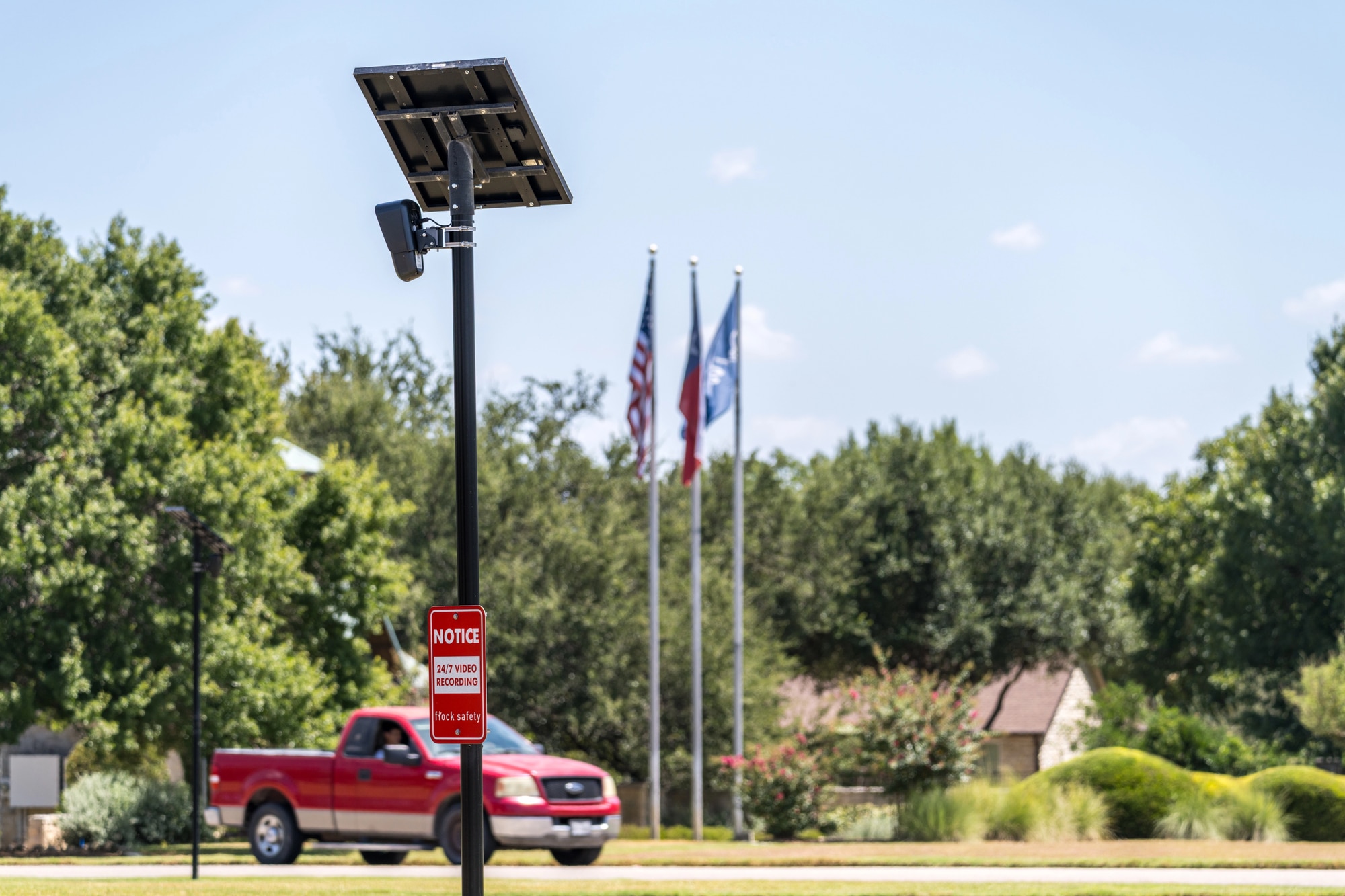
The 1998 action thriller Enemy of the State (RIP Gene Hackman) imagined a world in which government surveillance could follow an ordinary citizen almost anywhere, drawing on cameras, communications data, and increasingly sophisticated technology to monitor his movements. What once played as an exaggerated warning about the surveillance state now looks considerably less exotic. Some of today’s most consequential surveillance infrastructure is far less dramatic than the machinery of a Hollywood thriller. Instead of hidden trackers in your buttons and shoes, you instead have cameras mounted on utility poles, quietly recording your every move.
Flock Safety’s automated license plate readers have spread across the country at a dizzying pace. According to Flock’s own description of its technology, its system collects license plate images, vehicle characteristics, date and time stamps, and camera location identifiers, though there is reason to doubt that vehicles are the only thing these cameras record. By September 2026, Reuters reported that Flock operated roughly 120,000 cameras across forty-nine states.
That extraordinary proliferation has generated an equally notable backlash. Cities have canceled contracts, state governments have intervened, privacy advocates have challenged the systems in court, and some brave members of the public have taken it upon themselves to remove the Orwellian filth from their communities. The intensity of the reaction demonstrates that yes, the American public does still have lines it won’t allow government to cross.
Yet the retreat from Flock does not necessarily amount to a retreat from automated surveillance. In several jurisdictions, officials have responded to criticism of Flock not by abandoning license plate readers or reconsidering the broader surveillance model, but by replacing Flock with technology supplied by Axon. That distinction matters because Axon is not merely offering another network of roadside cameras. Its expanding ecosystem is capable of integrating license plate readers with body cameras, vehicle cameras, private security feeds, drones, and other streams of real-time information, potentially creating a surveillance architecture more comprehensive than the one now provoking resistance.
Supporters of automated license plate readers tend to begin with some variation of the familiar “nothing to hide, nothing to fear” argument. License plates are displayed in public, police officers can already observe them from the street, and motorists therefore have little reason to object when a camera does the same thing. Another common bootlicker-ism: this shouldn’t raise any alarms since smartphones already collect enormous amounts of information about their owners, as though the existence of one serious privacy problem provides a compelling justification for creating another.
Neither argument addresses just how far Big Brother is pushing the envelope. A police officer may see a particular vehicle traveling down Main Street at 2 p.m., but that isolated observation does not ordinarily produce a searchable record of where the vehicle was yesterday, where it went afterward, or how frequently it has appeared at other locations. A network of automated license plate readers can record thousands or millions of such observations, attach locations and timestamps to them, retain those records, and allow investigators to reconstruct a person’s movements after the fact. The relevant distinction is therefore not whether a license plate can be seen in public, but whether government should be permitted to transform countless fleeting observations into a centralized database of warrantless location tracking.
The dangers presented by such a database have already manifested themselves. The Institute for Justice has cataloged more than one hundred incidents of ALPR abuse, including officers using the systems to stalk former romantic partners, conduct searches for personal purposes, and access information outside legitimate law-enforcement investigations. In one particularly revealing case, an Alpharetta, Georgia, police officer used Flock to track a former romantic partner and another officer, sometimes entering misleading law-enforcement justifications for the searches. Cases such as these expose the weakness in the familiar assurance that surveillance powers are harmless because responsible officials will use them responsibly: the officials granted access to the system are human beings, and some human beings abuse power.
Even perfectly honest officers cannot eliminate the consequences of bad information, technological errors, or simple human mistakes. There have already been dozens of cases in which innocent motorists were wrongly stopped, detained at gunpoint, or jailed after ALPR errors. In Sherwood, Arkansas, a Flock camera misread a single character on an innocent family’s license plate, leading officers to conduct a felony stop with guns drawn while a six-week-old infant remained in the vehicle. In Florida, an innocent woman spent thirteen days in jail after investigators wrongly connected her vehicle to a fatal crash. The problem is therefore larger than deliberate misconduct. A surveillance system capable of acting upon enormous quantities of information can amplify an ordinary error into an armed police encounter or a wrongful arrest.
Flock has responded to growing criticism by introducing additional safeguards. In August, the company reduced the default retention period for new law enforcement customers from thirty days to seven, while also announcing mandatory case codes, expanded auditing, and tools intended to identify misuse. These measures may reduce certain opportunities for abuse, but they do not resolve the underlying constitutional problem. Seven days of warrantless location tracking remains seven days in which the government can accumulate a record of where people have traveled without first establishing probable cause before a judge.
The Fourth Amendment question is not simply whether government may observe something exposed to public view. It is whether modern technology permits government to automate that observation on an unprecedented scale, preserve the resulting information, and retrospectively search the movements of people against whom no warrant was ever obtained. In January, a federal district court rejected a Fourth Amendment challenge to Norfolk, Virginia’s Flock system, although the case is now on appeal. Tenth Amendment enjoyers should push their respective state and local courts to observe that unconstitutional acts are void regardless of the justifications put forth by federal judges elsewhere.
The Supreme Court has nevertheless recognized that technological aggregation can transform information that is individually observable into something constitutionally different. In Carpenter v. United States, the Court held that government acquisition of extensive historical cell-site location information constituted a Fourth Amendment search, rejecting the notion that a person necessarily forfeits all privacy protection merely because individual pieces of location data are held by a third party. ALPR technology differs from cell-site tracking, but the underlying constitutional problem is closely related: surveillance that once required substantial manpower and sustained observation can now be automated, aggregated, and searched retrospectively with remarkable ease. The government’s ability to see a license plate in public does not logically confer an unlimited power to construct a warrantless history of everywhere that plate has been.
That distinction between ordinary observation and a searchable history of a person’s movements is no longer confined to constitutional litigation or privacy advocacy. As the scale of Flock’s network has become more widely understood, opposition has increasingly translated into canceled contracts, state restrictions, funding cuts, and, in some cases, direct physical resistance.
As of August, The Guardian has reported that at least fifty-six municipalities have deactivated, canceled, or rejected Flock systems. The number is significant not merely because local governments are reconsidering a particular vendor, but because automated license plate readers were often adopted with relatively little public scrutiny in the first place. Much of the resistance emerged only after residents began asking what information the cameras collected, how long it was retained, who could search it, and how widely that information could be shared.
Florida went considerably further than most local governments. In September, the state ordered local police license plate readers removed from state highway rights-of-way and stopped issuing new permits for them. Texas Governor Greg Abbott likewise halted state grant funding for Flock cameras, placing financial pressure on departments that had used state money to expand their networks. Dallas subsequently announced that it would deactivate 321 Flock cameras affected by the funding decision.
Official resistance, however, has not been the only form of opposition. Flock cameras themselves have increasingly become targets. Dallas police reported that at least twenty-five cameras had been vandalized and acknowledged that attacks on the devices had become part of a broader pattern. In Burnet County, Texas, authorities went still further after two separate incidents in which cameras were damaged or destroyed, ultimately removing all fixed Flock cameras deployed by the local auto theft task force.
Whether one regards such destruction as vandalism, civil disobedience, or a modern echo of the long American tradition of physically resisting objectionable government measures, the phenomenon is politically revealing. Lockdowns and masking protocols are still fresh in the minds of a public that largely cowed to legally ridiculous and unscientific demands, yet this issue is different. The attacks on Flock cameras therefore provide an unusually visible measure of how deeply some members of the public have come to resent the spread of automated surveillance.
Taken together, canceled contracts, state intervention, withdrawn funding, lawsuits, and outright destruction suggest that Flock has become a symbol of a much broader argument over warrantless surveillance. That development might appear to represent a meaningful retreat from the surveillance state. In several jurisdictions, however, the disappearance of the Flock logo has proved considerably more significant than the disappearance of the underlying technology.
Some governments have not abandoned automated surveillance at all. They have simply purchased it from Axon.
Denver offers a frustrating example of how quickly opposition to Flock can be converted into little more than a change of vendor. After sustained criticism of the city’s use of Flock, officials declined to renew the contract and removed the city’s 111-camera network. The apparent retreat from automated license plate surveillance was short-lived. Denver subsequently approved a new system from Axon, with the official city contract allocating $150,000 for fifty automated license plate reader cameras, along with the hardware and software required to operate them.
The change therefore reduced the number of cameras but did not abandon the underlying surveillance model. Denver rejected Flock while preserving the central premise behind Flock: that police should maintain an automated system capable of recording and searching the movements of motorists who have not been accused of any crime.
Longmont, Colorado followed a similar course. Residents spent months opposing the city’s Flock deployment, and the city ultimately allowed its contract to lapse. Only months later, however, the city council voted to proceed with an Axon ALPR system, this time with additional restrictions governing data control, transparency, and a one-year review. Those safeguards may distinguish Longmont’s implementation from its previous arrangement, but they do not alter the more basic fact that the city responded to a controversy over automated license plate surveillance by purchasing a different automated license plate surveillance system.
The pattern extends well beyond those two municipalities. The Guardian found that Axon had moved to replace Flock in at least seven municipalities across five states. That trend complicates the increasingly common claim that cities are “getting rid of Flock,” because in several cases the underlying capability remains firmly in place after the Flock cameras disappear.
Douglas County, Colorado makes the distinction especially difficult to ignore. The sheriff’s office abandoned fifty Flock cameras after Sheriff Darren Weekly said he had lost trust in the company, but county commissioners then approved a long-term agreement with Axon worth nearly $23 million. Under that arrangement, Axon will replace the fifty Flock cameras and add another fifty, doubling the number of automated license plate readers rather than reducing them.
The broader agreement also includes drones, making the Douglas County transition especially important. What began as a dispute over one company’s license plate readers ended not with a smaller surveillance footprint, but with twice as many readers embedded within a much larger technological package. In other words, removing Flock is not enough to dismantle the surveillance state. In some cases, it has resulted in the opposite.
Axon deserves particular scrutiny because its role extends well beyond the sale of another automated license plate reader. Axon Outpost, the company’s fixed roadside system, combines automated license plate recognition with vehicle-attribute recognition and livestreaming capabilities. Those functions already exceed the narrow image of a camera that merely records a passing plate, but Outpost represents only one component of a much larger surveillance ecosystem.
That ecosystem expanded substantially in 2024, when Axon acquired Fusus, a company specializing in real-time crime center technology. At the time of the acquisition, Axon described Fusus as capable of aggregating “live video, data and sensor feeds from virtually any source.” The significance of that capability is difficult to overstate. A license plate reader becomes substantially more powerful when its information can be integrated with other surveillance systems rather than operating as an isolated source of data.
Axon Fusus is designed to perform precisely that function. The platform can combine feeds from public and private cameras, traffic systems, building security networks, drones, mobile cameras, officer locations, and other sensors within a single map-based interface. Axon describes the resulting system as a “common operating picture,” a phrase that sounds innocuous enough until one considers what information may be incorporated into that picture and how easily disparate forms of surveillance can be brought together.
The reach of the system is not limited to cameras owned by government. Through Fusus, residents and businesses can connect private security cameras to the network, giving law enforcement access to additional video feeds without requiring the government to install and maintain every camera itself. A surveillance network can therefore expand beyond police equipment into privately owned homes and businesses, dramatically increasing the number of locations from which information may be gathered.
Drones provide another layer. Axon promotes the ability to route live drone video directly into Fusus, allowing aerial footage to be viewed alongside other information already available to a department. When combined with license plate readers, body-worn cameras, police vehicle cameras, private security feeds, dispatch information, officer locations, and other sensor data, the result is something qualitatively different from a conventional ALPR network.
The central concern is therefore not that Axon has developed a more sophisticated license plate reader. It is that the company is building the infrastructure to consolidate multiple forms of surveillance into a single operational environment. What begins with the capture of a license plate can become one data point within a broader system capable of following vehicles, monitoring public spaces, incorporating privately owned cameras, and adding real-time aerial surveillance. At that scale, the debate is no longer merely about automated license plate readers. It is about the construction of an integrated surveillance architecture.
If communities emerge from the Flock controversy believing that the central mistake was choosing the wrong surveillance company, they will have learned remarkably little from the experience. The objection was never merely that one private contractor had become too large, too aggressive, or too careless. The deeper problem is the construction of systems that allow government to collect information about people who are not suspected of wrongdoing and only later decide whether that information might prove useful.
Viewed in those terms, replacing Flock with another vendor is difficult to describe as meaningful reform. If government responded to objections over warrantless searches by promising to hire a different contractor to conduct them, no one would seriously regard that as a restoration of constitutional limits. Yet the same substitution becomes easier to disguise when the technology is repackaged under a different brand name and sold as an improved platform.
Flock became the symbol of the controversy because its cameras spread so rapidly and became so visible. The constitutional issue, however, never depended on the logo attached to the pole. It rests on whether government should possess the technical capacity to compile, retain, and search detailed records of ordinary people’s movements without first obtaining a warrant based on probable cause.
The situation becomes even more dire when the replacement system is capable of integrating license plate data with livestreaming cameras, body-worn video, police vehicle feeds, private security systems, drones, dispatch records, officer locations, and other real-time information. A change in vendor may solve a contractual dispute or address a particular company’s data policies, but it does not resolve the underlying problem when the surveillance architecture remains intact or expands.
Getting rid of Flock can therefore represent a genuine victory only when it is accompanied by a reduction in the government’s capacity for warrantless surveillance. Otherwise, the public has not dismantled the system that caused the controversy. It has merely approved its replacement.