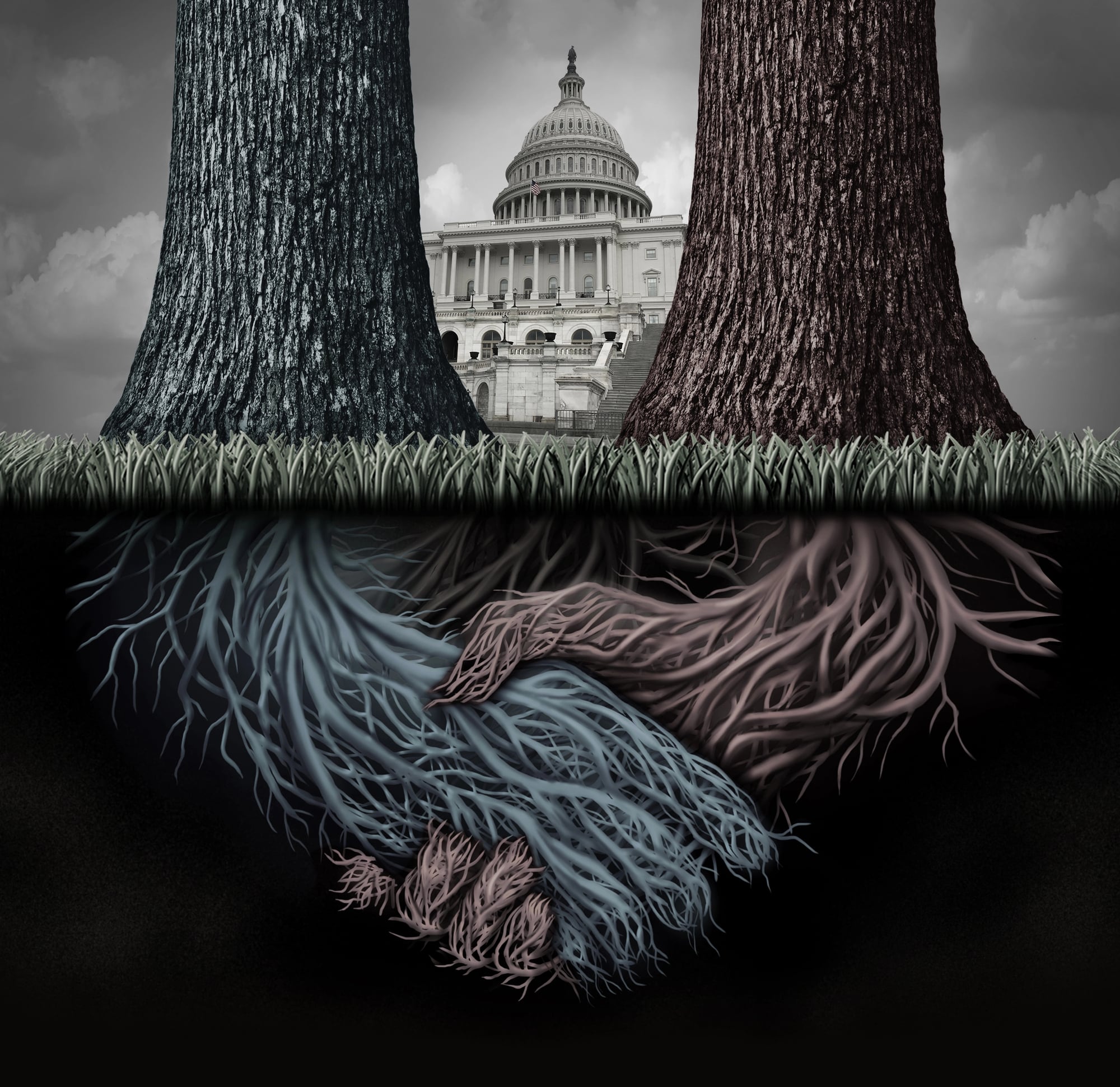
On February 17, 2026, in the run-up of the primary election to determine the Democratic nominee and de facto future occupant of Illinois’s open U.S. senate seat, The New York Times ran a headline asking, “Can suburban support beat the party machine?” The Times was referring to what turned out to be the unsuccessful challenge of U.S. Representative Raja Krishnamoorthi against Lieutenant Governor Juliana Stratton.
Krishnamoorthi is a Hindu born in Delhi and educated at Princeton who is supported by the Chief Technology Officer of Palantir as well as by Hindu and Indian donors and a series of universities and corporations and law firms and consultancies. Stratton is an African American from Chicago who has connections to public and private sector unions, Cook County wards, and Illinois’s Democratic governor—a “machine” coalition that has been unattractively recognizable in this country for more than a century and a half as unions have become vehicles for statism and finance and as wards have been hollowed out.
But what Krishnamoorthi represents is a coalition of its own that is much less understood, and even further from the ground. Calling him the “suburban” candidate is a stand-in for other things: last-minute out-of-state spending on ad buys; a consortium of military and corporate operators funding them; a candidate educated at the Ivy leagues in management capacities who doesn’t recognize his constituents.
In The Last Hurrah, the 1956 novel which first fictionalized Krishnamoorthi’s coalition, a four-term Boston mayor who knows his constituents by their first names is trounced in his final mayoral campaign by a candidate from the newly-sprung suburbs modelled on then-U.S. Senator from Massachusetts John F. Kennedy (Harvard ’40). This was the same John F. Kennedy who in real life moved into the White House where he entrusted the head of Ford Motors to produce Vietnam, our first un-entanglable entanglement of war and empire.
Krishnamoorthi, who “had stockpiled nearly $30.5 million—the second-largest fundraising haul among federal candidates nationally this election cycle—and spent more than $25 million on television ads that blanketed the state beginning last July,” is in many ways a Kennedy successor, but he is operating in an even more favorable environment. A process which began under WASPs has been accelerated by Zionists and Hindutvas to transform our country in the name of liberalism, while being anything but liberal in the constitutional sense. Having investigated the rising Hindutva presence in my most recent report for the Libertarian Institute, we must examine how that presence developed and how it manifests itself in conjunction with Zionism, exposing the threat.
Perhaps the key moment for extrapolating the rise of Krishnamoorthi’s elitist coalition is 1965. This was a year recognized for the triumph of the civil rights movement via the Voting Rights Act, celebrated by black, Jewish, and old-school ethnic Democrats which in attenuated form make up Juliana Stratton’s coalition. But 1965 was a year more actually influential for four other events. Namely: our entry in significant numbers into Vietnam; Washington’s use of corporate consultancies to begin outsourcing American labor; the beginning of the WASPs’ “War on Crime” in America’s “inner cities”; and the passage of the 1965 Immigration and Nationality Act, drafted by the Jewish Zionist Emanuel Celler, encouraging immigration of “high-skilled” workers to compete with the Soviet Union. The first three of these moves empowered America’s military-corporate complex, and the fourth brought in new operators to staff it. The biggest outsized quantitative and qualitative beneficiary, proportional to numbers, have been Indian Americans, the majority Hindu.
Since 1965, when their numbers were negligible, Indians have grown to over five million people in America. According to Pew Research, “two-thirds of Indian Americans say either that they are Hindu or that they identify with another religion but feel closely connected to Hinduism for other reasons, such as family background or culture.” Hindu Americans are highly educated. In the United States they “have nearly 16 years of schooling, significantly more than Jews, the next most highly-educated U.S. religious group,” and “70% of Hindu Americans have degrees” while “57 percent have some postgraduate education, which is nearly five times the national average.” They are wealthy: Hindu Americans’ “median household income exceeds $126,000, among the highest nationwide,“ while the median household income for Americans exceeds $83,000. And they are highly successful in the professional spheres tied to the military corporate complex.
In business, Hindu or Indians’ leading lights include the CEOs of Google, Microsoft, IBM, Adobe, FedEx; and the Chief Technology Officer of Palantir. In law and administration they include three of the nation’s most influential federal appellate court judges; the director of the FBI; and the Director of National Intelligence. Politically they include the former vice president of the United States; the current second lady of the United States; the current leading Republican candidate for the governorship of Ohio; and four congressmen. Academically they include more than half a dozen presidents or chancellors of universities and professional schools, including the second lady’s mother. They are, in other words, along with Jewish Zionists, the most highly concentrated group inside the apparatuses (corporations, administrative agencies, politics, universities) of American empire.
There are several obvious problems that occur when a tiny religious minority, historically Puritans and Jews and Hindus in America, assumes outsized power inside national institutions insulated from our state governments, free market exchanges, and voluntary associations. What Alexis de Tocqueville described as America’s particularly genius “form of society”—one which is “neither precisely national nor precisely federal,” but run from the ground by public opinion incubated by populist associations then siphoned through different spheres and branches of government—is a foreign concept to these operators.
Instead, as upper-middle class children of essentially hierarchical systems (New England for WASPs; Mitteleuropa for Jews; mid-century post-British India for Hindus) they operate by those systems’ logic, which is nationalizing and institutionalizing power. They have been some of the most aggressive pushers for what they call “colorblind” civil rights, taking the 1965 law as an invitation to expand institutions’ power using the courts to protect individuals from discrimination at the expense of states and legislatures. And they have not been particularly sympathetic to the mixing of religion and state-based politics, another feature of American political history.
Trained in the secular disciplines of administrative empire, they at least publicly support a “liberal” regime of public tolerance and private faith enforced from Washington DC. The most obvious expressions of these anti-constitutional commitments come from the intellectual side. These include WASPs’ longstanding distrust of popular politics in favor of reform by “the better class”; statements like the liberal Jewish writers’ Michael Walzer’s and Leon Wieseltier’s that “populism is by definition a threat to institutional stability”; and the Indian American intellectual Shikha Dalmia’s recent founding of an online magazine called, grammatically inventively but without prevarication, The Un-populist.
All of this is anti-constitutional, but there is a further problem in the case of Jews and Hindus. Their nations, India and Israel, which were founded in 1947 and 1948 with British and American backing as apparently secular and liberal homelands for persecuted religious minorities, have attached themselves to America’s empire and the administrative and technological proficiencies that make empire run. These nations have elected leaders, both liberal and conservative, who indirectly or directly argue that these proficiencies reflect superiority in the groups which have chosen to adopt them. And, despite their public proclamations of secular liberalism, many Jewish and Hindu operators in America have become explicit champions of their own supremacy—religious, cultural, ethnic, and sometimes racial and genetic—via Zionist and Hindutva ideology.
69 to 95% of Jewish Americans support Israel, and 55% of Hindu Americans believe in some version of Hindutva ideology, while 69% of Hindu Americans support Narendra Modi, the dominant political figure in India for the last dozen years and a Hindutva ideologue. Both Zionists and increasingly Hindutvas use their influence to affect American politics. Zionism is the position of each of the thirty-five elected national congresspeople who are Jewish, and the position of most of the five hundred elected non-Jewish national congresspeople. Zionism in some form is also the position of most major Jewish donors. And every national Hindu politician and many Indian ones, along with many major Hindu donors, are connected in one way or other to Hindutva ideology and those people pushing it.
The most obvious examples of this influence or dominance in both the Zionist and Hindutva cases are political and philanthropic organizations. The many explicitly Jewish Zionist organizations which dominate Jewish and American political life include AIPAC, the Anti-Defamation League, the American Jewish Committee, J Street, the Foundation for Defense of Democracies, the Republican Jewish Coalition, the Jewish Communal Fund, the Wexner Heritage Program, Taglit Birthright, and the Adam and Gila Milstein Foundation. The many explicitly Hindutva organizations or organizations linked to powerful Hindutva donors include Infinity, the Indian American Community Foundation, Indiaspora, the Republican Hindu Coalition, Hindu American Foundation (HAF), World Hindu Council, and Overseas Friends of BJP. And these lists leave aside those organizations, including the Manhattan and Hudson and American Enterprise Institutes, which are funded by many Zionists and increasingly by Hindutvas and which advance Zionist and Hindtuva priorities in America.
But institutions are not the limits of Zionist-Hindutva influence. Some of the many Jewish Zionist financiers, developers, political operators, professionals, economists, academics, and sports team owners who “freelance” their influence on behalf of Israel include Larry and David Ellison, David Sacks, Nelson Peltz, Stephen M. Ross, Miriam Adelson, Bill Ackman, Jared Kushner, Steven Witkoff, Rahm and Ari and Ezekiel Emanuel, Howard Lutnick, Stephen Miller, and Robert Kraft. In the broader scope, 19% of federal appellate judges, one Supreme Court justice, five of the eight Ivy league presidents, and (in some years) thirty of the one hundred wealthiest Americans identify as Jewish, many of whom are linked to Zionist networks.
A similar picture of influence applies for Hindus or Indian Americans who are linked in one way or other to Hindutva ideology or its main representative, Narendra Modi. They include Palantir Chief of Technology Shyam Sankar; Google CEO Sundar Pichai; Raj Subramaniam, CEO of FedEx; Microsoft CEO Satya Nadella; Arvind Krishna, the CEO of IBM; Shantanu Narayen, the CEO of Adobe; Asha Jadeja Motwani, the influential “widow of the engineer who helped craft the original Google search algorithm”; Director of National Intelligence Tulsi Gabbard; Republican gubernatorial candidate Vivek Ramaswamy; President and CEO of the Center for American Progress Neera Tanden; U.S. Congressman Ami Bera; former South Carolina Governor and 2024 presidential candidate Nikki Haley; and former Vice President Kamala Harris. Second Lady Usha Vance, a practicing Hindu, has been defended by these networks and has not disavowed them.
Much of the spread of Zionist and Hindutva ideologies through powerful Jewish and Hindu spheres occurred from the efforts of connected professionals and financiers and technologists, as I have related in reports for the Libertarian Institute in August and November and December and April. But the spread of these ideologies among powerful Jews and Hindus likely also occurred because these ideologies played into the influence Jewish and Hindu players were already enjoying in American empire. Indeed, from their inceptions both Zionist and Hindutva ideology have been explicitly tuned to and so attractive to imperialists.
Theodor Herzl, Edmond Benjamin de Rothschild, and Lionel Walter Rothschild were journalists and financiers who created the base for the Jewish state off of their connections to the French and British and German Empires. Israel’s first president, Chaim Weizmann, of the successor generation to Zionism’s founders, had no illusion about the character of this future Jewish state when he said in the 1930s about the land that was not yet Zionist that “we want only the best of Jewish youth…only the educated to enter Palestine for the purpose of increasing its culture” while “the other Jews will have to stay where they are and face whatever fate awaits them” because “we don’t want Tel Aviv to become another low-grade ghetto.” Israel was a project, in other words, that transnational WASP elite could recognize as one for “the better sort” who made empire run and could make an imperial outpost of British and American empire run, too. This logic continued even after World War II, when the justification for the country shifted to protecting those survivors of the European “ghetto” and then the concentration camps dismissed by Weizmann a decade before.
Indeed, to read The New Republic, America’s most influential Zionist publication from the 1970s to the 2000s, was to see the ingredients of this supremacy subtly but decisively delivered, week by week, to an audience of around 100,000 who lived and worked in New York and Washington DC—an intravenous feeding to operators of empire of the logic they wanted to hear. Anthropology, which examines communities on their own terms on the understanding that basic human values manifest differently in different cultures, was dismissed at The New Republic, in favor of a value hierarchy based on imperial success. Unconstitutional foreign interventions, mostly in the Muslim world, were justified at The New Republic as bringing “universal” secular liberal values of capitalism and individualism to sovereign nations, places in this framing infected with the “poison” of radicalism. The New Republic’s owner, Martin Peretz, wrote that “teaching someone to farm, in the late twentieth century, even with the newest equipment, is not modernizing.” His ally Israeli Prime Minister Shimon Peres, of the third generation of Zionist leaders, “express[ed] a vision for transforming the Gaza Strip” into a version of the techno-authoritarian city-state of Singapore based on “trade, tourism, and technology”—exactly the “values” expressed by Jared Kushner for “remaking” Gaza” today. These are the expressions of a muted fanaticism, for top-down modernization at any cost, that comes at the unstated expense of sovereignty and constitutional law and self-determination of legally constituted majorities.
The same expressions occur in Hindutva ideology. Audrey Truschke, a scholar of Hindutva at Rutgers, recounted unsettling anecdotes from recent annual meetings of the Indian Science Congress, which has “a robust membership of tens of thousands of scientists” but has been recently “undermined by the introduction of Hindu nationalist ideas.” At the 2019 meeting, “presenters told attendees that ancient Indians were proficient in stem cell technology and built aircrafts.” And “the 2015…meeting included a presentation on how ancient Indians had planes capable of interplanetary travel” echoing “claims…among Hindutva supporters about ancient India boasting everything from the internet to modern medicine” in “an imagined Hindu golden age of scientific progress interrupted by Muslim invaders who sought to crush Hindu culture and peoples.” This is the kind of fanaticism for modernity—as if science and technology and the imperial control they allow are the sum measurements of religions and politics and culture—that Hindutva supporters in America express in a different vernacular with Zionist support.
Vivek Ramaswamy, the Yale Law graduate and entrepreneur whom Martin Peretz’s mentee Bill Ackman endorsed for president in 2024 and who is connected to Hindutva organizations, delivered a version of this sermon in December 2024. That month, he posted on X that “the reason top tech companies often hire foreign-born & first-generation engineers over ‘native’ Americans…comes down to the c-word: culture” which in America has “venerated mediocrity over excellence for way too long.” He went on to advocate “more math tutoring, fewer sleepovers…more weekend science competition…less ‘chillin’… more extracurriculars, less ‘hanging out at the mall’” on the logic that otherwise “we’ll have our asses handed to us by China.” He concluded that “this can be our Sputnik moment” of “excellence over mediocrity; nerdiness over conformity.”
Considering that it was the same “nerds” who made the weapons for the Pentagon who also created the consumer goods sold at malls, this argument is circular—but Ramaswamy is promising to put his inconsistent principles into practice in Ohio, where he is running for governor on the Republican ticket. He has pledged “to turn the Ohio River Valley into the next Silicon Valley…through investments in early-stage companies, innovation hubs, and workforce training focused on high-demand digital skills”—areas in which Hindutva operators share with Zionists de facto arbitrative power. He has also pledged to centralize Ohio’s colleges and universities to achieve greater technical proficiency and advocated for year-round schooling to the same end, despite substantial pushback.
Ramaswamy is not the only one—indeed, Ramaswamy is the tip of the proverbial spear of Zionist and Hindutva operators, people inherently friendly to imperial accelerations, who are working to use technology as an imperial tool. Michael Bloomberg and other Jewish Zionists responsible for the tech-based development of “smart” or “surveillance” cities have partnered with Narendra Modi to develop similar cities in India. This development means that “centuries-old homes and shrines were razed with little notice or compensation” and “families who had lived there for generations were displaced, their histories reduced to rubble”—all to “monumentalize Hindu religious sites while removing the urban clutter that contradicts the streamlined, sanitized vision promoted by the state.” Geopolitically, Modi has paid back Zionists for their help by breaking from traditional allies like Brazil to favor Israel in its attacks on Iran. He has also sought “improved ties” with the United Arab Emirates, which besides America is Israel’s closest ally, “on issues including anti-terrorism, trade and migration.” Indeed, it was reportedly by Modi’s good graces that the daughter of the vice president of the United Arab Emirates was kidnapped in waters off India and brought back to her father after she mounted an escape by sea from what she described as the de facto prison of Dubai.
India and Israel are also increasingly partnering militarily and technologically in other ways. “India is Israel’s largest buyer of military equipment and its second-largest trade partner in Asia”; there is “cooperation in cybersecurity, the energy sector, [and] air transport agreements”; and “Israel is also actively assisting the Indian army in illegally occupied…[majority Muslim] Kashmir through information sharing, providing surveillance softwares and supplying weapons.” In America, Silicon Valley, where Hindutvas and Zionists are disproportionally represented, has pushed for an tech-based alliance to combat China, which includes a heavy reliance on H-1B visas for foreign nationals, many of them Indian. Finally, it is ICE’s deportations which have empowered Palantir, whose Chief Technology Officer is a Raja Krishnamoorthi donor, to set up a surveillance dragnet which has, tellingly, grown to include Muslims who speak out against American Empire’s policies in the Middle East and North Africa.
As this last example suggests, the surveillance in question reaches deeper than it seems, to target speech. Rajiv Malhotra, an ally of Ramaswamy’s and arguably the most prominent Hindutva intellectual in America, has cited Bill Ackman in a call in the Zionist journal Sapir for using artificial intelligence to patrol what he calls anti-Hindu and Jewish sentiment, which he describes as a “regressive movement against merit.” As I have reported for the Libertarian Institute, such a system was at the time of Malhotra’s writing already being set up in Massachusetts, at the hands of Robert Kraft in conjunction with Alan Garber, the president of Harvard. And Bill Ackman’s and Vivek Ramaswamy’s ally David Sacks, the Jewish Zionist technologist and the White House’s top adviser on AI, is responsible for the White House’s policy of pushing away constitutional barriers to this and other uses of AI by attempting to nationalize AI policy at the expense of states. These pushes are anti-constitutional in two senses: they infringe on the First Amendment, and they infringe on the policymaking power of states.
The political manifestations of this techno-imperialism reach, very consciously, across the “political aisle.” Like Jewish Zionists, the majority of Hindutvas vote with Democrats, but, as with Zionists, there is a strong contingent of Republican Hindutva donors as well as crossovers between parties. Just as Bill Ackman was a longtime Democrat until, in the aftermath of what he saw as Democrats’ insufficient attempts to police pro-Palestinian protests on elite college campuses, he switched to supporting Donald Trump, so Hindutva super-organizer Bharat Barai crosses the aisle when it suits what he sees as his purposes. Most notably, Barai brought Tulsi Gabbard into the Hindutva fold, despite the fact that she was then a progressive Democrat and Barai a Republican. Asked by the journalist Pieter Friedrich “why he backed a progressive,” Barai replied: ‘It doesn’t matter to me whether it is a Republican or Democrat.’” According to the sociologist Arvind Rajagopal, speaking to Friedrich about Hindutva operations, Barai’s comment was part of a larger Hindutva play: “Power is its principle, so the Democratic Party values are only relevant when convenient.” Jewish Zionists other than Ackman also take this line. Ben Horowitz, the Jewish Zionist technologist, was a donor in 2024 to Donald Trump and a donor in 2026 to Raja Krishnamoorthi.
What moves like these by military corporate players go to create is a permanent elite, neither left nor right, which speaks to Democrats in the language of multiculturalism and to Republicans in the language of patriotism, but both end up in the same place when it comes to power and liberty. Kamala Harris may talk about policing online spaces to prevent discrimination and Vivek Ramaswamy might talk about mandating the National Anthem in schools to ensure “unity,” but they are jointly compelling people to honor abstractions at the expense of the Constitution. Raja Krishnamoorthi may excoriate questions of his possible dual loyalties as “frankly racist” while Rajiv Malhotra may condemn Muslims for taking part in what he sees as subversive activities, but what they both support in practice is the marginalization of the state-based populism that is the core of American government as Thomas Jefferson and James Madison conceived it.
How might this stealth Zionist-Hindutva coalition manifest concretely in our politics? As I have reported for the Libertarian Institute and elsewhere, Zionism has, since the 1990s, exercised decisive influence on the political coalitions behind at least three presidents. The first two were Bill Clinton via Michael Steinhardt’s and Al From’s Democratic Leadership Council; and Barack Obama via Penny Pritzker, publicly acknowledged as the key backer behind his rise. The third is Donald Trump in his second term via Miriam Adelson, Paul Singer, David Sacks, Steven Wynn, Ben Horowitz, Larry Ellison, Bill Ackman, and other Wall Street-Silicon Valley players whose swing to Trump in 2024 ensured the funding that helped allow him to win reelection, and whose policy priorities have shaped his second term.
These three presidents have been astonishingly adept at pitching their politics to the tune of identity and culture. During their terms, tensions between ethnicities and races and genders increased in this country in the name of “multicultural progressivism” or “patriotic assimilation.” These tensions, not coincidentally, have effectively distracted the citizenry from questions of power and liberty, as the hold of Zionists behind the scenes has gotten quietly stronger and the liberties of Americans have diminished. There is every sign that ideological-identitarian coalitions of this kind on both sides of our politics will only accelerate, with Zionists but increasingly also Hindutvas holding the cards.
On the Democratic side, this ideological-identitarian coalition might look, counterintuitively given her apparent enmity with Raja Krishnamoorthi, like a version of Juliana Stratton’s winning coalition in Illinois, which is a re-run in a slightly different form of Barack Obama’s winning coalition of people of color and old school Democrats in 2008. Tellingly, J.B. Pritzker, Illinois’s governor and Stratton’s most powerful supporter, is a Jewish Zionist, and a past mentee of Martin Peretz, and it was J.B. Pritzker’s sister, Penny Pritzker, who was largely responsible for Obama’s senatorial and first presidential campaigns. Not unpredictably, under Obama, America continued to endorse a peace process that gave Israel cover to tri-furcate the Palestinian territories, edged ever-closer to Modi’s India, and funded defense-tech out of Silicon Valley to the benefit of both. It is easy to imagine a similar situation playing out at the hands of J.B. Pritzker, or Gavin Newsom, at the top of the Democratic ticket, in alliance with Hindutva-tied progressives like Rep. Ro Khanna (D-CA) and “moderate” Jewish Zionists like Daniel Biss. Their coalition would feature an Obama-like withdrawal from outright interventionism in which the same interests would still determine the pulling of the same strings with slightly different politicians at the ends of them.
But the same problem awaits with the presumptive Republican standard-bearer in 2028, J.D. Vance, purportedly a spokesperson for the left-behind white working class. Vance’s career was made by Zionists and Hindutvas and their supporters, most obviously Amy Chua and Jed Rubenfeld at Yale; Peter Thiel in Silicon Valley; and Vance’s wife Usha; as well as Vance’s right-hand-man, the Jewish Zionist Jacob Reses, Vance’s chief of staff. The first two of these operators are deeply connected to Bari Weiss, the editor-in-chief of Larry and David Ellison’s Free Press, which supports both Vance and his wife as “meritocrats” despite the fact that Vance’s political success has come precisely by appealing to voters left behind by this imperial “meritocracy.”
Increasingly entangled in this imperial orbit of “meritocracy” via Weiss’s assiduous attentions is Erika Kirk, who has explicitly committed her vast organizational capacity via Turning Point USA to electing Vance president. Finally, Chua and Rubenfeld are deeply connected to Vivek Ramaswamy, a classmate of the Vances at Yale Law School, who, if he is elected governor of Ohio, will be crucial to ensuring turnout there in 2028. This is in no way, in other words, an anti-Zionist or anti-Hindutva or anti-supremacist coalition. In many ways, it is more of the same: not a dismantling of the deep state but a continuation of U.S. empire, technological colonization at home, and militarist resource extractions abroad in the name of “America First.”
All of this creates an illuminating dilemma for what The American Conservative’s Scott McConnell called, in a recent piece entitled “The Iran War has Ended the Trump Coalition,” the “pro-peace Trumpers.” By this McConnell meant “the 15–20 percent” of Trump voters “who oppose Trump’s war”—people who, along with libertarians and those parts of the left which did not vote for Harris in 2024 over her support of the genocide in Gaza, could exercise potentially decisive influence in the 2028 election by shifting their support to whichever political party seemed more antiwar. In the face of the extreme minoritarian supremacist capture of both parties, an antiwar and anti-empire contingent with the potential to swing an election will need to clearly and publicly demand the disavowal by whatever party it supports of Hindutvas and Zionists: supremacist operators of empire.
A strategy like this will, at the very least, force a response from the supremacists, and, as we have seen since October 7, forcing a response from power makes power that is latent act in its own defense and so reveal itself. Three years ago, Zionist capture of American political institutions was a theory confined to conspiracy fringes; today it is a common part of political discourse. In three more years, the same reality could manifest when it comes to the Zionist-Hindutva capture of our political parties.